
B2B SaaS Case Studies for Lead Generation: Proof Buyers Can Check

TL;DR: A B2B SaaS case study generates leads when a buyer can verify the result and recognize their own situation in it. CMI’s 2025 benchmark survey found 75% of B2B marketers used case studies. But a story without a named role, a starting figure and a time window gives buyers nothing to check. The fix is five checkable parts built into the story from the start.
Key Takeaways:
- CMI’s 2025 benchmark survey found 75% of B2B marketers used case studies or customer stories. They rated them the second most effective content type at 53%, behind videos at 58%.
- TrustRadius’s 2026 B2B Buying Disconnect Report found 63% of buyers used AI during their purchase journey. Of those, 94% fact-check its responses at least some of the time. A case study gives that buyer something to check only if it names a role, a starting figure, and a time window.
- A checkable B2B SaaS case study has five parts. It names the customer and role, states the starting figure, and describes the change in the buyer’s terms. It reports the result with a time window and gives the buyer a way to verify it.
- Forrester’s Buyers’ Journey Survey, 2025 found 73% of purchases involve three or more departments. On average, 13 people inside the buyer’s organization and nine from outside take part. One case study built around one metric speaks to one role in that group.
- A B2B SaaS team measures a case study at each funnel step. Track views by target accounts, assisted form fills, opportunities where sales shared it, and win rate on those opportunities.
A B2B SaaS case study is only worth its budget if a buyer can check it, and most can’t be checked.
Here’s the common scenario. Your team publishes a case study, sales shares it on a late-stage call, and later nobody can show it moved a number. The story reads well, but it gives the buyer nothing to verify.
There’s no named role, no starting figure, no time window, and no way to confirm the claim outside the vendor’s own page.
The format itself is everywhere. CMI’s 2025 benchmark survey found 75% of B2B marketers used case studies or customer stories.
In this guide, I name the five parts that make a case study checkable and read two published examples against that structure. I then show where case studies sit among the sources buyers use to check proof, and how to measure a case study’s contribution to pipeline.
What makes a B2B SaaS case study generate leads?
A B2B SaaS case study generates leads when a buyer can verify the result and see their own situation reflected in it.
The format is widely used. CMI’s 2025 benchmark survey found 75% of B2B marketers used case studies or customer stories. It reports on 980 B2B respondents, surveyed between June 25 and Aug. 16, 2024.
It also rates well on effectiveness. The same CMI survey found B2B marketers rated videos the most effective content type at 58%, with case studies or customer stories close behind at 53%. Case studies or customer stories had topped the list the year before.
B2B SaaS lead generation needs proof at each stage of the buyer’s research, and a case study is one proof asset, not a replacement for the rest of the funnel. In this guide, I treat a case study as a checkable artifact: a result the buyer’s own team could confirm, not a polished story.
Why do B2B SaaS buyers discount case studies they cannot check?
B2B SaaS buyers check what they read, and a case study with no named role, starting figure, or time window gives them nothing to check.
TrustRadius’s 2026 B2B Buying Disconnect Report found 63% of buyers used AI during their purchase journey. Of those buyers, 94% fact-check AI’s responses at least some of the time.
The survey included 1,862 technology buyers and 444 technology vendors, surveyed worldwide in January 2026. It also found 74% of buyers use reviews to inform their purchase decisions.
The symptom is easy to spot. A B2B SaaS team publishes case studies, sales shares them, and pipeline reports still show no connection to the stories.
The cause is that the stories make claims a buyer cannot check: no named role, no starting figure, no stated method, and no time window. In the diagnostic view I use in this guide, a number a buyer cannot verify reads as marketing copy, not evidence.
“Buyers are using AI to move faster, not to think less,” said Rajat Bhatnagar, SVP of Growth at HG.
Rajat Bhatnagar, SVP of Growth at HG (HG Insights, which owns TrustRadius), in TrustRadius’s 2026 B2B Buying Disconnect Report
The fix is to rebuild each case study around facts a buyer can confirm, inside or outside the vendor’s page. The anti-pattern to avoid is adding more adjectives, more design polish, or more case studies before fixing the ones that already cannot be checked.
Polish treats the symptom. Checkable facts treat the cause.
Who does a B2B SaaS case study have to convince?
A B2B SaaS case study has to convince the whole buying group, not just the champion who found it.
Katie Fabiszak, VP and Principal Analyst at Forrester, reports on Forrester’s 2025 Buyers’ Journey Survey. It found 73% of purchases involve three or more departments. On average, 13 people inside the buyer’s organization and nine from outside take part.
One result that matters to a VP of Sales does not automatically matter to a CFO or a security reviewer on the same deal. A case study built around a single metric speaks to one role in that group. It does not address what the other roles need to see.
Building trust and credibility in B2B SaaS marketing requires proof suited to each stakeholder’s own question, not one story stretched to cover every role. I treat a single case study as one data point for one stakeholder.
The fix is a small set of results that covers the stages and roles the buying group actually cares about.
What goes into a checkable B2B SaaS case study?
A checkable B2B SaaS case study has five parts: a named customer and role, a starting point, the change, the measured result, and a way for the buyer to verify it.
Each part answers one question a buyer is already asking. Each missing part leaves one of those questions unanswered.
| Part | What to include | Buyer question it answers | Weak version to avoid |
|---|---|---|---|
| Named customer and role | The company and the title of the person speaking for the result | Is this a real company like mine? | An unnamed “leading software company” |
| Starting point | The situation and the baseline number before the change | Was their starting point like mine? | A result with no number to compare against |
| The change | What was done, by whom, and which part of the product was involved, using the buyer’s own terms | What would we actually do? | A vague reference to “a new strategy” |
| The measured result | The metric, the size of the change, the time window, and how it was measured | How big, how fast, and measured how? | A percentage with no baseline or time window |
| The check | A named quote, a public review profile, or a reference call | Can I confirm this without trusting the vendor? | “Results may vary” with no way to follow up |
The five parts are a diagnostic lens, not an exhaustive checklist. Part three builds on the Translation Layer, a method that restates a product feature as what the buyer’s own team experienced, not as the feature’s internal name.
Here is a result sentence that names the metric, the method, and the window. Inside a B2B software company, a paid-search landing page redesign I helped lead through an A/B test achieved an 83% increase in conversion rate in the first half of 2023.
That sentence names the metric (conversion rate) and the size of the change (83%). It also names the method (an A/B test) and the window (the first half of 2023). A checkable case study needs exactly that much specificity, not more adjectives.
The failure pattern is a team reaching for better photography or a more dramatic headline when the story is missing a number. Polish cannot substitute for a starting figure or a time window. A story can read well and still give a buyer nothing to check.
What do two published B2B SaaS case studies show?
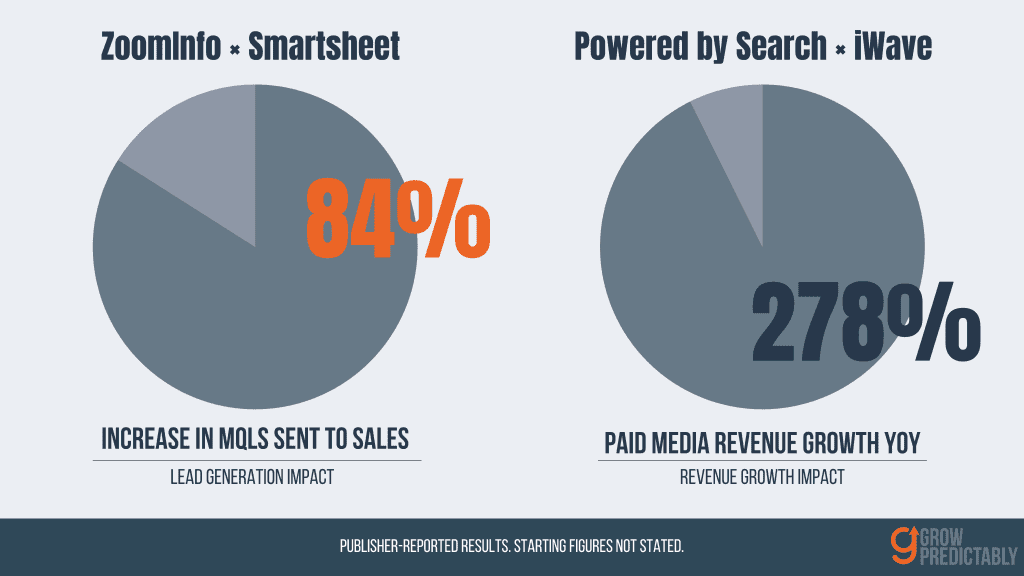
Two published B2B SaaS case studies, ZoomInfo’s customer story about Smartsheet and Powered by Search’s case study about iWave, both report a named result. Neither states a starting figure, and neither lets a buyer place the result on a calendar, so the buyer has to take the publisher’s word for the size of the change.
Both follow the arc covered in storytelling in B2B SaaS content: a named customer, a change, and a result.
ZoomInfo’s customer story quotes Kassia Bennett, Director of Marketing Operations at Smartsheet. She reports a 40%+ increase in form fills on every multi-field form where Smartsheet added ZoomInfo’s FormComplete.
On the highest-volume demo form, the story reports an 84% increase in MQLs sent to sales. It also reports a 26% increase in opportunity rate and a 59% increase in win rate.
The story names the customer and the role, and it names the change. It does not state the starting figures for form fills, MQLs, opportunity rate, or win rate before the change. It also does not give a time window for when these results were measured.
Powered by Search’s case study about iWave names Jill McCarville, VP of Marketing at iWave. It reports 278% paid media revenue growth year over year and 251% lead volume growth between Q1 and Q4.
It does not state a starting revenue or lead figure, and it does not say which year the quarters fall in. A buyer cannot place the result on a calendar without that detail.
I read both stories against the five checkable parts. Both supply a named customer and role, describe the change, and report the size of the result. Both also carry a named quote, the lightest form of the check.
Neither supplies the second part, a starting point. The Smartsheet story also gives no time window, and the iWave story gives quarters without a year.
Where should a B2B SaaS case study sit in the buying journey?
A B2B SaaS case study belongs wherever a buyer checks proof before narrowing a list, not only at the bottom of a sales deck.
TrustRadius’s 2026 report found 83% of buyers shortlisted 3 or fewer products. Read that way, the research before the shortlist is the window where a case study can still change the list.
The same report found that what AI tools recommend leans heavily on content the vendor did not write, such as customer reviews, independent publications, and peer experiences. A case study that lives only on the vendor’s own website may never reach the places an AI tool or a buyer actually checks.
Four placements to consider:
- The solution page where a buyer compares vendors. B2B SaaS inbound marketing brings buyers here, and this is where they check whether your proof holds up against the alternatives.
- A comparison page against a named alternative. Inbound traffic reaches this page too, and a buyer deciding between two named options is exactly the reader who needs a result they can check.
- A sales follow-up after a demo. The buying group reviews it after the call, so it needs the starting figure and time window that let each person confirm the result on their own.
- A third-party review profile, where the vendor cannot edit the text. AI search visibility for B2B SaaS covers why proof also needs to exist outside the vendor’s own domain, and this is the placement that does it.
How do you measure whether a B2B SaaS case study generates leads?
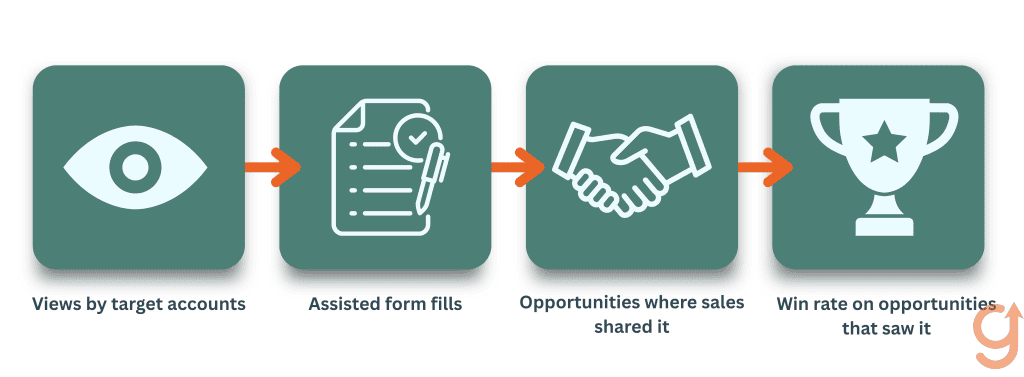
Measuring whether a B2B SaaS case study generates leads means tracking it at each step of the funnel, not just counting page views.
The chain has four steps. Each step should tie back to the same named case study, so the chain stays traceable from first view to closed deal.
- Views of the case study by target accounts. This shows whether the right buyers are reading it, which raw page views can’t tell you.
- Form fills assisted by a case study view. This shows whether reading it moved a buyer to act.
- Opportunities where sales shared the story. This connects the content to pipeline, using the late-stage sharing described earlier in the guide.
- Win rate on those opportunities. This shows whether deals that included the story close at a different rate than deals that didn’t.
ZoomInfo’s customer story about Smartsheet illustrates what a full metric chain can look like, even without a starting figure. It moves from a form-fill increase, to an MQL increase, to an opportunity-rate increase, to a win-rate increase, each one a step closer to revenue.
A B2B SaaS team can borrow that shape with a view metric, a conversion metric, a pipeline metric, and a win-rate metric.
None of these figures prove that the case study caused the result by itself. A case study is one input alongside sales conversations, pricing, and timing. I treat the metric chain as an association to track every quarter, not a single number to report once.
Where should a B2B SaaS team start with case studies this quarter?
A B2B SaaS team does not need more case studies this quarter. It needs one existing case study rebuilt around the five checkable parts.
Pick the result already sitting in a sales deck, add the missing starting figure and time window, and start tracking it through the view-to-win-rate chain.
Case studies are one piece of proof inside a larger B2B SaaS pipeline, and a weak case study is not the only possible constraint on growth.
Take the Growth Gap Scan to find the constraint actually holding back your pipeline.
Frequently Asked Questions
How long should a B2B SaaS case study be?
Length is not fixed by a word count. A checkable case study is long enough to include all five parts: the named customer and role, the starting point, the change, the measured result with its time window and method, and a way to verify it. A short story that includes all five parts works. A long story missing one part does not.
What is the difference between a case study and a testimonial?
A testimonial is a quote endorsing a vendor. A case study is a structured account that names the customer and role, states a starting point, describes the change, and reports a measured result with a time window and method. The five-part structure gives a buyer something to check. A testimonial alone gives only an opinion to trust.
Should a B2B SaaS case study name the customer?
Naming the customer and the title of the person speaking for the result is the first of the five checkable parts. Both published examples in this guide do it: ZoomInfo’s customer story names Smartsheet’s Director of Marketing Operations, and Powered by Search’s case study names iWave’s VP of Marketing. An unnamed leading software company gives a buyer nothing to verify.
What metrics should a B2B SaaS case study include?
A B2B SaaS case study should report the starting figure, the measured result, the time window and the method used to measure it. To track whether it generates leads, follow it through the funnel: views by target accounts, assisted form fills, opportunities where sales shared it, and win rate on those opportunities.
Are video case studies better than written case studies?
CMI’s 2025 benchmark survey rated videos the most effective content type at 58%, with case studies or customer stories close behind at 53%. The format matters less than whether the story includes a named role, a starting figure, the change, a measured result, and a way to verify it. A video case study still needs those five checkable parts.
How do you ask a customer for a case study?
Ask after a specific, measurable result the customer can verify, not just general satisfaction. Request the starting figure, the change that was made, and the result with its time window, in the customer’s own words. Confirm whether the customer will let you name their role and company, or whether they can only confirm the result in a reference call.