
Founder-Led Sales for B2B SaaS: Win With Positioning, Not Ad Spend

TL;DR: Founder-led sales in B2B SaaS works when the founder treats every buyer conversation as positioning research, not just a step toward a signed deal. The mechanism is translation, turning technical features into the buyer’s own words, publishing that language, and testing it before a rep or an ad budget ever touches it. Skip the translation and more calls just burn the founder faster.
Key Takeaways
- Founder-led sales in B2B SaaS is a positioning advantage before it is a sales motion, because the founder is the person testing the message on real buyers every week.
- Gartner’s 2025 research found that 61% of B2B buyers prefer a rep-free buying experience, so the position has to work in writing before the founder ever gets on a call.
- The Translation Layer turns product knowledge into buyer language in three moves: understand the buyer beyond demographics, map features to feelings, then build and test the market message.
- A capital-efficient B2B SaaS company cannot win a spending contest, so a sharper position makes every conversation, post, and referral work harder.
- Forrester’s 2026 data shows 94% of business buyers now use AI in their buying process, which means the founder’s translated message has to already exist in public before the first call happens.
When you’re still closing every deal yourself, each sales call is running two experiments at once. One is closing the deal in front of you. The other is testing whether the words you just used would work on the next ten strangers.
I’d argue that founders who treat selling this way build a position in the market, while founders who just grind through more calls build a longer calendar.
If you can’t outspend a funded competitor, the question that keeps coming back is whether the fix is more outreach or a sharper message. Most sales-process guides cover call scripts, CRM setup, and when to hire the first rep.
This piece covers something different: the Translation Layer, a six-step operating loop built from your buyer conversations, and where the line falls between what you keep and what your first hires take on. More activity can’t fix a stage that only understanding controls.
What is founder-led sales in B2B SaaS?
Founder-led sales in B2B SaaS is the stage where the founder personally runs most buyer conversations, from the first customer until a message and process exist that someone else can run.
Most sales-process guides treat it as a stopgap before the first sales hire. I treat it as a positioning loop, which makes it the fastest way to learn which words make a buyer say yes.
The stopgap framing treats your time as a cost to eliminate. A more useful framing treats it as the company’s research budget.
Every call tests whether a buyer with no patience for architecture diagrams understands the point fast enough to keep listening. If you only track whether the deal closed, you throw away the more valuable signal: which words landed.
So keep two scoreboards. One is close rate. The other is message quality, checked every week.
Alex Kracov, co-founder and CEO of Dock, ran his early calls in the same spirit. In his account of founder-led sales, he describes positioning them as feedback calls whose main objective was making the product better, not generating revenue.
When is founder-led sales the right motion for a capital-efficient B2B SaaS company?
Founder-led sales is the right motion for a capital-efficient B2B SaaS company in the early stage. It fits while the product is technical enough that a hired rep could not yet explain it convincingly, and before the message has been tested enough to hand off.
It stops being right once a documented message closes deals without you in the room.
Three conditions make it the correct choice rather than a habit:
- The company is pre-message. Nobody has written down, in words a buyer uses, why to choose this product over the status quo.
- The product is technical enough that a script cannot carry it. Explaining it well still takes judgment.
- The buyer pool is small enough to reach personally. You can talk to a meaningful share of it yourself.
The loop only teaches the right lessons with the right buyer, so define the ideal customer profile first. Whether founder selling has proven the business model is a separate go-to-market validation question.
Gartner’s 2025 buyer survey found that buyers prefer self-service for general information. For tasks that need contextual intelligence, such as deciding whether a product fits their company’s needs, they prefer seller input.
So in a technical B2B SaaS sale, put yourself on those calls early. You can supply that context.
The motion stops being right when your calendar, not the market, caps growth.
Why can positioning beat a bigger ad budget in B2B SaaS?
Positioning beats a bigger ad budget in B2B SaaS because most buyers would rather not rely on a seller at all, and more impressions cannot rescue a confusing position.
Gartner’s 2025 research found that 61% of B2B buyers prefer an overall rep-free buying experience.
So your message has to work without you in the room to translate it.
That changes what ad spend buys. A clear position makes every dollar of reach work harder. A confusing one pays to show a hard-to-parse message to more strangers, who then leave.
April Dunford, author of Obviously Awesome, points to where weak positioning shows up first:
“You see signs of weak positioning across your entire sales marketing funnel, but often the place where it’s most obvious is looking at how a customer reacts when they first encounter your product or your offering.”
April Dunford, on the Actionable Marketing Podcast
When you’re still on every call, you see that first reaction directly, call after call. A paid campaign sees it only as a bounce rate.
The method I teach, Growth Gap Marketing, runs on one rule: diagnose before you treat, so effort goes to the single stage capping growth.
If buyers reach a demo and still cannot say why this product beats the status quo, the constraint is understanding, not reach. To check which stage is actually capping your growth, find the constraint first.
Spend aimed at the wrong constraint does not fail loudly. It just raises cost per lead while the real problem sits untouched.
How does a technical B2B SaaS founder translate product knowledge into buyer language?
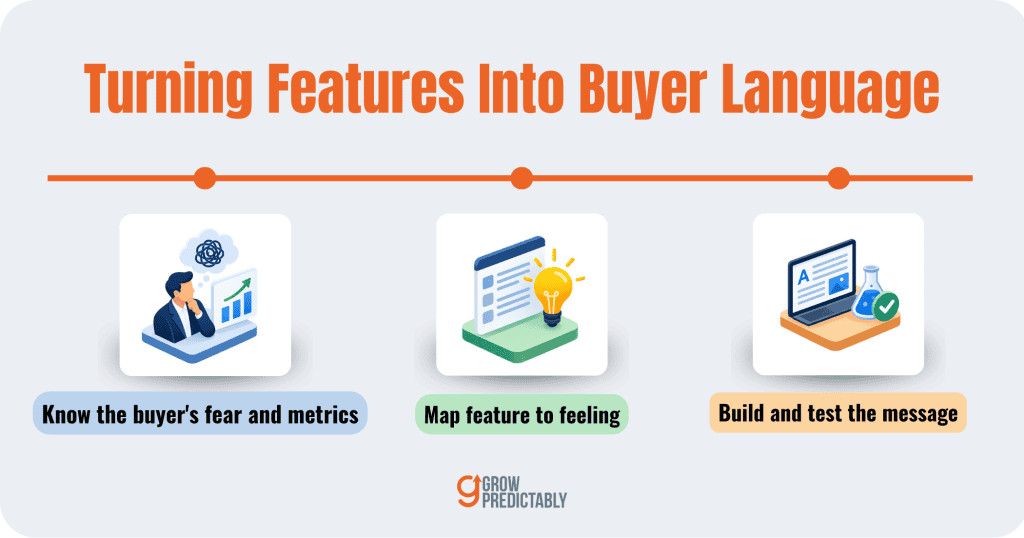
You translate product knowledge into buyer language with the Translation Layer, a three-step method:
- Learn the buyer’s real fears and job metrics. Go beyond demographics.
- Map every feature to the feeling or outcome it changes. Do this for each feature, not just the headline ones.
- Build the market message from those outcomes. Then test it with real buyers.
The Translation Layer exists because you’re not short on expertise. The risk is describing the product the way an engineer would, not the way the buyer living with the problem would.
Business buyers are not engineers. They care about urgent, risky problems more than technical tricks.
The symptom is specific. A demo goes well by every technical measure, and the buyer still says, “interesting, let me think about it.” The message describes architecture instead of outcome, so the buyer cannot connect how it works to why it matters fast enough to stay engaged.
Start from the feelings, not the technology behind them. Here is an illustrative feature-to-feeling table for a hypothetical B2B SaaS reporting product. Copy it and fill it in for your own product before the next call.
| Feature | What it does | What it changes for the buyer |
|---|---|---|
| Automated data sync | Pulls numbers from every source each night | The Monday report is ready without a weekend of spreadsheet work |
| Single source of truth | One shared definition for each metric | Nobody argues about whose number is right in the board meeting |
| Scheduled alerts | Flags a metric that moves past a threshold | The team hears about a problem before the CEO asks |
The failure mode is leading with the first column: frameworks, integrations, and architecture for a buyer who only cares about the third.
The recovery is mechanical. Say the third column first, and explain the first only when the buyer asks how it works. The same rule applies to content, covered in the next section: write about the problem, not the product.
Edelman’s 2025 research on hidden B2B buyers found that 71% of hidden buyers have little or no interaction with sales teams. For those buyers, the translated message has to do the work a seller would do in the room.
How do customer conversations sharpen B2B SaaS positioning and content?
Customer conversations sharpen B2B SaaS positioning and content when you capture the buyer’s exact words on the call and turn them into your next piece of content.
Writing from what the product team assumes matters skips that test. Each cycle gets sharper because the message meets a real objection before it is published.
Picture a B2B startup with no blog and a technical team that sees blogging and SEO as too big a lift. A practical first step is small, problem-focused LinkedIn posts written by each member of the team, instead of starting with blogging and SEO.
Short posts about problems buyers already feel are a foundation, not the whole strategy. They build credibility and a voice before a bigger content program exists. That bet matches what buyers say about content: in the same Edelman research, 64% trust thought leadership more than product sheets or brochures when assessing capabilities.
The same mechanism sits under your own sales calls. A sentence a buyer says unprompted, such as “we keep finding out about problems after the customer does,” beats a paragraph of copy guessing at the same idea. Write it down during the call.
Turning that sentence into a public message is its own discipline, covered in this guide to executive communication for founders.
What does the founder-led sales operating loop look like in B2B SaaS?
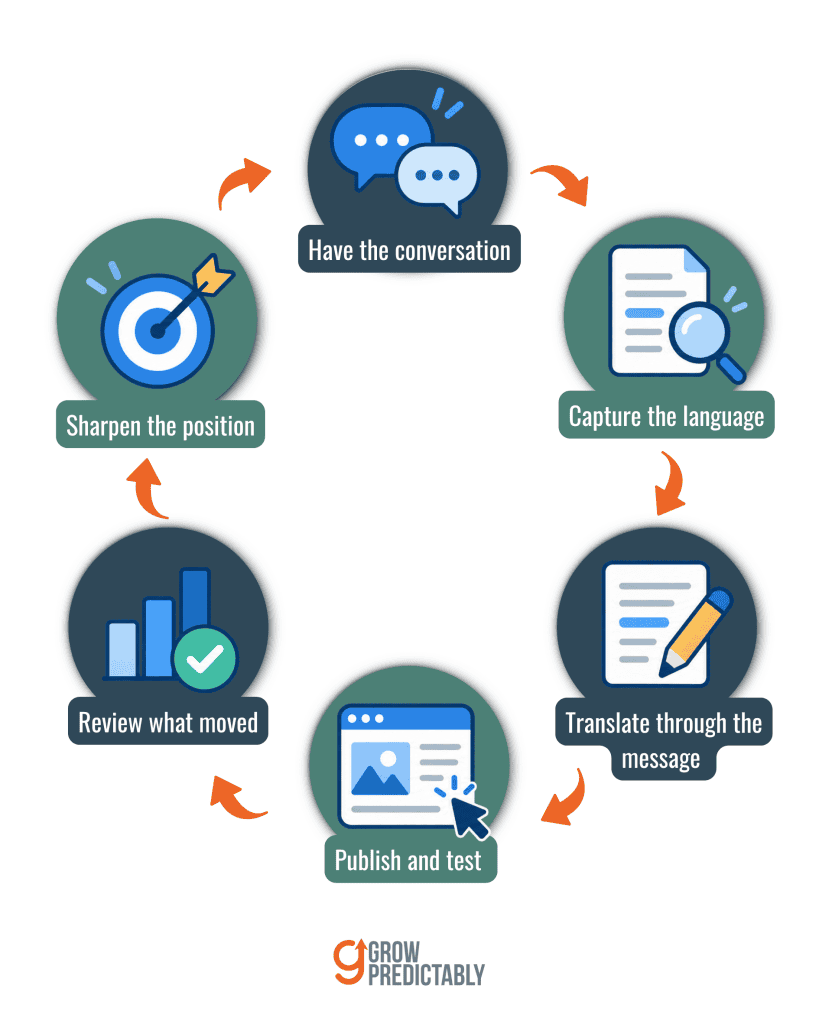
The founder-led sales operating loop is a six-step cycle that turns a B2B SaaS founder’s selling time into market research. It is the core of a founder-led sales strategy for a company that cannot outspend its rivals.
Each step feeds the next, so even a slow week of calls produces usable signal, not just a closed or lost deal.
- Have the conversation. Treat every buyer call as a research session first and a pitch second.
- Capture the buyer’s language. Write down the exact phrases the buyer used for their problem, their fear, and the outcome they want, within minutes of hanging up.
- Translate through the message. Run the captured language through the Translation Layer, feature to feeling, before it goes anywhere near a slide or a landing page.
- Publish and test. Put the revised line in front of buyers in the next call, the next post, or a headline, and watch what it does.
- Review what moved. Check which version of the message came before a buyer leaning in, asking a follow-up question, or advancing a stage.
- Sharpen the position. Fold what worked into the core message and cut what fell flat, even the founder’s favorite line.
This paste-ready template keeps step two consistent after a long week of calls:
Buyer: [role, company size]
Problem in their words: "..."
Metric they mentioned: ...
Objection raised: "..."
Phrase that got a visible reaction: "..."
As Kracov puts it, “After every call, you need to look and think about how you can evolve the pitch. This is one of the many reasons why a founder needs to do sales themselves.” (Kracov.co) The loop only works if someone actually reviews the notes.
A folder full of unread call recordings is not a loop. It is a backlog.
What should transfer to B2B SaaS sales and marketing hires, and what stays with the founder?
Process, follow-up, the documented message, and content production should transfer to your first B2B SaaS sales and marketing hires once a message is proven. The position itself, and the final call on what the company claims, should stay with you until the market has validated it beyond your own calls.
Gartner’s 2025 survey found that 69% of B2B buyers report inconsistencies between the information on the sales organization’s website and what sellers provide.
A message that lives only in your head, said slightly differently on every call, hands that risk to every new hire.
What transfers cleanly:
- Scheduling, follow-up cadence, and CRM hygiene. None of these need your judgment once a process exists.
- The documented message. Write it in enough detail that a new hire can say it correctly without sitting in on your calls.
- Content production. Hand it off once the loop produces a steady supply of captured buyer language.
What stays with you, for now:
- The position itself. Changing it is a strategic decision, not an execution task.
- Final approval on new claims. This matters most for claims a buyer could later hold the company to.
A hire who only inherits the activity, without the documented message behind it, just repeats your early inconsistency at a larger volume.
What are the warning signs that a B2B SaaS founder has become the bottleneck?
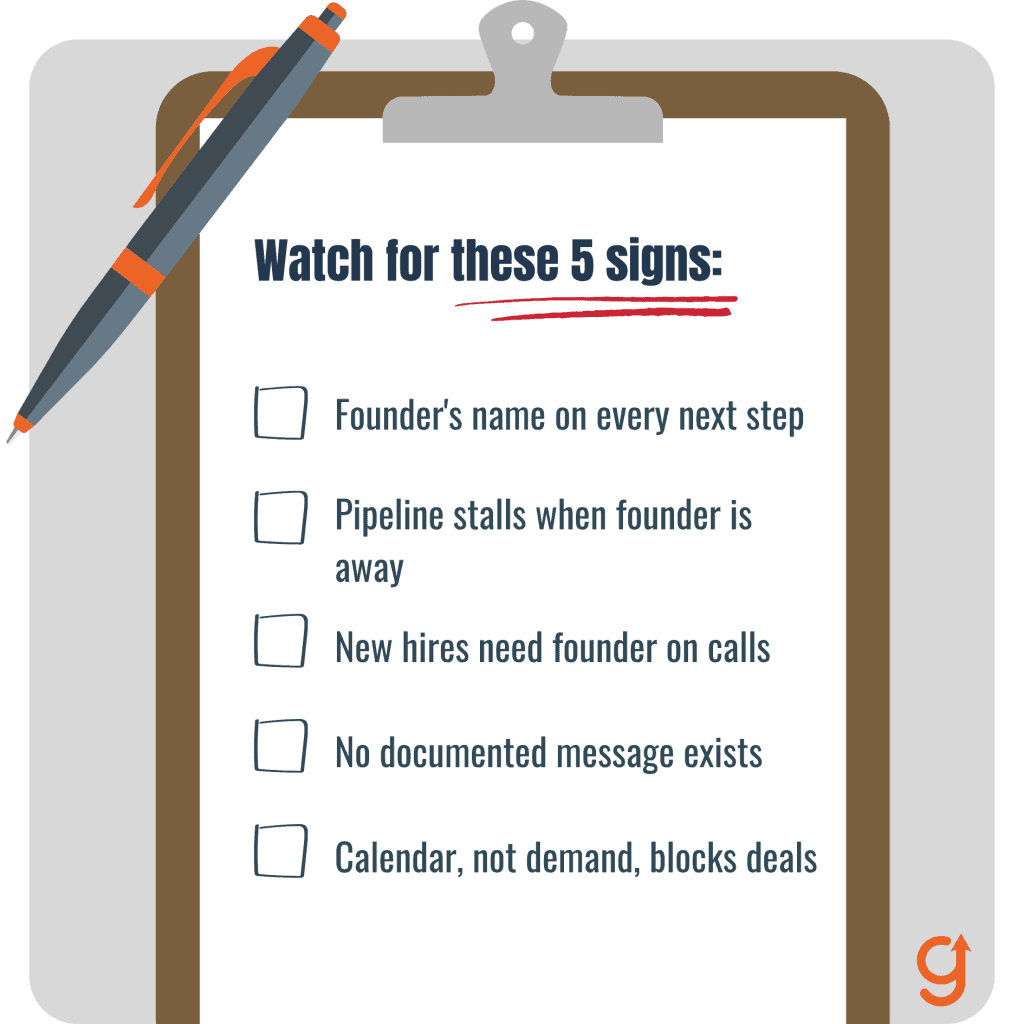
You’ve become the bottleneck in B2B SaaS sales when pipeline depends on your personal calendar, deals stall waiting for your follow-up, or the company can’t describe its own position without you.
Five checkable signs make the hand-off point visible before burnout forces it:
- Every next step has your name on it. No one else can move an active deal forward.
- You can’t take a week off. Pipeline visibly stalls when you do.
- New hires ask you to join their calls. They aren’t confident repeating the message alone.
- The documented message is missing. It doesn’t exist anywhere a new hire could actually find it.
- Your calendar is the stated reason. It, not market demand, is why deals aren’t closing faster.
Signs 3 and 4 trace back to the translation gap from earlier. If the message lives only in your head, nobody else can carry it.
Buyers feel that gap as the mismatch between website and seller that Gartner’s survey measured in the previous section. The fix there is the documented message, not more founder hours.
Treat one sign as a warning worth watching. Three or more, and the constraint has moved from the market to the person running the loop.
That needs its own operating fix, covered in this guide to when the founder is the constraint.
How can AI support B2B SaaS founder-led sales without replacing the founder’s judgment?
AI can support founder-led sales in B2B SaaS by speeding up research, summarizing call notes, preparing for meetings, and repurposing content. It cannot supply the founder’s earned point of view, and that point of view is the asset worth protecting. The hard line is simple. AI amplifies judgment. It does not replace it.
Forrester’s January 2026 research found that 94% of business buyers use AI in their buying process, up five points in a year. When buyers research with AI, the founder’s translated message has to exist in public, in the buyer’s own words, for those tools to find and repeat it.
Inside the operating loop, AI earns a role in four places:
- Research: summarizing what is public about a prospect’s company and role before a call.
- Synthesis: turning a week of call notes into the repeated phrases and objections worth acting on.
- Preparation: drafting likely objections and questions for the next conversation.
- Repurposing: a first draft of a post or email from the founder’s own notes, which the founder edits into their voice.
The principle I teach at Co-thinking with AI draws the line. AI amplifies a founder’s thinking, but it cannot supply the lived experience or earned point of view that makes the thinking theirs. A founder who lets AI write the position from scratch skips the buyer conversations that produced anything worth saying.
Use AI to amplify the team’s judgment, not to manufacture a position nobody earned.
Where should a capital-efficient B2B SaaS founder start this quarter?
Founder-led growth starts small and diagnostic, not with a rebuild of the sales motion. Spend the next quarter proving which words make buyers understand the product, before you spend on reach or hire anyone to repeat the message. That takes no new budget, only discipline on the calls you already have.
Three moves matter most:
- Capture the buyer’s exact words on the next ten calls.
- Run the Translation Layer pass on the message after each one.
- Track whether buyers start repeating the message back before you judge it on closed revenue.
If you suspect your explanation is where buyers drop off, confirm it before you spend against it.
Take the Growth Gap Scan to find the one stage actually capping growth before spending another dollar trying to fix the wrong one.
Frequently Asked Questions
What is founder-led sales?
Founder-led sales is the stage where a company’s founder personally runs most buyer conversations, from the first customer until a documented message and process exist that someone else can run. In B2B SaaS, it functions as a positioning loop: each conversation tests whether the message works before a rep or an ad budget relies on it.
What is a founder-led sales strategy?
A founder-led sales strategy is a plan for how a founder spends personal selling time: which buyers to talk to, what to capture from each conversation, how the message changes as a result, and when parts of the work move to the first B2B SaaS sales and marketing hires. It treats selling time as market research, not just a path to revenue.
When should a B2B SaaS founder stop doing founder-led sales?
A B2B SaaS founder should stop doing founder-led sales once a documented message closes deals without the founder in the room, and the founder’s calendar, rather than the market, has become the limit on pipeline. The position itself and the final call on company claims can stay with the founder even after the selling task transfers.
Why does positioning matter more than ad spend for capital-efficient SaaS?
Positioning matters more than ad spend because a small budget cannot win a spending contest, and paid reach only amplifies whatever message it carries. Gartner’s 2025 research found that 61% of B2B buyers prefer a rep-free buying experience, so the message has to work in writing before paid reach or a seller ever reaches the buyer.
How do technical founders market their product?
Technical B2B SaaS founders market their product by mapping each feature to the outcome or feeling it changes, using the buyer’s own words captured from sales conversations, then publishing short, problem-focused content in that language. The method, called the Translation Layer, builds the message from those outcomes and tests it with real buyers before it reaches a pitch or a post.
What is founder-led growth?
Founder-led growth is an approach where a founder’s direct conversations and public voice drive both sales and market presence, through calls that double as positioning research and through content such as short, problem-focused posts. Each conversation feeds the message the company later uses in sales, content, and the first marketing hire’s work.
Can AI replace founder-led sales?
No, AI cannot replace founder-led sales because it cannot supply the founder’s earned point of view, which is the asset a translated message depends on. AI can speed up research, summarize call notes, prepare for meetings, and repurpose content into drafts, but the founder still edits the result into their own voice and judgment before it ships.