
SEO for B2B SaaS: Why the Generic Playbook Fails and What Works

By Brian Shelton, Founder of GrowPredictably.com
TL;DR: SEO for B2B SaaS breaks when it copies the generic playbook, because the buyer is narrow and the terms that actually convert are usually low-volume and specific, not the broad, high-traffic terms most content programs chase. The fix is reprioritizing keyword research around buyer-fit over search volume and sequencing content bottom-of-funnel-first.
Key Takeaways
- SEO for B2B SaaS optimizes for a narrow, high-consideration buyer, not general traffic, so a low-volume keyword that matches a real evaluation moment often outperforms a high-volume one.
- The B2B SaaS market was valued at roughly $390 billion in 2025 and is projected to reach $1.58 trillion by 2031, which raises the cost of paid acquisition and the relative value of organic search.
- Traffic and rankings can climb for months while demos and signups stay flat when content targets top-of-funnel terms a real buyer with budget authority rarely searches.
- Bottom-of-funnel-first content, one dedicated piece per real evaluation question that sells the product directly inside it, converts before it expands into broader terms.
- ProductLed’s analysis of 446 B2B SaaS companies found the SEO metric that matters shifts by growth stage, from self-serve conversion rate early on to net revenue retention once a company scales past $4M.
Early in my own SEO and SEM work I built and ran an internet marketing business across affiliate marketing, SEO and SEM, content, and ecommerce product development. The lesson that stuck was simple. Traffic and rankings are vanity metrics dressed up as strategy the moment they stop tracing back to a buyer with money to spend.
This article walks a B2B SaaS leader through why the generic SEO playbook quietly fails this business model: define goals, do keyword research, publish content, fix technical SEO, build links. Then it covers what to do instead. Reprioritize keyword research around buyer-fit, sequence content bottom-of-funnel-first, and measure the right thing at each growth stage.
This is for the B2B SaaS founder, CMO, or head of growth in one of two spots. Either they inherited a content program that’s growing traffic without growing pipeline. Or they’re about to stand up SEO from scratch using the same playbook every agency pitch deck repeats.
The work that follows is not “publish more content on a regular calendar.” It is targeting the specific, often low-volume terms your actual buyer types, before you touch a broader term at all.
What is SEO for B2B SaaS?
SEO for B2B SaaS is optimizing a software company’s site and content to rank for the specific terms its actual buyer searches during evaluation, not general consumer traffic. It uses the same technical, content, and link-building pillars as any SEO. But it prioritizes low-volume, high-intent terms over broad, high-volume ones, because the buyer pool is narrow and the sales cycle is long.
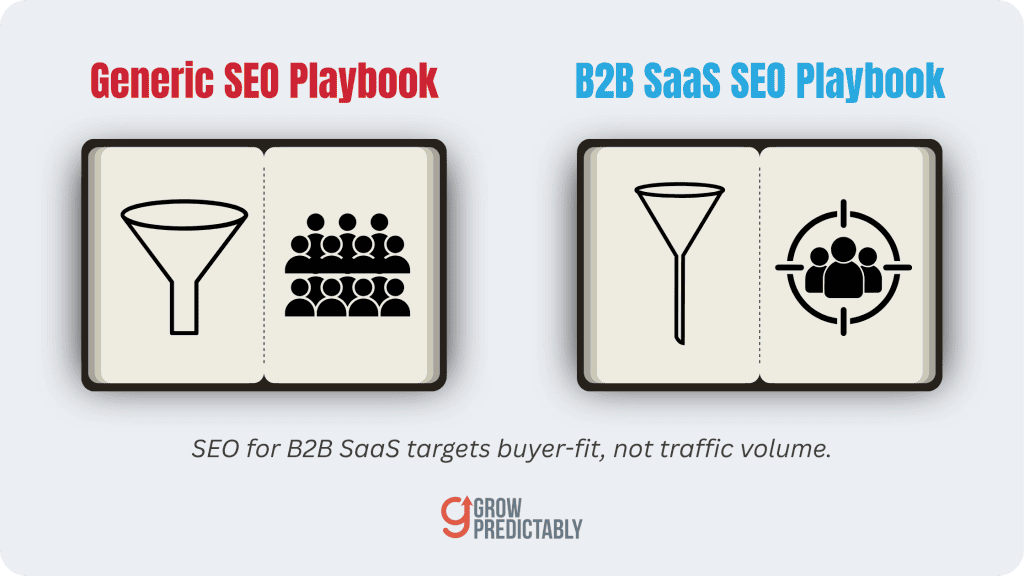
That prioritization is the entire difference. A generic SEO program treats a keyword’s search volume as the main signal of whether it’s worth targeting. A B2B SaaS SEO program treats buyer-fit as the main signal, search volume second.
A term with 50 monthly searches from people evaluating your exact category of product is worth more than a term with 50,000 searches from people who will never buy anything. They have the wrong audience entirely.
Why does SEO matter more for B2B SaaS as the market keeps growing?
The B2B SaaS market was valued at roughly $390 billion in 2025 and is projected to grow to about $1.58 trillion by 2031, a 26.24% compound annual growth rate. That scale means more competitors chasing the same buyer attention every year, not fewer.
More competition for the same buyers pushes paid acquisition costs up. It does not do the same to organic search. That’s why the relative value of a working SEO program keeps rising even as the absolute cost of running one stays roughly flat. A B2B SaaS company that treats SEO as a someday project is choosing to compete on the channel getting more expensive every year, while leaving the one that isn’t sitting unused.
Why does B2B SaaS SEO fail when it’s run like generic SEO?
Traffic and keyword rankings can climb for months, sometimes for a year, while demo requests and signups stay completely flat. That is the symptom most B2B SaaS marketing leaders notice first. It usually surfaces right before someone in a board meeting asks why the content budget keeps growing without pipeline to show for it.
I’ve watched this exact pattern repeat, because a content calendar fills up and rankings climb while the sales team still says leads feel unqualified.
The real cause sits underneath the traffic chart. Content targets high-volume, top-of-funnel terms, “what is CRM,” “customer service tips,” “project management best practices,” because those terms look impressive in a rank tracker.
A real buyer with budget authority almost never types them. Devesh Khanal, Co-Founder of Grow and Convert, puts it plainly:
We don’t prioritize high-volume, top of the funnel keywords like ‘what is CRM,’ ‘customer service tips,’ or ‘project management best practices.
Devesh Khanal, Co-Founder of Grow and Convert
That names the exact failure mode. The tempting anti-pattern is treating traffic and impressions as the success metric instead of pipeline. Traffic is easy to report. Pipeline takes longer to trace back to a specific piece of content.
Fix the target, not the volume of content produced. The next two sections cover exactly how.
What makes B2B SaaS keyword research different?
Near-zero search volume is a feature for B2B SaaS keyword research, not a bug. A term with 50 monthly searches that matches a specific buyer role and pain point converts at a completely different rate than a term with 50,000 searches from a general audience that will never buy.
Take the contrast directly. “What is CRM software” pulls in tens of thousands of searches a month from students, job seekers, and casual researchers. A term like “CRM for a 20-person outbound sales team switching from spreadsheets” pulls in a fraction of that volume.
But those searchers are in the exact evaluation moment your product exists to win. Standard keyword tools are built around consumer-scale volume, so they routinely undersell terms like that second one. The research process has to prioritize buyer-fit over the number the tool shows. Otherwise it will systematically point you at the wrong terms.
How do you build a content strategy that actually drives signups, not just traffic?
Sequence content bottom-of-funnel-first, not the other way around, in three steps.
- Map the specific evaluation questions your ICP asks right before a buying decision, not generic category questions.
- Write one dedicated piece per question that fully answers it and sells the product directly inside the content, not a soft mention at the end.
- Only then expand upward into broader, more competitive terms once the bottom-of-funnel terms are covered.
Selling the product directly inside bottom-of-funnel content is not the same as being pitchy. The reader is already evaluating solutions at that point in the journey, they came looking for exactly that comparison. The generic-agency pattern, publish broad educational content first and hope it eventually converts, delays the exact conversation your buyer already wants to have.
This sequencing question sits inside the broader B2B SaaS content marketing program. Turning each mapped question into a real brief is its own skill. SEO-driven content briefs for B2B SaaS marketers covers that step in more depth.
Technical SEO fundamentals for a B2B SaaS product
The technical fundamentals that matter most for a B2B SaaS site are documentation, help-center pages, and clean crawl efficiency as the site grows. Neither needs a full audit to direct. You just need enough to tell an engineer or a technical SEO hire what to prioritize.
Product documentation and help center pages
Documentation and help-center pages deserve real SEO treatment, not just internal support content. They often answer the exact high-intent questions a bottom-of-funnel buyer searches. Think “does this integrate with X” or “how does pricing work for Y use case.”
When I go through a SaaS site’s technical setup, docs are almost always the most under-optimized asset on the whole domain, because product or support owns them instead of marketing.
Site speed and crawl efficiency at scale
Clean internal linking between docs, blog, and product pages matters more as a B2B SaaS site grows, because orphaned or duplicate content gets harder to untangle the bigger the site gets.
Common mistakes B2B SaaS companies make with SEO
The mistake I see most often is publishing generic, top-of-funnel content to hit a calendar quota. It’s almost always driven by a content calendar that rewards volume over fit. A close second is treating traffic and impressions as the success metric instead of pipeline or signups, which quietly optimizes the whole program for the wrong outcome.
A third, less obvious mistake is ignoring documentation and product pages as SEO assets. They sit organizationally under product or support instead of marketing, even though they often carry the highest buyer intent on the entire site.
How do you measure SEO success for a B2B SaaS company?
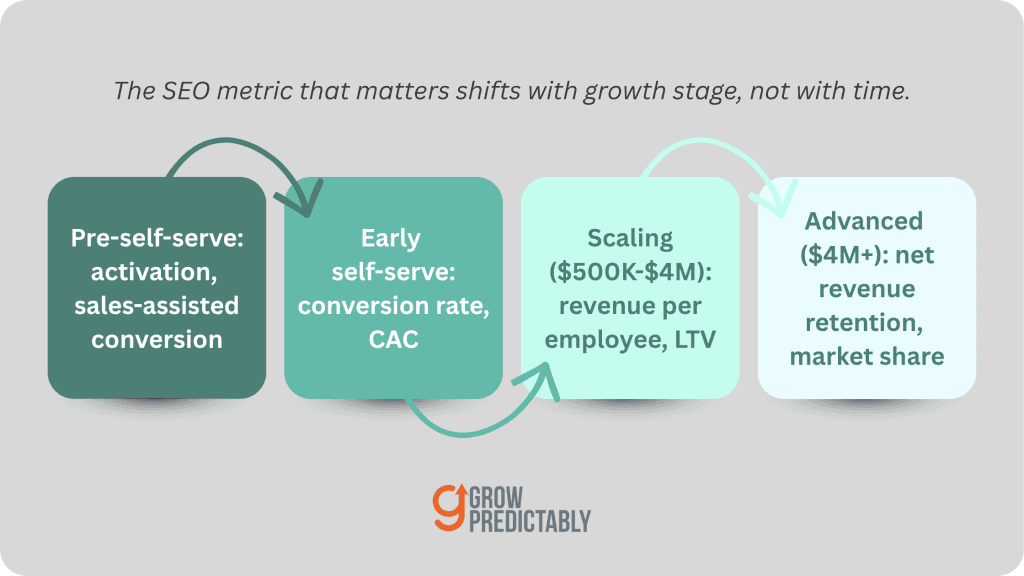
The right SEO metric shifts as a B2B SaaS company scales, so a single fixed target across every stage is the wrong model. ProductLed’s analysis of 446 B2B SaaS companies breaks down exactly how the metrics that matter move with growth stage, not with time.
Tying organic traffic back to revenue at each stage is exactly what measuring SaaS SEO ROI covers in more depth.
Per that same breakdown, track self-serve conversion rate and acquisition cost from organic traffic before self-serve revenue takes off. In their early self-serve stage (roughly $100K to $500K), shift toward self-serve conversion rate and revenue per visitor. In their scaling stage (roughly $500K to $4M), shift toward revenue per employee and lifetime value tied to organic-sourced customers.
Past $4M, the metric that matters most is net revenue retention and market-share growth from the organic-sourced cohort, not raw traffic or keyword count ranked. Vanity metrics do not disappear as a company scales. They just get more expensive to keep chasing.
Frequently Asked Questions
What is B2B SaaS SEO strategy?
A B2B SaaS SEO strategy prioritizes buyer-fit over search volume, targeting the specific, often low-volume terms a real evaluation-stage buyer types rather than broad, high-traffic terms. It sequences content bottom-of-funnel-first and shifts what it measures as the company scales, rather than chasing a single fixed traffic target.
What is SaaS SEO?
SaaS SEO is search engine optimization applied to a software-as-a-service company’s site and content. It uses the same technical, content, and link-building pillars as any SEO, but for B2B SaaS specifically it prioritizes a narrow, high-consideration buyer over general traffic volume.
What should be on a SaaS SEO checklist?
Start with mapping the specific evaluation questions your ICP asks before a buying decision, then build content bottom-of-funnel-first around those questions. Add technical fundamentals like documentation SEO and clean internal linking, and track the metric that matches your current growth stage rather than raw traffic.
Do low search volume keywords matter for B2B SaaS?
Yes, often more than high-volume ones. A term with 50 monthly searches that matches a specific buyer role and evaluation moment converts at a completely different rate than a term with 50,000 searches from a general audience that will never buy.
How long does B2B SaaS SEO take to show results?
There is no fixed timeline that applies to every company, since it depends on the current state of the site and the competitiveness of the bottom-of-funnel terms targeted first. A faster, more reliable signal than waiting on rankings is checking whether new content maps to a real evaluation question your ICP asks.
Should a B2B SaaS company optimize its documentation pages for SEO?
Yes. Documentation and help-center pages often answer the exact specific, high-intent questions a bottom-of-funnel buyer searches, and most B2B SaaS companies leave them unoptimized because product or support owns them instead of marketing.
How do you know your B2B SaaS SEO strategy is working?
The fastest check is whether new organic content maps to a real evaluation question your ICP asks, not whether it ranks. If you cannot name the specific buyer moment a piece of content is meant to catch, that’s a warning sign. It is probably a top-of-funnel term that will climb the rank tracker and do nothing for pipeline.
The same diagnostic instinct threaded through this whole article, audit what’s actually converting before you invest more, applies one level up to the entire growth funnel, not just SEO.
Find your real growth gap with the free scan (the same diagnose-before-you-fix approach applied to the full funnel, not just SEO).