

How to Grow a B2B SaaS Business: Pick the Right Growth Lever First

TL;DR: A B2B SaaS business grows through four levers, acquire, convert, retain, and expand. Growth can stall when a team pulls all four levers at once instead of finding the one capping revenue. T2D3 and the Rule of 40 are benchmarks for judging the result, not instructions for producing it. Pick the lever that is the constraint, then fix that one first.
Key Takeaways
- A B2B SaaS business has four growth levers, acquire, convert, retain, and expand. In a constraint view of growth, fixing a lever that is not the constraint changes little downstream.
- Net revenue retention and growth move together, a correlation rather than a proven cause. In SaaS Capital’s benchmark study of private subscription software companies above $1 million ARR, groups with net revenue retention of at least 110% grew faster than the 24% survey median. Groups below 100%, by contrast, grew slower.
- In ProductLed’s analysis of 446 companies, 32.1% say they cannot consistently identify their bottlenecks, and companies that excel at pinpointing their primary bottleneck report 41% faster revenue growth.
- T2D3 was named by Neeraj Agrawal, then a general partner with Battery Ventures, in a 2015 TechCrunch article. It describes triple, triple, double, double, double annual revenue growth across 7 phases starting at product-market fit.
- The Rule of 40, described by Brad Feld in a 2015 post, states growth rate plus profit should add up to 40%. Feld scoped it to software companies at scale, at least $50 million in revenue.
By Brian Shelton, Founder of GrowPredictably.com
A B2B SaaS team can run a demand-gen sprint, ship a new onboarding flow, and launch an expansion play in one quarter. Revenue still misses plan. In a constraint view of growth, that pattern means effort is spread across every stage. It is not landing on the one stage capping growth.
This guide gives a B2B SaaS founder, CEO, or VP of Growth four levers, acquire, convert, retain, and expand. It also includes a one-page Lever Check for picking which lever to pull first.
T2D3 and the Rule of 40 get read from the people who wrote them, Neeraj Agrawal and Brad Feld. A board conversation about benchmarks should not get mistaken for a growth plan.
How do you grow a B2B SaaS business?
A B2B SaaS business grows by pulling one of four levers, acquire, convert, retain, or expand, at the stage that is capping revenue. Pulling every lever at once spreads a team thin and can leave the top-line number where it was. In the constraint view this guide uses, growth comes from treating the constraint, not from adding activity.
Benchmarks like T2D3 and the Rule of 40 judge whether that growth was good. They do not tell a team which lever to pull. A board can ask why net revenue retention is flat while growth accelerates, and the answer still points back to one of the four levers.
The deeper diagnostic question, which constraint is actually capping the system right now, is answered in full on B2B SaaS Growth Strategy. This guide stays at the lever level. It covers the four levers, what breaks when a team pulls all of them at once, and how to pick the first one.
The diagnostic view this guide uses treats every growth system as having one constraint at a time. That gives every recommendation here one test. Does it move the lever that is capping growth, or does it just add activity?
What are the four growth levers of a B2B SaaS business?
A B2B SaaS business has four growth levers, acquire, convert, retain, and expand. Acquire brings qualified demand into the funnel. Convert turns that demand into paying customers. Retain keeps the revenue already won.
Expand grows revenue inside existing accounts.
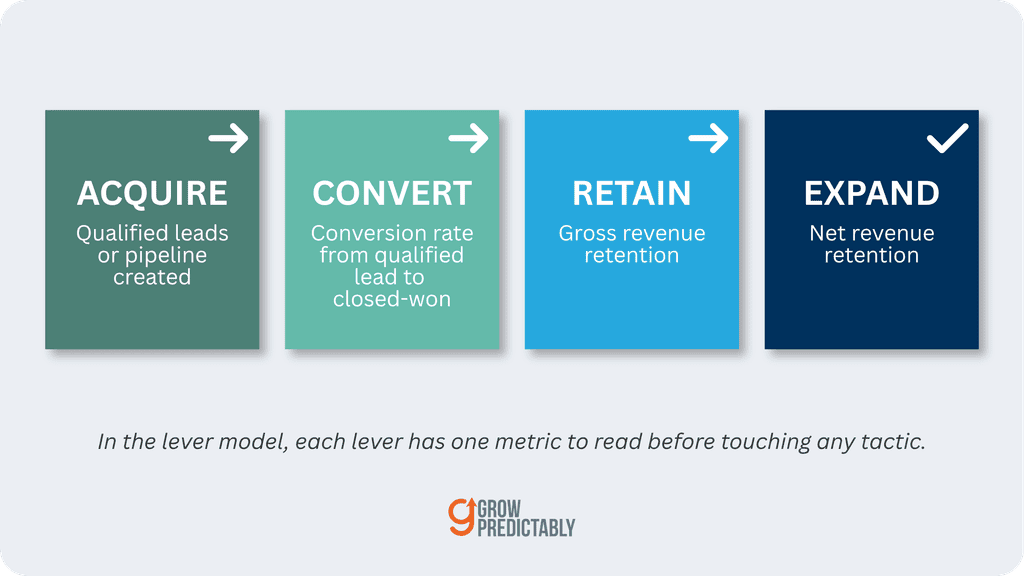
Each lever has one metric worth reading before touching any tactic.
Acquire: bring in qualified demand
Acquire is the lever that brings qualified demand into the funnel. The metric to read is qualified leads or pipeline created, not raw traffic or impressions.
Inside a B2B software company, qualified-lead volume across inbound streams grew 58% year over year in the first half of 2025, beating a 20% goal and a 25% stretch target. A number like that is the acquire lever’s scorecard: qualified demand measured against plan.
SEO for B2B SaaS covers acquisition channel work in full. This lever only asks whether qualified demand is growing against plan.
Convert: turn demand into customers
Convert is the lever that turns qualified demand into paying customers. The metric to read is conversion rate from qualified lead to closed-won.
A broken convert lever shows up as plenty of demand and a stalled close rate. That gap can point to the sales conversation or the page asking for the sale, rather than to the channel that brought the demand in.
Retain: keep the revenue you won
Retain is the lever that keeps the revenue a business already won. The metric to read is gross revenue retention, which excludes upsells and cross-sells and cannot exceed 100%. A weak retain lever shows up as a bucket that leaks almost as fast as acquire can fill it.
Expand: grow revenue inside existing accounts
Expand is the lever that grows revenue inside accounts a business already has, through upsells, cross-sells, and price increases. The metric to read is net revenue retention.
According to SaaS Capital’s retention benchmarks, the median growth rate across its survey of private subscription software companies above $1 million ARR was 24%.
SaaS Capital found that growth rates for companies with net revenue retention of at least 110% were higher than the survey median. By contrast, growth rates for companies with NRR below 100% were lower than that median.
For companies with annual contract values between $25,000 and $50,000, median NRR was 102%. SaaS Capital describes this as a correlation, not a cause.
What Is Lifetime Value In B2B SaaS and How to Reduce Churn in B2B SaaS cover the tactics behind retain and expand in depth.
What goes wrong when a B2B SaaS team pulls every growth lever at once?
A B2B SaaS team that pulls every growth lever at once spreads effort across stages that are not the constraint. Revenue can stay flat even as activity increases. The constraint may not be the lever getting the most attention. It can be the lever nobody is reading carefully, the one actually capping the system.
Here is the symptom. The team runs more campaigns, launches a new onboarding sequence, and still misses plan. The root cause is that effort spreads across levers that are not capping revenue. So the constrained lever gets a fraction of the attention it needs.
According to ProductLed’s analysis of 446 companies, 32.1% of companies say they cannot consistently identify their bottlenecks. ProductLed says that leaves them solving the wrong problems while real limitations persist. ProductLed also found that companies that excel at pinpointing their primary bottleneck report 41% faster revenue growth than companies that struggle with it.
Still, that is a self-reported association, not a controlled result.
The anti-pattern to watch for is adding acquisition spend while retain is the weak lever. New customers arrive and a similar share leaves. The top of the funnel gets busier, but the revenue number barely moves. This is the lever version of a wider rule.
Under that rule, a growth system has one constraint at a time, and treating any other stage does little until that constraint moves. The intervention is simple. Read one metric per lever, find the one furthest behind plan, and put the next quarter’s effort there.
How do you choose which B2B SaaS growth lever to pull first?
A B2B SaaS team chooses its next growth lever by reading one metric per lever against plan and against last quarter, then giving the lever furthest behind the next quarter of effort. This is the Lever Check, a one-page read of acquire, convert, retain, and expand.
It is a diagnostic tool, not an exhaustive list of what can go wrong.
| Lever | Metric to read | Sign it is the constraint | First move |
|---|---|---|---|
| Acquire | Qualified leads or pipeline created | Qualified leads are flat or behind plan while convert, retain, and expand hold steady | Fix the pages and offers that produce qualified leads before adding spend |
| Convert | Conversion rate from qualified lead to closed-won | Qualified leads are on plan but closed-won is behind | Fix the sales conversation or the page before adding more demand |
| Retain | Gross revenue retention | Revenue leaves almost as fast as new revenue arrives | Fix onboarding and support before spending on new logos |
| Expand | Net revenue retention | Existing accounts hold steady but do not grow | Build the upsell and cross-sell motion before chasing new markets |
The Lever Check composes with a wider rule. A growth system has one constraint at a time, and effort spent anywhere else changes little until that constraint moves. Growth Gap Marketing is the diagnostic approach built around that rule.
On a redesigned paid-search landing page, an A/B test I helped lead achieved an 83% increase in conversion rate. A result like that belongs to the convert lever. It is the kind of first move the table points to when demand is on plan and conversion is behind.
To run the Lever Check, pull the four numbers for the current quarter and the prior quarter. Mark the lever furthest behind its own plan, not the lever that feels urgent in a meeting. Give that lever the next quarter’s budget and attention, and leave the other three at maintenance.
Re-run the check at the end of the quarter, because the constraint can move once the first one is treated.
What is the 3-3-2-2-2 rule for B2B SaaS growth?
The 3-3-2-2-2 rule, known as T2D3, describes a revenue growth pattern of triple, triple, double, double, double annualized revenue growth across 7 phases. Neeraj Agrawal, then a general partner with Battery Ventures, named it in a 2015 TechCrunch article. The phases start at product-market fit and move through $2 million in annual recurring revenue toward $144 million.
The 7 phases, in order:
- Establish product-market fit.
- Reach $2 million in annual recurring revenue.
- Triple to $6 million.
- Triple to $18 million.
- Double to $36 million.
- Double to $72 million.
- Double to $144 million.
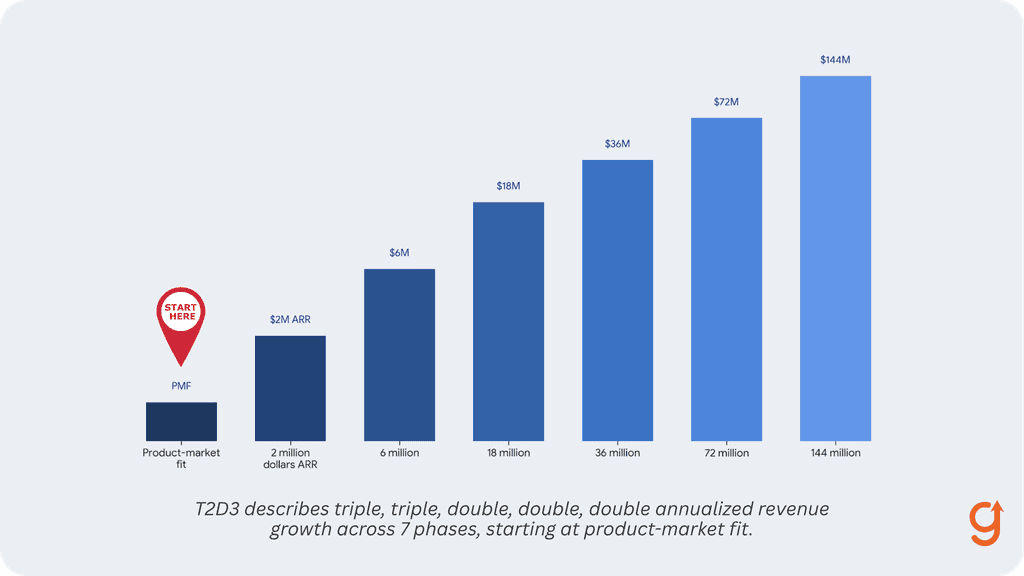
Agrawal’s chart in the same article shows 7 public software companies that roughly followed this path. They are Marketo, NetSuite, Omniture, Salesforce, ServiceNow, Workday, and Zendesk. He was also careful about how far to stretch the rule. He wrote that T2D3 is not the only growth path, pointing to enterprise software companies that got there another way. He still called it one sure-fire way to get there.
His first phase sets the condition for everything after it. Describing what establishing product-market fit takes, Agrawal wrote:
This involves finding and prioritizing customer pain points, then aligning your product to address those pain points precisely.
Neeraj Agrawal, general partner with Battery Ventures, in The SaaS Adventure (TechCrunch, 2015)
For a B2B SaaS operator, T2D3 works best as a yardstick for a growth rate already achieved. It is not a lever to pull, and it says nothing about which of the four levers, acquire, convert, retain, or expand, produced the number.
What is the Rule of 40 for a B2B SaaS company?
The Rule of 40 says a B2B SaaS company’s growth rate plus its profit should add up to 40%. Brad Feld described the rule in a 2015 blog post after hearing it from a late-stage investor at a board meeting. Feld wrote it for software companies at scale. He assumed at least $50 million in revenue.
Brad Feld put the idea plainly in that post: “The 40% rule is that your growth rate + your profit should add up to 40%.” He used EBITDA as his profit baseline and checked it against other profit measures. For growth, he used year-over-year growth of monthly recurring revenue.
Feld’s worked examples make the tradeoff concrete. A company growing 20% should be generating a 20% profit. A company growing 40% can run at breakeven. A company growing 50% can afford to lose 10%.
Feld warned that slowing growth to get profitable right away can leave a company sub-scale for a much longer time. His advice to venture-funded companies was to use T2D3 to reach scale first. The Rule of 40 comes after. Applying the Rule of 40 to an early-stage company measures a company Feld was not describing.
For comparison, Agrawal’s second phase ends at $2 million in annual recurring revenue.
When is fast growth the wrong goal for a B2B SaaS company?
Fast growth is the wrong goal for a B2B SaaS company when retain is the lever capping the system, because new revenue just refills a bucket that keeps leaking. Growing the top of the funnel in that situation adds cost without adding much net revenue.

Brad Feld warned that slowing growth to get profitable right away can leave a company sub-scale for a much longer time. That is a caution against slowing down for its own sake, and it does not conflict with fixing a leak first. A company that keeps pushing acquire while retain is broken has a different problem: it buys revenue that walks back out the door.
Neeraj Agrawal wrote that many founders ask him how they will know they have product-market fit, and that there is no clear test for it. Chasing T2D3-style growth before that fit exists risks scaling a leak rather than a lever.
The diagnostic view this guide uses treats growth as a constraint problem. Once retain or expand is confirmed as the constraint, the fast-growth goal is premature. The next quarter belongs to fixing the leak, not filling the funnel faster. How to Scale a SaaS Business covers the operational side of building the team and process that can support growth once the constraint is treated.
Where should a B2B SaaS team start growing this quarter?
A B2B SaaS team should start this quarter by running the Lever Check. Pull the four numbers, acquire, convert, retain, and expand, against plan and against last quarter. Then give the next quarter to the lever furthest behind. The aim is one lever, one metric, and one quarter of focused effort.
Take the Growth Gap Scan to find the one constraint capping growth across the full customer journey, past the lever level. Running both together gives a B2B SaaS team a clear read on where to spend the next 90 days.
Frequently Asked Questions
What is a good growth rate for a B2B SaaS company?
The median growth rate among private subscription software companies above $1 million ARR was 24%, according to SaaS Capital’s benchmark study. Groups with net revenue retention of at least 110% grew faster than that median, while groups with NRR below 100% grew slower. SaaS Capital describes the relationship between NRR and growth as a correlation.
Does net revenue retention affect SaaS growth?
Net revenue retention and growth move together, but SaaS Capital describes the relationship as a correlation, not a proven cause. In its survey of private subscription software companies above $1 million ARR, groups with net revenue retention of at least 110% grew faster than the 24% median, while groups below 100% grew slower. Net revenue retention is the metric behind the expand lever.
Should a SaaS company prioritize growth or profitability?
The Rule of 40, described by Brad Feld, says growth rate plus profit should add up to 40%, but Feld scoped this to software companies at scale, at least $50 million in revenue. He warned that slowing growth to get profitable early can leave a company sub-scale for a much longer time, and advised venture-funded companies to use T2D3 to reach scale first. Which to prioritize depends on company stage and which growth lever is the constraint.
Do you need product-market fit before growing a SaaS business?
In Neeraj Agrawal’s T2D3 framework, establishing product-market fit is Phase 1, before a company moves to $2 million in annual recurring revenue and through the triple, triple, double, double, double phases. Agrawal wrote that many founders ask him how they will know they have product-market fit, and that there is no clear test for it. Scaling acquisition before that fit exists risks growing a leak rather than a lever.
Which growth lever should a B2B SaaS team fix first?
No single lever, acquire, convert, retain, or expand, comes first by default. The lever to fix first is whichever one is currently capping revenue, found by reading one metric per lever against plan and against the prior quarter. In a constraint view of growth, putting effort into a lever that is not the constraint changes little downstream.
How do you measure SaaS growth?
A B2B SaaS team can measure growth lever by lever: qualified leads or pipeline created for acquire, conversion rate from qualified lead to closed-won for convert, gross revenue retention for retain, and net revenue retention for expand. Benchmarks like T2D3 (triple, triple, double, double, double annual revenue growth) and the Rule of 40 (growth rate plus profit adding up to 40%) judge the result. They do not produce it.