
How to Reduce Churn in B2B SaaS: Fix It Where It Starts

TL;DR: Reducing churn in B2B SaaS starts with finding where it begins. The churn origin map is a diagnostic framework with four origins to check first. They are a failed payment, a promise the sale couldn’t keep, a slow first win, and fading value before renewal. Fix the dominant origin first, before adding new tactics. Treating the wrong stage leaves the real constraint untouched, so the number doesn’t move.
Key Takeaways
- The churn origin map gives B2B SaaS teams four origins to check first: a failed payment, an oversold promise, a slow first win, or fading value before renewal. Each has a different owner.
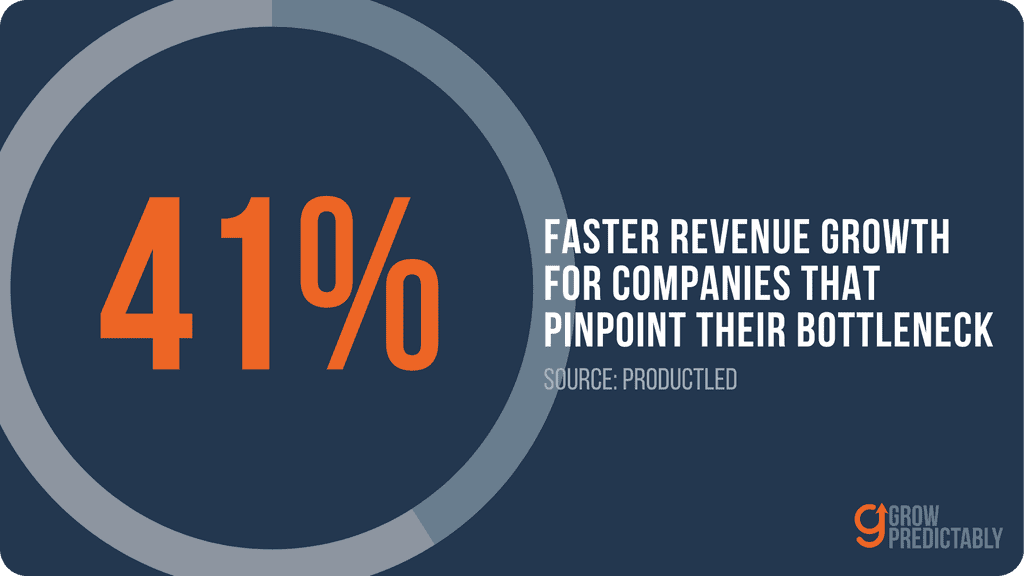
- Companies that pinpoint their primary growth bottleneck report 41% faster revenue growth than those that cannot, according to ProductLed’s analysis of 446 companies.
- Optimized payment retry strategies lifted failed-payment recovery to about 71%, up from roughly 53%, with 90% of recoveries happening within 10 days.
- SaaStr’s Jason Lemkin says customers who aren’t onboarded almost immediately after they sign up and pay are already at risk of leaving.
- Median net revenue retention sits at 102% for B2B SaaS companies with $25,000 to $50,000 ACV. Companies below 100% NRR grew slower than the median company in SaaS Capital’s survey.
A B2B SaaS board asks why net revenue retention sits under 100% while new bookings look healthy. The team already runs onboarding emails, health scores, and quarterly reviews. Those tactics run in parallel, and none of them touches the actual constraint.
This guide walks through the churn origin map. It is a diagnostic framework built around four places B2B SaaS churn can begin, each with its own owner and first fix. It’s grounded in retention data from ProductLed, Recurly, and SaaS Capital.
It’s written for the CEO, VP of Marketing, or head of customer success who has watched gross retention slip for two or three quarters. They need to know which stage to fix first, and in what order.
What actually reduces churn in B2B SaaS?
Reducing churn in B2B SaaS starts with a diagnosis. Tag each lost account by where it started, then fix the biggest origin before touching the rest. The sequence below moves the number without spending a quarter on tactics aimed at the wrong stage.
- Tag every lost account from the last two quarters by where the churn started.
- Recover failed payments first. Recurly’s data shows optimized retry strategies lifted recovery from about 53% to 71%.
- Fix the promise the sale makes, so new customers get what they were sold.
- Shorten the time between signup and a customer’s first measurable win.
- Watch renewal signals 90 to 120 days before the contract ends.
- Put one owner on churn and make it a top company goal.
Each step is covered below, including how churn rate is actually calculated. That keeps the tagging in step one consistent from the start.
Why do retention tactic lists fail to move B2B SaaS churn?
Retention tactic lists fail because they treat every stage of the customer journey as equally urgent. In the constraint view this guide uses, churn has one dominant origin at a time. Running onboarding emails, health scores, and discount offers all at once spreads effort across stages that aren’t capping retention. The churn number barely moves.
Here is the symptom. Onboarding emails go out. A customer success platform tracks health scores. Quarterly business reviews happen on schedule. Gross revenue retention still slips every quarter. The team is busy, and the number stays flat.
The upstream problem is a misdiagnosis. According to ProductLed’s analysis of 446 companies, bottleneck awareness pays. Companies that excel at pinpointing their primary bottleneck report 41% faster revenue growth than those that struggle to identify it. Yet 32.1% of companies say they cannot consistently identify their bottlenecks. ProductLed notes that this leaves teams solving the wrong problems while the real limitations persist.
The constraint view treats a customer base like any growth system. It has one constraint that limits how much revenue it keeps. Improving a stage that isn’t the constraint changes nothing downstream, no matter how much effort goes into it.
That’s the same logic behind finding the one constraint that’s actually capping growth instead of improving everything at once. Seen this way, what looks like a growth problem in B2B SaaS can be a retention problem wearing an acquisition costume.
The fix is finding which of the four origins below is doing the damage, then working that one first.
Where does B2B SaaS churn actually start?
The churn origin map checks four places B2B SaaS churn can start. They are a failed payment, a promise the sale couldn’t keep, a first win that arrives too late, and value that fades before renewal. Each origin shows a different symptom, has a different owner, and needs a different first fix.
Losses outside the map, such as an acquisition, a budget cut, or a customer shutting down, get tagged as other.
By SaaS Capital’s definition, churn is simply 1 minus gross retention. A team holding 95% gross retention is already losing 5% of its revenue base, before anyone runs a single save play. Which 5% it is, and why, is the diagnostic question that matters.
Origin 1: the payment failed
On the dashboard, the team sees card declines, dunning emails, and revenue dropping with no cancellation request behind it. Check for expired cards, reissued card numbers, or a bank blocking a recurring charge.
Origin 2: the sale promised something the product does not deliver
On the dashboard, the team sees early cancellations clustered in the first few months, along with “not what we expected” notes in exit surveys. Check whether the demo sold features instead of outcomes, or whether the account was ever a good fit.
Origin 3: the first win came too late
On the dashboard, the team sees low usage in week one, with support tickets about setup instead of about features. Check whether the onboarding flow buries the customer’s first real outcome under configuration steps.
Origin 4: value faded before the renewal
On the dashboard, the team sees flat usage and a champion who’s gone quiet, months before the renewal date. Check whether the account stopped expanding its use of the product after the initial rollout.
| Origin | What you see | Who owns it | First fix |
|---|---|---|---|
| Payment failed | Revenue drops, no cancellation request | Finance or billing ops | Smart retries, card updater |
| Sale overpromised | Early cancellations, “not what we expected” | Head of sales, with marketing | Promise inventory |
| First win came late | Low week-one usage, setup tickets | Customer success | Define and measure time to first win |
| Value faded | Flat usage, quiet champion | Account management | Renewal signal checklist, 90 to 120 days out |
Cancellation notes, billing logs, and CRM history hold the data needed to tag each loss. Tag the last 20 lost accounts against this table, with one owner running the exercise.
One failure mode is worth naming. Picture a team that keeps funding onboarding emails and in-app tooltips while its losses trace back to what sales promised in the demo. That onboarding spend cannot fix those losses, because onboarding was never the constraint.
The sale and the first experience work as one handoff. Treating them as two separate departments is how the oversold-promise origin gets miscounted as an onboarding problem.
How do you recover involuntary B2B SaaS churn from failed payments?
Recovering involuntary churn starts with smart payment retries, the fix that works before the subscription actually lapses. The customer never chose to leave, so there is no objection to overcome. There is only a billing problem to fix before the account cancels itself by default.
Involuntary churn is, by Recurly’s definition, “revenue lost not because a subscriber chose to leave, but because a payment failed.”
The fix lives in the billing system. Finance can run it without talking to the customer.
Three moves handle this origin:
- Smart retries that space attempts across different days and card networks instead of hammering the same declined card.
- A card updater that refreshes expired or reissued card details automatically, before the next billing date.
- A pre-expiry notice and an in-app payment banner, so the customer can fix the card without opening a support ticket.
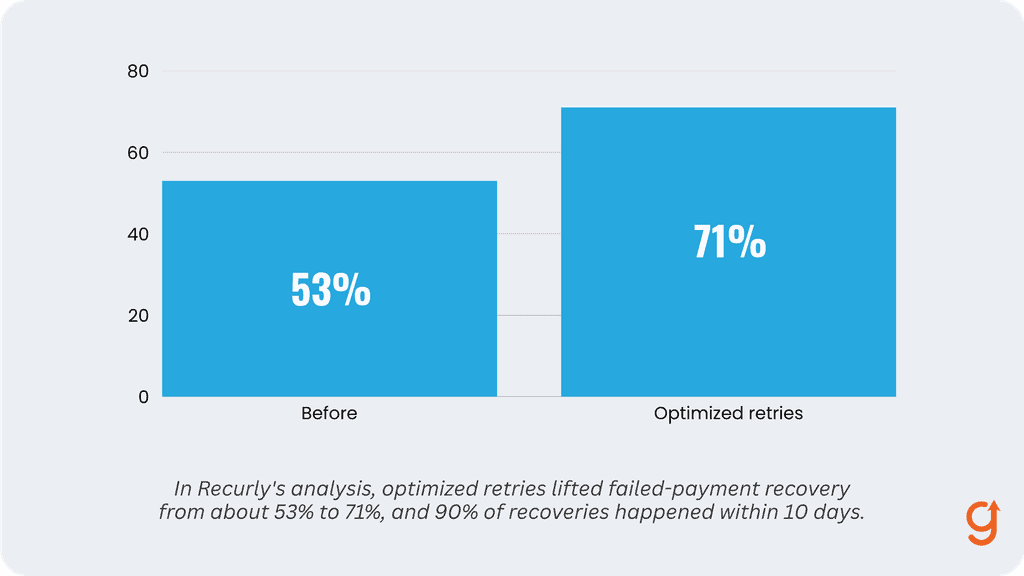
Recurly found that optimized retry strategies improved failed-payment recovery from about 53% to 71%, without replacing existing billing infrastructure. The same analysis found that 90% of recovered transactions happen within 10 days of a failed payment. The retry sequence has a short window to work in.
Finance or billing ops owns this origin. Once retries and card updates are running, automating the follow-up sequence keeps this origin from draining attention away from the other three.
How do you stop churn that the B2B SaaS sale created?
Stopping churn that the sale created means closing the gap between what was promised and what the product actually delivers, before the account ever reaches onboarding. Marketing pages, demos, and proposals all make promises. Each one has to match what a new customer can reach in the first 90 days.
In the diagnostic view this guide uses, onboarding cannot recover a broken promise, so this origin has to be fixed at the point of sale.
Check two causes first. One is a demo built around features instead of outcomes. The other is discovery that skips whether the account fits the product. Either one can produce a signed deal that was never going to renew.
A promise inventory is the paste-ready fix. List every outcome the marketing pages, demo script, and proposal template promise. Then mark which ones the product delivers inside the first 90 days. The rows below are illustrative.
| Promise made | Delivered in 90 days? | Owner |
|---|---|---|
| “Cuts reporting time in half” | Only with a data integration the account has not set up | Sales, with product marketing |
| “Works out of the box” | Requires an admin setup step the buyer was not told about | Sales, with onboarding |
| “Replaces your spreadsheet workflow” | True only for the top usage tier | Sales qualification |
Where the gaps show up, two moves fix the origin. Qualify out accounts that don’t fit the product’s real strengths. Then tie part of sales compensation to retained revenue as well as signed revenue. The head of sales owns this origin and works with marketing on the promises themselves. The promise is written long before the contract is signed.
How fast does a new B2B SaaS customer need a first win?
A new B2B SaaS customer needs a first win as close to signup as possible. Until that win arrives, the customer is still testing whether the purchase was the right call. Treat time to first value as a number someone owns, and measure it in days.
SaaStr’s Jason Lemkin is blunt about the risk. In his Dear SaaStr answer on churn, he warns that a customer who is not onboarded right away is at risk almost at once. That holds especially after the customer has paid.
Watch for it as low login counts and unopened onboarding emails in the first two weeks.
The fix starts with defining the first win in the customer’s own words, then making it measurable and reachable in days. ProductLed’s 2025 research found that time-to-value delivery has a 0.69 correlation with overall company performance. Companies in the top quartile for time-to-value reported 38% higher performance scores than those in the bottom quartile.
Time to first value needs an owner and a tracked number, the same way revenue has one. Head of customer success is the natural owner, since the first win lives inside the product itself. A full onboarding plan built around that first win is the next step once the win itself is defined.
Which signals warn you before a B2B SaaS renewal is lost?
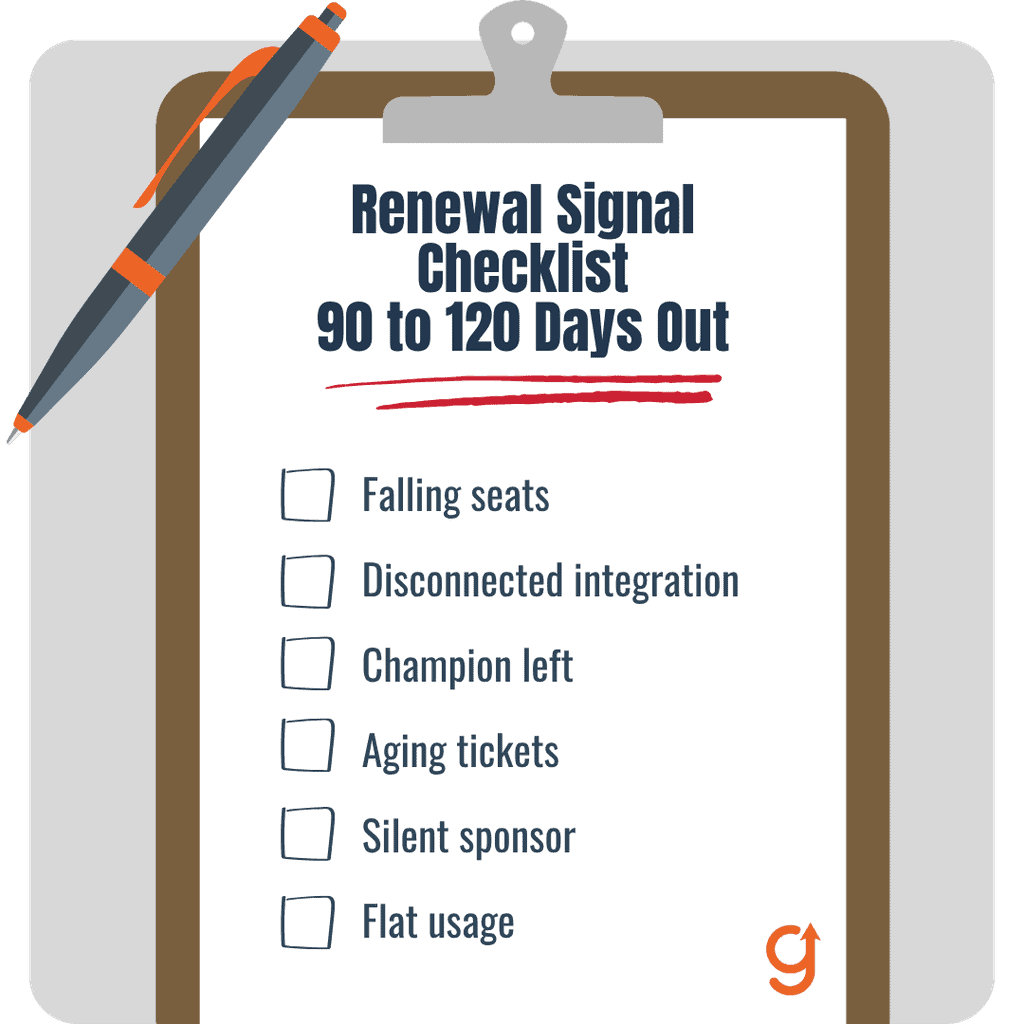
B2B SaaS renewal risk shows up months before the contract date, so start watching 90 to 120 days out. The clearest early signals are falling seats, a disconnected integration, a departed champion, aging tickets, a silent sponsor, and flat core usage. Each signal has an owner and a play, which gives account teams time to act.
A renewal signal checklist beats a single health score. It pairs each signal with its play.
- Seats fall without a headcount change: review usage, which product usage data can confirm.
- A key integration is disconnected or never finished: fix it with the customer’s admin.
- The champion left or changed roles: build a new relationship before renewal talks start.
- Support tickets age without resolution: escalate and close them before the renewal conversation.
- The executive sponsor goes silent: follow up fast, because silence can mean the account has stopped valuing the product.
- Core workflow usage flattens: rerun the first-win plan with the team that uses it.
Regret is a renewal signal too. A 2023 Gartner survey of 1,503 technology buyers found that 60% of buyers involved in renewal or expansion decisions regret nearly every purchase they make. Gartner traces it mainly to the buying team and advises watching for buyers who revisit decisions or clash inside that team.
Champion loss deserves its own alert. UserGems reports that over 20% of professionals change jobs each year. Mark Kosoglow, Chief Revenue Officer at Catalyst Software, put the stakes this way.
Account management owns this origin because fading value is a relationship and usage problem. Running this checklist against every account 90 to 120 days before renewal turns a last-minute save attempt into a planned intervention.
How do you know B2B SaaS churn work is paying off?
To know whether churn work is paying off, track both gross revenue retention and net revenue retention. Break both out by account size and by origin. A falling logo count by itself can hide a growing revenue problem in the accounts that remain.
SaaS Capital’s 2025 benchmarks put median net revenue retention at 102% for companies with $25,000 to $50,000 ACV. The top quartile sits at 111% and the bottom quartile at 97%. Across SaaS Capital’s full survey of companies above $1 million in ARR, median growth was 24%. Companies below 100% NRR grew slower than that median.
Jason Lemkin’s advice matches that data. On SaaStr, he tells leaders to “make it a Top 3 goal for everyone in the company.”
His instruction on ownership is just as direct.
Put someone 100% in charge of it (i.e., your head of customer success).
Jason Lemkin, SaaStr, in Dear SaaStr: How Can I Reduce Our Churn Rate in SaaS?
Segment the number by customer size and put that one owner on it. Then compare it against current benchmarks and check what retained revenue is actually worth over time.
On the same SaaStr page, Lemkin says that once churn is a top goal with one owner, it comes down within about a quarter.
Where should you start reducing B2B SaaS churn this quarter?
Start by tagging your last 20 lost accounts against the four origins this week. Then put the next quarter’s effort on the origin with the largest count. Run that exercise before another round of health-score tuning or a new customer success platform.
Churn is a constraint problem first and a tactics problem second. The origin map above only works if you identify the origin that’s actually capping your retention right now.
Find your growth gap with the free Growth Gap Scan and see whether retention is the real constraint on your growth this quarter.
Frequently Asked Questions
How do you calculate churn rate for B2B SaaS?
SaaS Capital describes revenue churn as 1 minus gross revenue retention, so 95% gross retention equals 5% churn. Logo churn counts lost accounts instead of lost dollars. Track both, because losing a few large accounts can hide behind a healthy logo count.
What is a good churn rate for B2B SaaS?
A good churn rate depends on contract size, so compare yourself with companies at a similar price point. SaaS Capital benchmarks retention by contract size and puts median net revenue retention at 102% for companies at $25,000 to $50,000 ACV. Keeping more than 100% of revenue from existing customers, after churn and expansion, is the practical bar to aim for.
What is the difference between voluntary and involuntary churn?
Involuntary churn is revenue lost because a payment failed, not because the customer chose to leave, as Recurly defines it. Voluntary churn is a customer’s active decision to cancel. In the churn origin map it traces to an oversold promise, a slow first win, or fading value before renewal, and to outside events such as an acquisition or a budget cut. Smart retries and card updates can resolve involuntary churn without contacting the customer.
Can better onboarding fix churn on its own?
Only for one origin. In the churn origin map, onboarding addresses a slow first win. If the account churns because the product does not deliver what the demo or proposal promised, the fix belongs at the point of sale: qualify out poor-fit accounts and tie part of sales compensation to retained revenue.
Why does net revenue retention matter more than logo churn?
A falling logo count can hide a growing revenue problem in the accounts that remain, since it doesn’t show whether retained customers are expanding or shrinking their spend. Net revenue retention captures both. SaaS Capital’s 2025 data shows companies below 100% NRR grew slower than the 24% median growth rate.
How long does it take to reduce churn?
According to SaaStr’s Jason Lemkin, churn comes down within about a quarter once it becomes a top company goal with a single owner. The timing also depends on the origin. Recurly found that 90% of recovered failed payments come back within 10 days of the failure, while fixes to the sales promise or the first win show up as new customer cohorts move through sales and onboarding.