
AI Website Optimization: What Actually Changes Anything

TL;DR: AI website optimization means two different things, and the confusion is expensive. One is using AI tools to do SEO faster. The other is making sure AI systems can reach, read and cite your pages. This is about the second, and the order matters: access, then whether your content is in the HTML you serve, then whether it deserves to be cited.
Key Takeaways
- The phrase covers two unrelated jobs. Most articles sell you the tool version while you were asking the visibility question.
- Access comes first. If an AI crawler cannot reach the page or gets an error, nothing downstream matters.
- Google states plainly that structured data is not required for generative AI search and no special schema markup exists for it. Most AIO advice implies the opposite.
- Major AI crawlers do not execute JavaScript, so a page that looks complete in a browser can arrive nearly empty.
- You control access, rendering, structure, and distinctiveness. You do not control whether a model cites you, and anyone guaranteeing that is selling something that does not exist.
The reason this search returns such a confused mix of results is that the phrase itself is doing two jobs. Sorting that out is most of the value here.
What does AI website optimization actually mean?
It means one of two things, and almost nobody tells you which one they’re talking about.
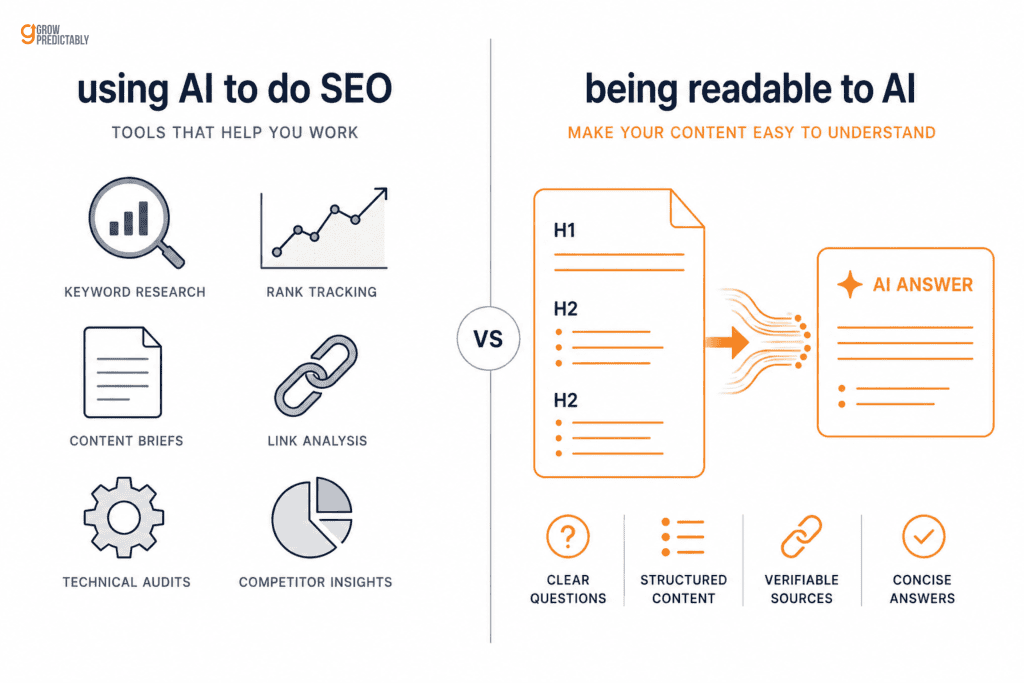
- Using AI tools to do SEO work faster. Generating drafts, clustering keywords, auditing pages at scale. This is a real activity with a crowded market, and it’s not what this article covers.
- Making your site legible to AI search systems. This is the actual subject here: can crawlers reach your pages, can they read what’s on them, and is there anything worth citing once they do?
These two things are unrelated. You can buy every AI SEO tool on the market and still be completely invisible to the systems answering your buyers’ questions, because those tools operate on content you already publish. They don’t touch whether anything can read it in the first place.
Here’s a quick way to tell which one an article is actually selling you: count how fast it reaches a list of tools. If a piece names the ambiguity and then ranks software, it answers the first question. If it starts with crawlers, rendering, and content structure, it’s answering the second.
I’ve structured the rest of this piece around the order that actually gates results:
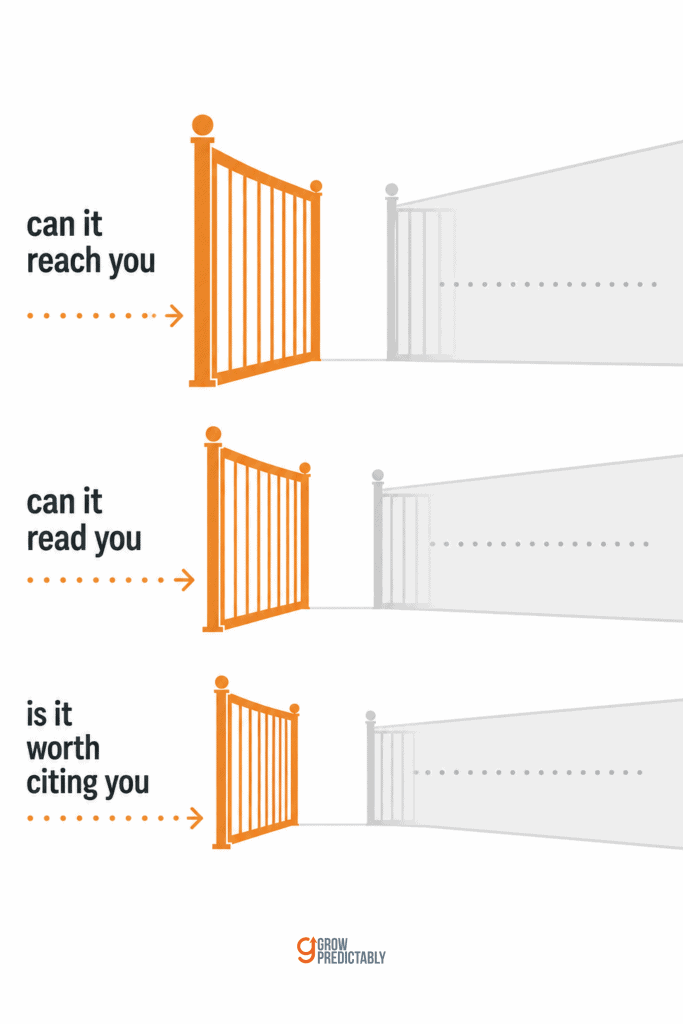
- Can AI systems reach you
- Can they read what you serve
- Is there any reason to cite you
Each step gates the next one. Most advice sold under this heading starts at step three, which is exactly why teams end up buying optimization for pages that nothing can currently read.
Can AI systems reach your site at all?
Access is the gate everything else sits behind, and it’s the least discussed part of this whole subject. Two separate things have to be true: AI crawlers need to be permitted by your robots.txt and whatever sits in front of your origin, and the page has to actually return a successful response when they ask for it.
Google’s own guidance is blunt about the baseline. Its advice on succeeding in AI search says to make sure your pages meet the technical requirements for Search so that it can find, crawl, and index them, including making sure Googlebot is not blocked and the page returns an HTTP 200 success status. That sounds too basic to check. Check it anyway. Firewalls, bot-mitigation rules, and CDN configurations get updated all the time by people who’ve never been asked to think about AI crawlers.
The practical test takes one command: request one of your own pages with a crawler user agent and read what actually comes back, not what your browser assembles for you.
If the response is an error, a challenge page, or a redirect loop, you’ve found your problem, and it’s not a content problem.
A few things worth checking when you run this:
- Test more than the homepage. Access rules are frequently applied unevenly.
- Check each template you care about being cited from, not just one page type. It’s common to find marketing pages reachable while the blog sits behind a rule someone added during a bot-traffic scare and never revisited.
- Pull a representative page from each section, not just the ones you assume are fine.
If you’re in the middle of a rebuild or a replatform, access and rendering failures cluster differently and deserve their own treatment. That’s covered separately in the piece on what actually breaks during a website redesign.
Is your content actually in the HTML you serve?
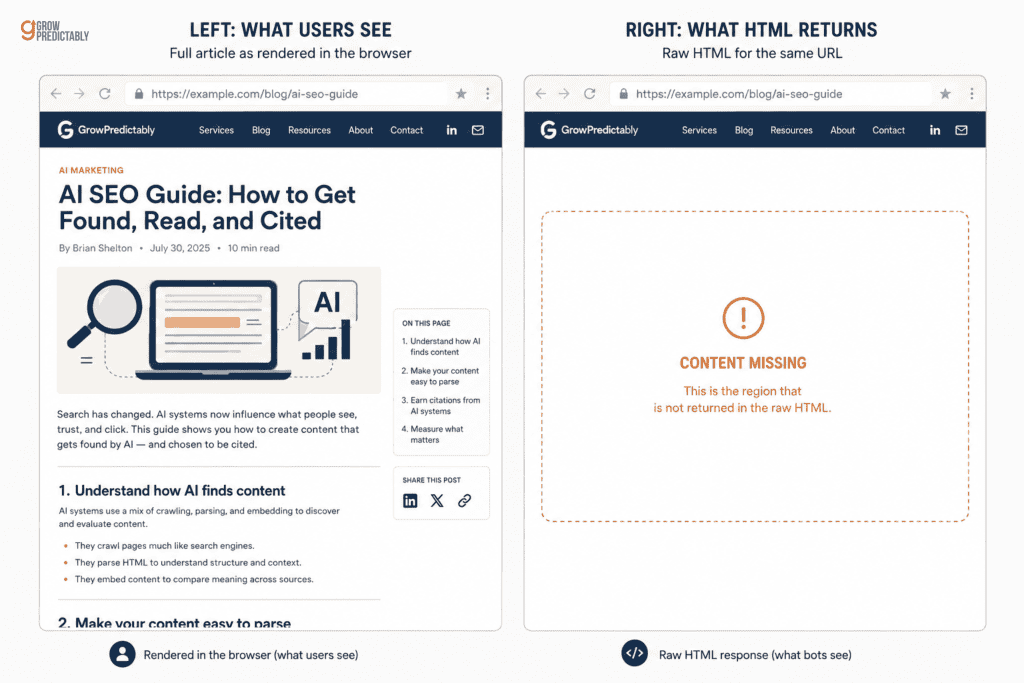
This is the failure that hides best, because everything looks correct in a browser. If your site renders its content client-side, a visitor sees a complete page, while anything that doesn’t execute JavaScript gets something close to an empty shell with a sitewide header.
Research from Vercel and the technical SEO firm Merj, analyzing crawler traffic across their network, found that none of the major AI crawlers currently render JavaScript. That covers OpenAI’s GPTBot, Anthropic’s ClaudeBot, PerplexityBot, Meta, and ByteDance. GPTBot alone generated 569 million requests in a single month.
The study also found that ChatGPT and Claude crawlers do download JavaScript files in 11.50 and 23.84 percent of requests, and simply never execute them.
How likely is this to affect you? HTTP Archive’s 2024 Web Almanac compared rendered and raw word counts across home pages and found a median difference of 13.6 percent on mobile and 17.5 percent on desktop. For most sites, the gap is modest.
For a meaningful minority, particularly single-page applications and heavily componentized builds, the gap is close to everything.
I found this on my own site before I found it in anyone’s research. A single request with a crawler user agent returned only the sitewide head:
- No per-page title
- No canonical
- No h1
- No Article or FAQ structured data
In a browser, the same page looked perfect.
The fix is architectural rather than a setting, which is exactly why it belongs before any AIO engagement rather than after one. Server-side rendering, static generation, and prerendering all solve it. Adding more content to a page that isn’t being served in the first place solves nothing, and it’s the more commonly purchased option because it looks like progress.
Do you need special schema markup for AI search?
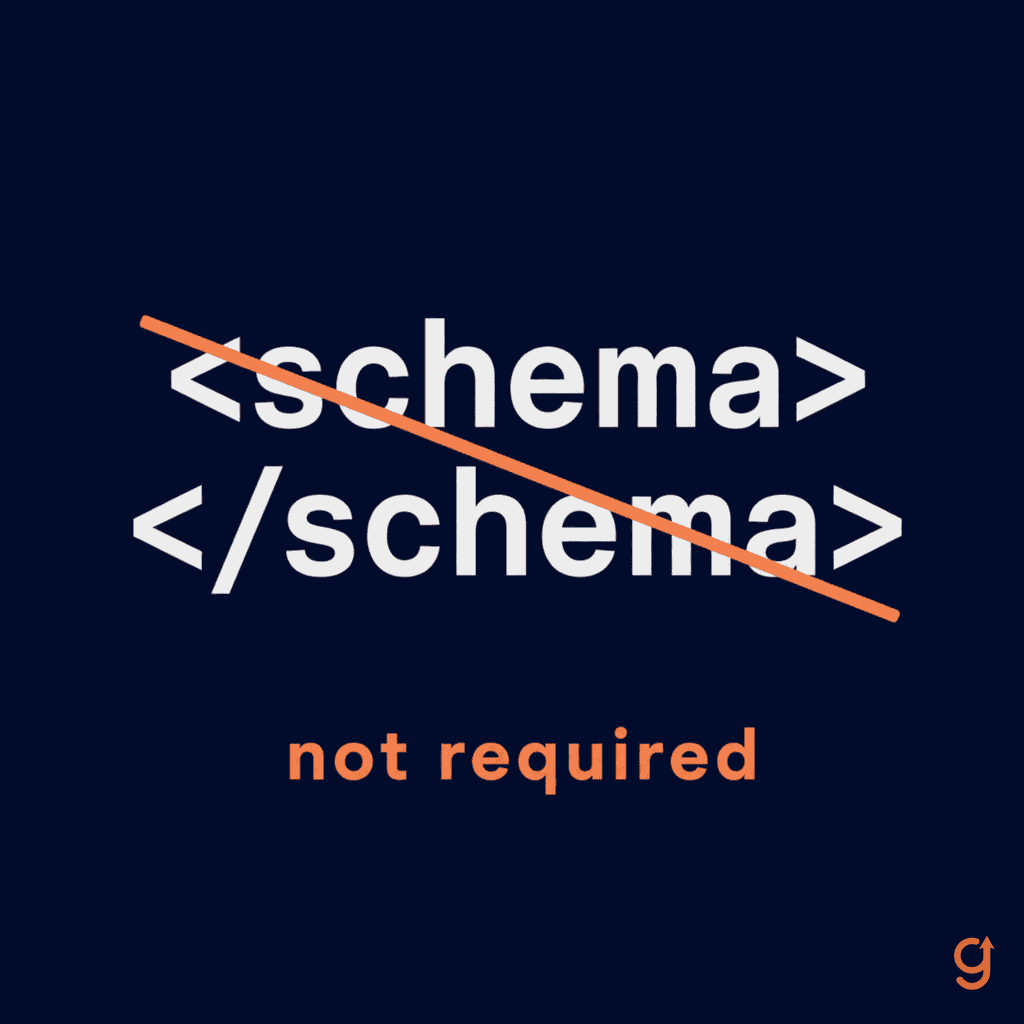
No, and this is the section most likely to save you a quarter of wasted effort. Google’s guidance on optimizing for generative AI search states it directly: structured data is not required for generative AI search, and there is no special schema.org markup you need to add.
That contradicts a lot of what’s currently sold as AI optimization, and the reason the myth persists isn’t mysterious. Schema is legible, packageable, and easy to demonstrate. It produces a deliverable a client can see, a before-and-after a consultant can screenshot, and a scope that fits neatly into a statement of work. Whether it’s the lever that actually matters is a separate question from whether it’s easy to sell.
The honest nuance matters here, so don’t overcorrect:
- Structured data still earns rich results in classic Search.
- It remains worth maintaining as part of ordinary SEO. Google says as much in the same guidance.
- The correction is narrower than “stop using schema.” It’s: stop treating schema as the mechanism by which AI systems decide to cite you, because the people who build those systems say it isn’t.
The real cost of the myth is opportunity cost. A team can spend a quarter implementing markup while the access problem and the rendering problem stay exactly where they were, and then conclude that AI optimization doesn’t work.
If you’re being sold schema as the AI lever, the question worth asking is which specific system consumes it and what evidence exists that it changes citation behavior. The answer usually traces back to classic rich results, which is a real benefit, just under a different heading.
What actually makes a page worth citing?
Once a system can reach your page and read it, the remaining question is whether there’s any reason to quote you rather than summarize three competitors. That’s a content question, and it’s harder than the technical ones because it can’t be delegated to a configuration change.
In practice, citable pages share a shape:
- They answer a specific question in a passage that stands on its own, without needing the surrounding article for context.
- They contain something that a synthesis of the existing top results wouldn’t produce. Usually, that means data you gathered, a decision you made, or a failure you can describe precisely.
- They’re attributable. The claim belongs to someone rather than floating free.
Commodity content is the failure mode, and it’s the most common one. If a model can reconstruct your page from three others, naming you adds nothing for the reader, so it won’t.
Google’s guidance says the same thing in its own terms: creating content people find unique, compelling, and useful will influence your presence in generative AI search more than any other suggestion in the guide.
John Mueller of Google Search Relations puts the underlying continuity plainly:
“Focus on your visitors and provide them with unique, satisfying content. Then you should be well positioned as Google Search evolves.”
John Mueller, Google Search Relations
That’s a less exciting answer than a new optimization discipline, and it’s the one coming from the people who build the systems. First-hand evidence is the hardest thing for a summary to replicate, which is why the experience signals search systems reward matter more here, not less.
What can you not control here?
You control whether AI systems can reach your pages, whether your content exists in the HTML you serve, whether each passage answers something specific, and whether you have anything distinctive to say. That’s a substantial list, and it’s genuinely actionable.
You do not control whether a given model cites you on a given query. Answer surfaces change without notice and without a changelog you can plan against. The same question asked twice can produce different sources, and none of that is something a site owner can configure.
The correct posture follows from that split: remove every reason not to be cited, then accept the remaining variance rather than paying someone to pretend it doesn’t exist. Since Google states that its generative AI features are rooted in its core Search ranking and quality systems, treating AI visibility as a separate discipline with separate levers is usually just a way to sell separate services.
Anyone guaranteeing placement in AI answers is selling something that doesn’t exist. That’s worth saying plainly, because the guarantee is currently a common feature of proposals in this space.
The useful version of the same promise is bounded and checkable. We will make sure:
- AI crawlers can reach every page that matters
- Your content and metadata are present in the served HTML
- Each key page answers a specific question in a passage that stands alone
All three are verifiable on the day the work ships. None of them is a guarantee of citation, and a supplier willing to say so is telling you something about how they work.
How do you measure AI visibility without fooling yourself?
Start from what’s actually reportable rather than from a dashboard someone is selling you. Google’s guidance points site owners to Search Console to measure visibility in generative AI features, and the important structural detail is that this performance is reported within existing Search metrics rather than as a separate stream.
That limits what can be attributed cleanly, and the limitation is worth stating rather than working around. You will generally not get a clean answer to which AI surface sent which visit, and building a reporting narrative that implies otherwise creates a number nobody can defend later.
The honest posture is comparative. Take the pages you deliberately made accessible, well-structured, and distinctive, and watch them against pages you didn’t touch. That’s a slower signal than a dashboard, but it’s one you can actually stand behind in a review.
Avoid the vanity version. That’s asking a chatbot about your category, screenshotting the answer when your name appears, and treating that as a metric. It’s a single non-reproducible sample from a system that will answer differently tomorrow, and the screenshot is only ever taken on the runs where the name appeared.
If you want something closer to a real read, sample deliberately rather than opportunistically:
- Fix a set of questions your buyers actually ask
- Run them on a schedule
- Record every result, including the ones where you’re absent
That’s still directional rather than precise, and it’s honest about being directional. The wider discipline of measuring SEO honestly applies here without modification.
Where should you start?
Work the order, because each step gates the one after it. Confirm AI crawlers reach your pages and get a successful response. Confirm your content and metadata exist in the HTML you serve rather than only after JavaScript runs. Only then invest in being worth citing, which is where the durable advantage sits.
The most common wasted quarter in this space is buying schema and tooling before checking whether anything can read the page at all. That sequence produces a tidy deliverable and no visibility, and it is the pattern this article exists to interrupt.
The reframe worth keeping: most of the work that makes you legible to AI systems is the work that made you legible to search engines, done properly rather than done again under a new name. Where it differs, it differs on access and rendering, which are engineering problems with clear tests. If you are not sure which constraint is actually limiting your growth, find the growth gap first.
Frequently Asked Questions
Is AI website optimization different from SEO?
Mostly, it is the same work done properly. Google states that its generative AI features are rooted in core Search ranking and quality systems, so the fundamentals carry across. Where it genuinely differs is access and rendering: AI crawlers do not execute JavaScript, so a site that Google eventually renders may be invisible to them entirely.
Do I need schema markup to appear in AI Overviews?
No. Google’s guidance states directly that structured data is not required for generative AI search and that no special schema.org markup exists for it. Keep structured data for classic rich results, where it does earn eligibility, but do not buy it as the mechanism that gets you cited in AI answers.
Can ChatGPT and Claude read a JavaScript site?
They can fetch it, and they will not execute it. Research from Vercel and Merj found no major AI crawler renders JavaScript, and that ChatGPT and Claude download JavaScript files in a minority of requests without running them. If your content only exists after JavaScript runs, those systems see an almost empty page.
Should I block AI crawlers?
That is a strategic choice rather than a technical one, and it should be made deliberately rather than inherited from a default. Blocking protects content from training use and also removes you from the systems your buyers increasingly ask. Whatever you decide, verify what your robot’s rules and bot mitigation actually do rather than assuming.
How do I check what an AI crawler sees on my site?
Request your own page with a crawler user agent and read the raw response rather than the rendered page in a browser. Check the status code first, then look for your title, canonical, headings, and body copy in that response. Test one page per template, not just the homepage, because access rules are often applied unevenly.
Can anyone guarantee placement in AI answers?
No. You control access, rendering, structure, and whether the page says anything distinctive. You do not control whether a model cites you on a given query, and answers vary between runs. A supplier who commits to verifiable technical outcomes is credible. One who guarantees citation is not.