AI Outbound Calling: Does It Fix Your SDR Bottleneck?

TL;DR: AI outbound calling fixes a dial-volume ceiling, thin after-hours coverage, or inconsistent qualification. It does nothing for bad targeting, weak messaging, or a broken handoff to your closers, and it scales those problems faster and more expensively. Run one three-question test before you evaluate any vendor, not after.
Key Takeaways
- AI outbound calling fixes capacity and consistency problems. It does not fix a targeting, messaging, or complex-deal-closing problem, and buying it for the wrong reason scales the real problem faster.
- Only 1% of B2B sales teams had deployed AI SDRs as a distinct category in 2025, and only 60% of SDRs hit quota that year, the lowest figure on record. This is an early, selective tool, not the default everyone else has already adopted.
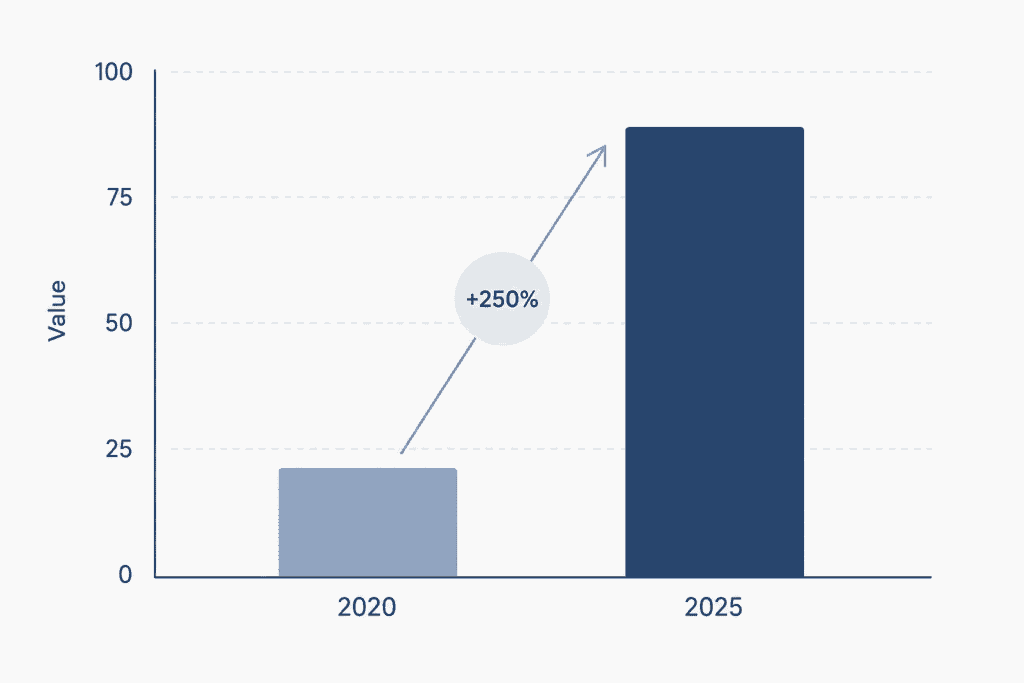
- The fully-loaded cost per SDR meeting rose 270%, from $143 in 2020 to $529 in 2025, which is the real economic pressure pushing teams toward automation in the first place.
- AI-generated voices are governed by the same TCPA rules as any robocall since the FCC’s February 2024 ruling: prior consent, AI-voice disclosure, and a working opt-out.
- Buyers still want a human at key moments. Gartner’s survey of 645 B2B buyers found they were 28 percentage points more likely to say a sales rep, not GenAI, helped them advance to the next purchase step.
You watch the activity dashboard, and the numbers look fine. Dials are up, connect rates are steady, and your SDRs are hitting the calls-per-day target you set for them. The pipeline is flat anyway.
If you lead sales or RevOps at a B2B SaaS company, you have stared at this exact contradiction and wondered whether the fix is a better tool, a better team, or something upstream of both.
AI outbound calling shows up in that search with a lot of vendor noise behind it and very little honest diagnosis in front of it.
The question worth answering before you evaluate a single platform is not “Does AI outbound calling work?” It is “Does it fix the specific thing that’s actually broken on my team?”
What is AI outbound calling?
AI outbound calling is software that places outgoing phone calls and carries out a goal-directed conversation without a human dialing or talking. It qualifies a lead, books the meeting, and logs the outcome to your CRM on its own, using natural-language conversation instead of a fixed decision tree.
That’s a different animal from a basic auto-dialer, which only:
- Connects the call and plays a fixed script, or
- Hands the prospect to a rep the moment someone picks up
An AI outbound caller works through the same rough sequence a decent SDR would follow. It:
- Opens with a line that’s scripted but flexible
- Listens for the prospect’s actual response, not a keyword match
- Adapts its follow-up question to what it just heard
- Hands off to a booking flow or a human the moment the conversation earns it
The sophistication sits in the listening and adapting, not the talking.
Despite the volume of vendor content on this topic, adoption is still early.
The Bridge Group’s 2025 SDR benchmark study, surveying 351 B2B companies, found that only 1% of respondents had deployed an AI SDR as a distinct category, the first year the metric appeared as an option at all. That number will likely move fast in a category this new, but based on the most recent benchmark data available, if you feel like you’re evaluating something newer and less proven than the marketing suggests, that instinct is correct.
Why does outbound calling stall even with a good team?
The symptom is specific: reps hit their dial and activity targets, but qualified meetings and pipeline stay flat or slide.
The Bridge Group’s same 2025 study found only 60% of SDRs hit quota, the lowest figure in the study’s history, even as pipeline generated per SDR rose.
Activity isn’t the constraint. Something upstream of the activity is.
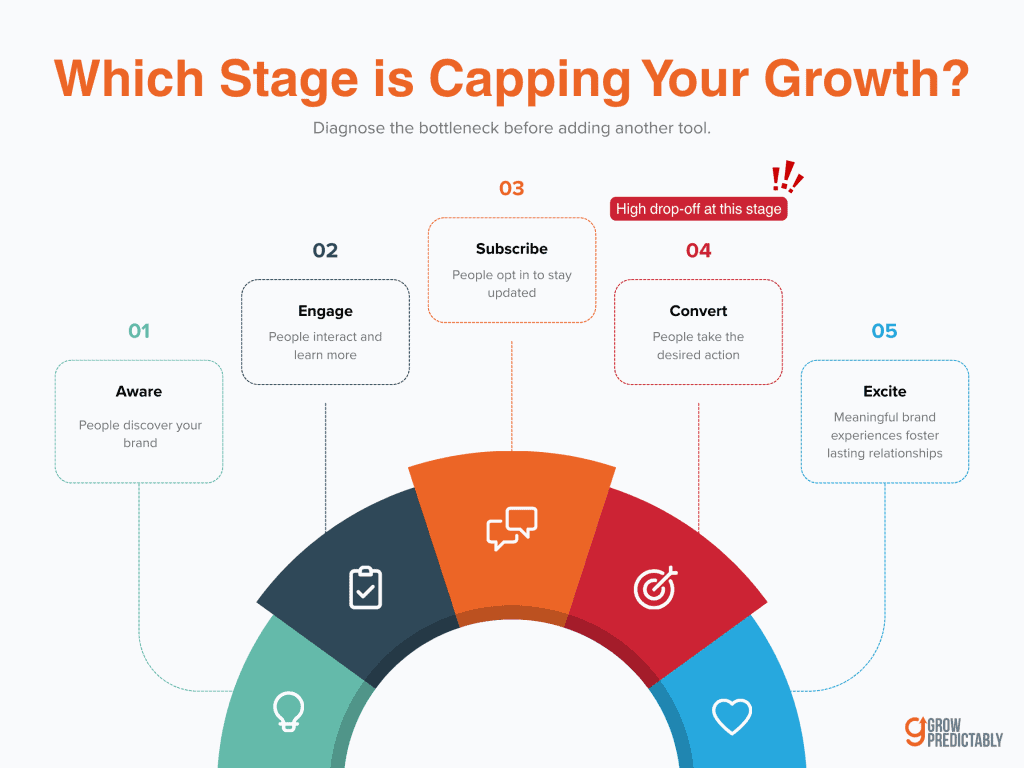
This is the exact question my Growth Gap Marketing framework is built to answer: diagnose before you treat. The process runs in order:
- Read the customer journey and the actual metrics
- Find the one stage currently capping growth
- Apply a tool only at that stage, once you know where it belongs
Most teams skip straight to the tool because the tool is the visible, well-marketed option, and the diagnosis takes actual work.
The anti-pattern is buying before naming the constraint. If the real cap on growth is bad targeting, weak messaging, or a broken handoff from SDR to AE, adding a faster or more consistent way to make calls doesn’t relieve that cap. It just runs more prospects through the same broken step, faster and at a higher cost.
Here’s what that failure usually looks like in practice. A team sees a flat pipeline, assumes the constraint is dial volume because that’s the visible, measurable number on the dashboard, and buys an AI outbound calling platform to fix it.
Activity climbs. Connect rates hold steady. The pipeline still doesn’t move because the actual leak was in the qualification conversation itself, where reps were passing leads to AEs who didn’t match the ICP the messaging was written for.
The recovery move isn’t undoing the AI purchase. It’s reading the customer journey and the actual conversion metrics stage by stage, the way the diagnosis should have run before any tool got bought, then fixing the qualification criteria the AI is now enforcing faster than a human ever did.
Which SDR bottleneck does AI outbound calling actually fix?
AI outbound calling genuinely fixes three constraints:
- A hard ceiling on how many calls a human team can physically make in a day
- Missing after-hours and time-zone coverage that a human shift schedule can’t reach
- Inconsistent qualification quality across a team, where individual reps vary in how well they screen a lead
These are capacity and consistency problems, not strategy problems, and the economics explain why teams reach for a fix here first.
Ken Lundin, Founder and CEO of RevHeat, found that the fully-loaded cost per SDR meeting rose from $143 in 2020 to $529 in 2025, a 270% increase, based on benchmarking data from 2.5 million sellers across 33,000 companies.
When the cost of a human dial is climbing that fast, a volume-constrained team feels real pressure to automate the dial itself. That pressure is legitimate, and it’s exactly the kind of number a sales motion should be tracking in the first place. It’s also only the right fix if dial volume, not something upstream of it, is the actual constraint.
Inconsistent qualification is the least visible of the three and often the most expensive. Two reps working the same list can pass wildly different lead quality to your AEs. One screens hard against a specific ICP criterion, another passes anything that answers the phone, and the dashboard shows the same “meetings booked” number for both.
An AI outbound caller enforces one qualification standard on every call, every time, which is a real fix for that specific inconsistency, even before you touch dial volume at all.
When does AI outbound calling make the problem worse?
It backfires in two specific situations. First, when the real constraint is bad targeting or weak messaging. Automating a call script that already doesn’t land just runs more prospects through the same failure, faster and at greater cost. The activity dashboard will look busier while the pipeline gets worse, not better.
Second, in complex, multi-stakeholder, high-ACV deals, where a prospect’s objections require judgment and trust-building, an automated conversation can’t yet replicate.
The buyer-side data backs up that second point directly. A Gartner survey of 645 B2B buyers, conducted August through September 2025, found they were 28 percentage points more likely to say a human sales rep, not GenAI, helped them advance to the next step in the purchase process.
Robert Blaisdell, VP Analyst and Chief of Research in Gartner’s sales practice, put it this way:
“B2B buyers are more comfortable using digital channels and GenAI to navigate the purchase process on their own, but that does not eliminate the role of the seller.”
Robert Blaisdell, VP Analyst, Chief of Research, Gartner Sales Practice
The tempting anti-pattern is treating AI outbound calling as a replacement for the whole sales motion instead of a volume tool for the top of it.
A team that scales its AI caller into the middle and late stages of a complex deal, past the point of initial qualification, is scaling the exact gap Gartner’s data describes: more automated touches, less of the human validation buyers say they still need to move forward.
Is AI outbound calling legal?
Yes, it’s governed by the same rules as any robocall. The FCC issued a Declaratory Ruling on February 8, 2024, confirming that AI-generated voices fall within the TCPA’s existing prohibition on “artificial or prerecorded voice” calls. That means an AI outbound caller needs, exactly like a traditional robocall:
- Prior express consent from the person it calls
- A clear disclosure that the voice is AI-generated
- A working opt-out mechanism
The consent rules also tightened on the prospect’s side of the call.
As of April 11, 2025, a prospect can revoke consent using any reasonable manner that clearly expresses that they don’t want further calls, including saying stop, quit, cancel, or unsubscribe on the call itself. The caller must process that request within a reasonable time, not to exceed 10 business days.
An AI outbound calling platform needs to detect and log that revocation on the call where it happens, not rely on the prospect to submit a separate opt-out form afterward.
The penalty exposure isn’t abstract. TCPA violations carry statutory damages of $500 per call, rising to $1,500 for a willful or knowing violation, with no cap on total exposure.
A platform or vendor that treats compliance as an afterthought is exposing your company to per-call liability, not a one-time fine, and at outbound-calling volume, a compliance gap compounds fast.
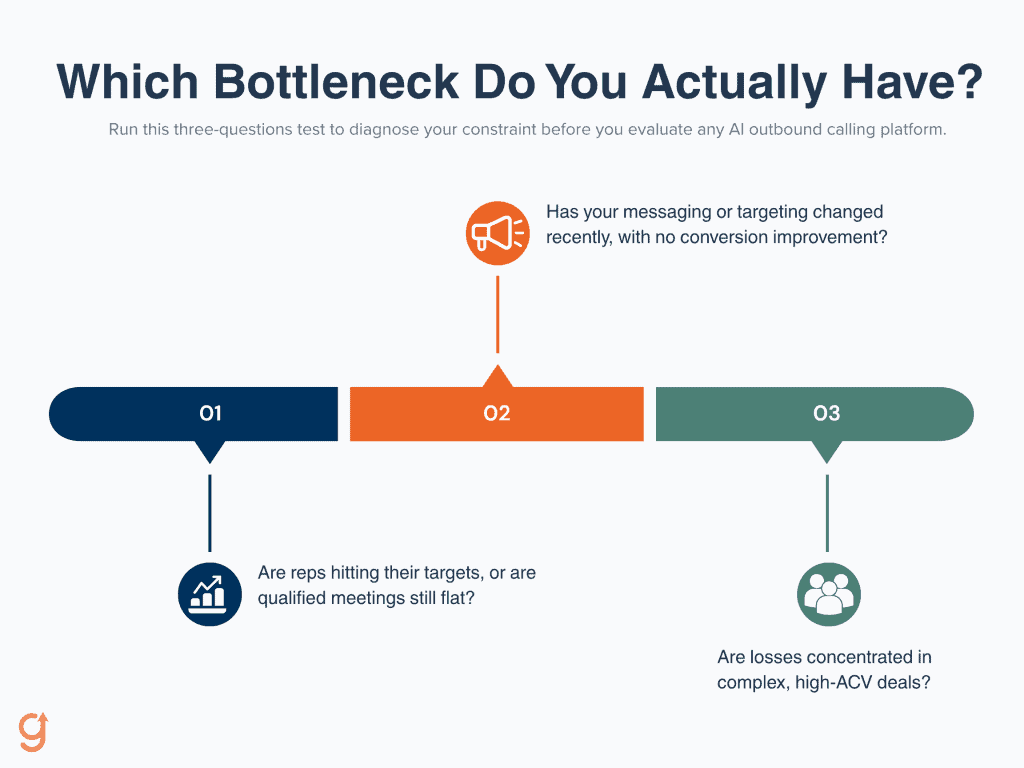
How do you tell which bottleneck you actually have?
Run this three-question test before you evaluate a single vendor: check whether your problem is volume, targeting, or complex-deal closing, because AI outbound calling only fixes the first one, and buying it for the wrong reason makes the other two worse, not better.
- Are your reps hitting their dial and activity targets, but qualified meetings are still flat or declining? That points to a volume or consistency constraint, the kind AI outbound calling is built to fix.
- Has your messaging or targeting changed recently, or has conversion been sliding for months regardless of how many calls get made? That points to a targeting or messaging constraint, and AI outbound calling will not fix it. It will scale it.
- Are your losses concentrated in complex, multi-stakeholder, high-ACV deals rather than early-stage qualification? That points to a human-closer constraint. AI outbound calling can help fill the top of your funnel, but it will not close these deals for you.
Most teams have a mix of all three, which is fine. The point of the test is not to find a single pure answer. It is naming which one is dominant right now, so the fix you buy actually targets it.
A team whose losses are 70% concentrated in complex enterprise deals and only 30% in raw volume gets a very different recommendation than a team with the ratio reversed, even though both teams might describe their problem the same way on a sales call with a vendor.
The test only works if you answer it honestly before you start evaluating platforms, not after you have already picked one and are looking for a reason it will work.
How should a B2B SaaS team roll out AI outbound calling once it fits?
The teams getting real results converge on the same hybrid model: AI handles the top of the funnel (dialing, initial qualification, meeting booking), and a human closer takes over once a prospect is warm and qualified.
This is the same discipline behind automating the parts of a sales process that happen before the call: automate the volume work, protect the human judgment work. Don’t attempt to automate the whole motion end-to-end on day one.
Build compliance in before the first call goes out, not after. That means:
- Capturing consent explicitly
- Scripting the AI-voice disclosure into the opening of every call
- Building opt-out handling so a request to stop is honored, not queued for later
Then track the right metrics for the first 60 to 90 days:
- Cost per qualified meeting against your current human-SDR baseline
- Whether quota attainment actually moves
- Whether call quality holds steady or decays
In practice, teams that treat this as “set it up once and leave it” tend to see script and compliance drift within that same window. A weekly review of a sample of calls is what keeps the tool doing the job you deployed it for.
That weekly review isn’t a formality. Pull a random sample of the week’s calls and listen for three things: where the AI’s qualification questions drifted from what you actually want screened, where the compliance disclosure got clipped or skipped, and where a prospect’s response should have triggered a human handoff but didn’t.
Fix what the sample surfaces before the next week’s calls go out, the same way you’d coach a new SDR in their first month rather than assuming week-one training holds forever.
Ready to find your team’s actual pipeline constraint?
Before you evaluate a single AI outbound calling vendor, name the constraint you are actually solving for.
If it is capacity or consistency, this is the right category of fix. If it is a targeting, messaging, or closing problem in complex deals, no amount of automated dialing fixes it, and the constraint is somewhere else in your demand-generation system, not at the dial.
Take the Growth Gap Scan and find the actual bottleneck before you spend a quarter and a budget line on the wrong fix.
Frequently Asked Questions
What voice AI works best for outbound sales calls?
The strongest platforms use conversational AI that adapts to what a prospect actually says, not a fixed decision tree or basic auto-dialer with pre-recorded prompts. Look for real-time speech understanding, CRM logging, and clean handoff to a human once a lead is qualified, rather than any single named product, since this category is still early and shifting fast.
Can AI make phone calls for me without a human on the line at all?
Yes, for qualification, appointment setting, and early-stage outreach, an AI outbound caller can run the entire call without a human present. For complex, multi-stakeholder, or high-value deals, buyers still respond better to a human at key moments, so most effective setups hand off to a person once a lead is warm rather than automating the whole motion end to end.
How much does AI outbound calling cost compared to hiring an SDR?
A fully-loaded human SDR now costs roughly $529 per qualified meeting on average, up 270% from $143 in 2020, according to RevHeat’s benchmark research. AI outbound calling platforms typically price per minute or per call rather than per meeting, so the real comparison depends on your qualification rate, not the sticker price of either option alone.
Does AI outbound calling replace SDRs entirely?
No. It replaces the repetitive, high-volume dialing and initial qualification work, which is where most of an SDR’s day already goes. It does not replace the judgment, objection handling, and trust-building a human still provides in complex or high-ACV deals, which is why the teams seeing real results run a hybrid model instead of a full replacement.
What happens if a prospect asks an AI caller to stop calling?
The caller must honor that request. Since April 2025, a prospect can revoke consent in any reasonable manner, including saying stop, quit, cancel, or unsubscribe during the call itself, and the business must process that revocation within a reasonable time, capped at 10 business days. An AI outbound calling platform needs to detect and log that request on the call, not rely on a separate opt-out form.
Is AI outbound calling only for enterprise companies, or does it work for smaller B2B SaaS teams?
It works for smaller teams too, often more noticeably, since a single SDR’s dial-volume ceiling or after-hours coverage gap is proportionally a bigger constraint on a small team than a large one. The decision still comes down to which bottleneck you actually have, not company size. A five-person sales team with a genuine volume constraint benefits the same way a fifty-person team does.