

B2B SaaS Founder Burnout: When You Are the Constraint

By Brian Shelton — Founder of GrowPredictably.com
TL;DR: In a B2B SaaS company, founder capacity becomes the binding constraint when work can only move as fast as one person clears it. You can diagnose that without guessing: list the recurring items that cannot finish without you, measure how long each one waits, write one rule about what leaves your desk, and give every founder-held decision a named backup.
Key Takeaways
- A constraint is whatever sets the pace of the whole system. When finished work waits on one person, that person is the constraint, and the tell is work sitting still in a queue with a name on it rather than how busy the B2B SaaS founder feels.
- Approval latency is measurable. The real cost is the idle time of everything downstream, not the founder’s own hours.
- A delegation threshold is a condition decided before the next request arrives, not a judgment made request by request.
- Single-founder dependency is a continuity risk with an operational fix: a named backup and a stated decision limit for every founder-held queue.
- This is an operating problem with operating fixes, and it is separate from anyone’s health.
What does it mean to say the B2B SaaS founder is the constraint?
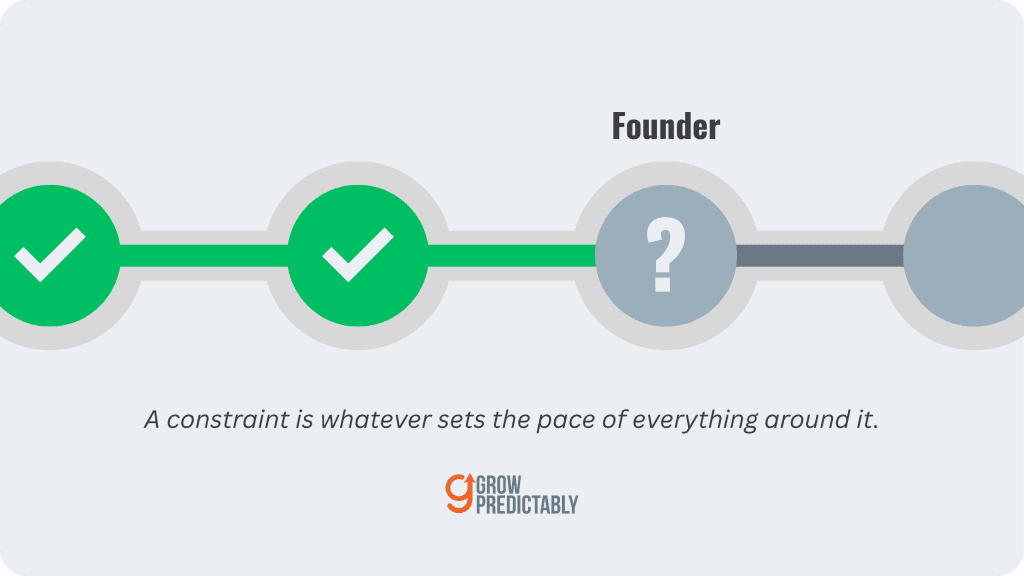
A constraint is the one stage that sets the pace of everything around it. Improve any other stage and the system does not move. Improve the constraint and the whole thing moves. Applied to a business, that idea locates the one stage currently capping growth inside a funnel or a delivery process. It applies just as cleanly to a person.
A B2B SaaS founder becomes the constraint when a meaningful share of recurring work has no completion path that does not route through them. Pricing exceptions, final copy review, hiring calls, contract sign-off, the introduction only they can make. None of it is unreasonable on its own. Together it means output is capped at whatever one person can clear in a week.
Exhaustion is the first place to look and the least reliable signal available, because it moves for reasons that have nothing to do with how work is routed. A tired founder may be running a company that flows fine, and a calm one may be sitting on a queue that stalled nine days ago.
The signal you can actually check is simpler: finished work that is not released, waiting on one name.
The scope of this article
This article is about operating conditions and business continuity. It does not diagnose, treat, prevent or predict any health condition, and it makes no claim about anyone’s wellbeing. Burnout is one search that leads here, which is why you may have arrived on this page, but everything below is about how work is routed.
If you have health concerns, those belong with a qualified professional, not with a marketing article.
How do you find the queues that only you can clear?
Start with an inventory, because you cannot set a rule for a queue you have not named. For five working days, write down every recurring item that reached you and could not have completed without you, together with what it held up and how long it waited. Five days shows the shape without becoming a project of its own.
Build the queue inventory
Four columns is enough:
- The item. What actually arrived, in the words the person used.
- Who raised it. A name, not a department.
- What stops while it waits. The specific downstream work that cannot proceed.
- When it arrived and when you released it.
That last column is the one that turns a feeling into a measurement, so record both ends. Without them the inventory can only tell you what you already suspected.
Read what the inventory tells you
After five days, sort by frequency, and look at what dominates the top of the list. The question worth asking of each frequent item is whether it needed judgment or only needed you. Approving an expense that is inside a budget you already set.
Confirming copy that matches a brief you already approved. Signing off a discount at a level you have never once refused.
Dave Kerpen, CEO of Kerpen Ventures, put the pattern plainly:
“Every founder I’ve seen struggle with scaling has the same problem underneath everything else: They’re still operating like they need to be in every decision, every conversation, every relationship, and every email.”
- Dave Kerpen, CEO of Kerpen Ventures, writing in Inc.
Routine items are the ones a threshold can remove. Judgment items are the ones worth protecting. Sorting one from the other is the entire point of the exercise.
What is approval latency actually costing you?
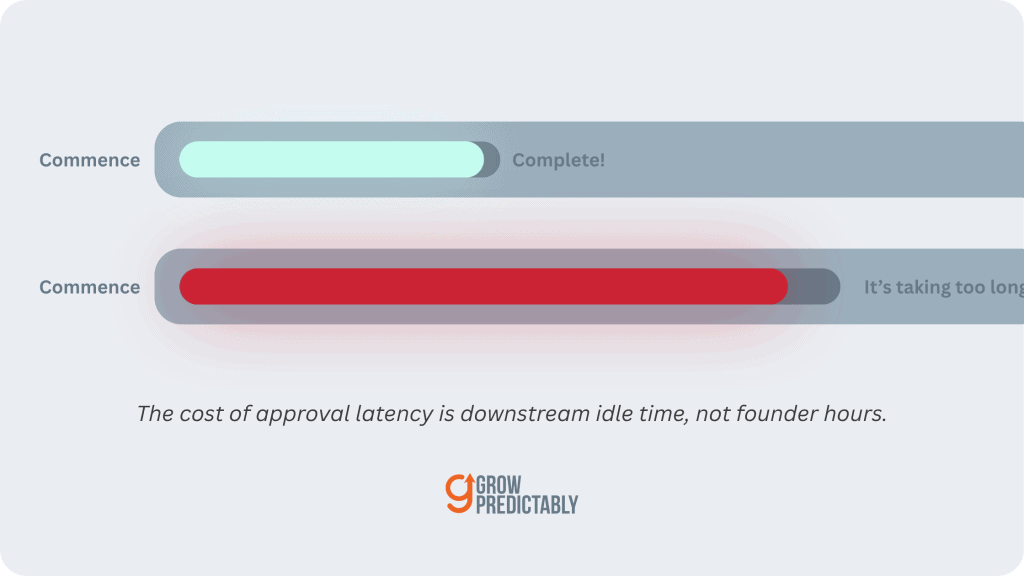
Approval latency is the elapsed time between work being ready and work being released. It is a number rather than an impression, and it applies to every queue in your inventory. If it does not appear on a B2B SaaS reporting line anywhere in your business, it can run for months without anyone naming it as the reason things feel slow.
Measure it on the queues you already inventoried, across the same five days, so the two records line up. Use the median rather than the average. One item that sat for three weeks while you were traveling will drag an average somewhere useless, while the median gives you the middle wait and is far less sensitive to that one outlier.
The cost is easy to state wrongly. It is not the time you spend approving things, which for a routine item is a short task. It is the idle time of everything downstream: the writer who moved to a lower-value task, the campaign that missed its window, the customer who got a slower answer than a competitor gave them.
Latency compounds because every step after the wait inherits it.
There is a wider version of this that shows up well above startup scale. McKinsey reports that executives spend almost 40 percent of their time making decisions, and 60 percent say that time is poorly used. Read that next to your own inventory.
If most of your queue is routine and most of your decision time feels wasted, those are the same finding seen from two directions.
When should work leave your desk, and what is the threshold?
A delegation threshold is a written rule, decided in advance, about what leaves your desk without you. Decided in advance is the load-bearing part. A judgment made fresh on every request is not a threshold, it is just the queue with extra steps.
Thresholds work best stated as conditions rather than as categories:
- Spend below a stated figure goes ahead without sign-off.
- Customers below a stated tier are handled without escalation.
- Anything reversible inside a week proceeds, and you hear about it afterward.
The point of writing them as conditions is that a condition can be checked by someone else, whereas a category still needs your interpretation. Reversibility is the most useful axis of the three. A decision you can undo in a week is cheap to get wrong and expensive to delay. A decision that is hard to reverse deserves your attention and probably should not be delegated yet.
Gallup’s work on this is worth reading precisely rather than loosely. Studying 143 Inc. 500 CEOs, Gallup found that those with high Delegator talent posted an average three-year growth rate of 1,751 percent, 112 percentage points above CEOs with limited or low Delegator talent, and generated 33 percent greater revenue in 2013, 8 million dollars against 6 million.
Two cautions on that figure. It measured a talent, not a technique, and the population was CEOs of some of the fastest-growing private companies in America, so it does not transfer neatly onto every founder.
The more useful number from the same research is quieter. Across 1,446 employer entrepreneurs studied in 2014, 75 percent had limited-to-low Delegator talent. If delegating badly feels like a personal failing, it is worth knowing that it described three quarters of that sample.
Set the threshold before the next request arrives
Write it down in one sentence and tell the people it affects. An intention that lives only in your head cannot be followed by anyone else, which means it is not a control. It is a preference.
What happens to the company when you are unavailable?
Take the inventory and ask a blunt question of every row: if you were unreachable for two weeks, what would stop? Set aside the rows that would merely be uncomfortable or would need catching up afterward. You are looking for the rows that come to a halt and stay there until you are back at your desk to release them.
Nothing about that question is dramatic. Unavailability can be planned or unplanned, and either kind is a live test of the same thing. Single-founder dependency is a description of how the work is arranged, not a judgment about the founder.
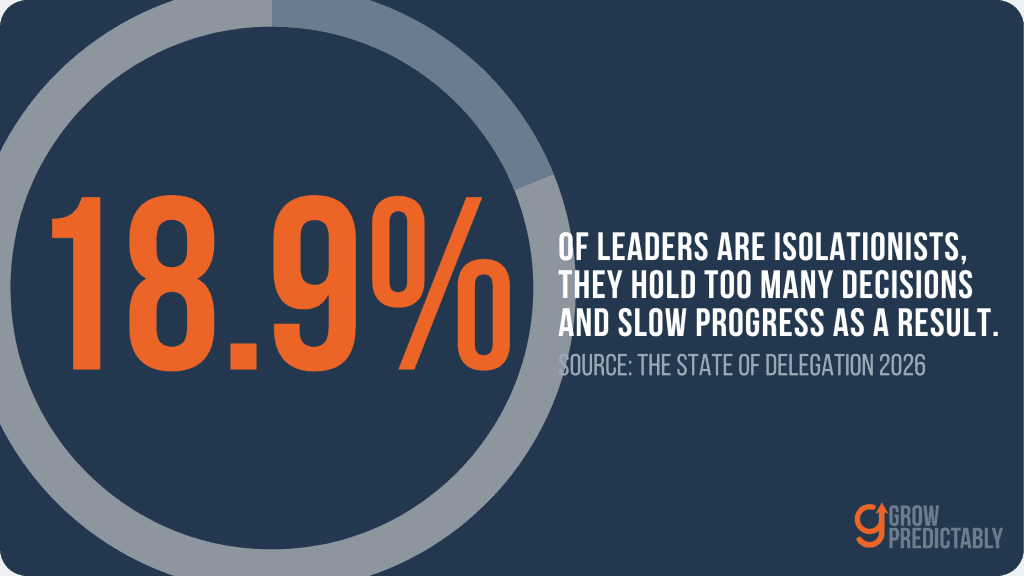
It is also a recognized pattern rather than a personal quirk. The State of Delegation 2026 report from Delegate Solutions and Verve sorts leaders into delegation profiles and finds 18.9 percent are what it calls Isolationists, who hold too many decisions and slow progress as a result.
A further 20.6 percent delegate and then step back in. Between them, that is roughly two in five leaders whose decisions do not durably leave their own desk.
Name a backup for every founder-held decision
Whatever stops is where the dependency lives, and each of those rows needs the same two things attached to it. Coverage means two things together, and one without the other is theater.
- A named person. Not a team, not “ops.” One name per queue.
- A stated limit. What that person may decide alone, and the line where they wait for you.
The test of coverage is whether the backup has ever actually decided anything. A named deputy who has spent six months forwarding items to you has not been delegated to. They have been given a title.
A cheap way to find out is to grade each row of the inventory before you need the answer. Green means someone else already decides it today. Amber means someone could decide it, but never has. Red means it genuinely stops. Amber is the interesting column, because a row can sit there for a year while the org chart says it is covered.
The fix for an amber row is not a document, it is letting that person make the next three of those decisions while you are still reachable, so the first live test is not also the first attempt.
Which operating controls actually reduce founder load?
Once you know which queues exist and what may leave your desk, the remaining question is what keeps the arrangement stable. Controls here are practices rather than software. No tool fixes a routing problem. If the routing is unchanged, a new tool becomes one more place work waits for you.
- Batch each queue instead of handling items as they arrive. A predictable daily window beats a random scatter of instant replies, because a known wait can be planned around and an unpredictable one cannot.
- Publish the criteria you already use. If you can say out loud why you approved the last three and refused the one before them, that reasoning can be written down. Once it is, the team can predict your answer, which removes the request entirely rather than speeding it up.
- Give every recurring queue an owner who is not you, with the threshold attached to it. An owner without a threshold inherits your bottleneck rather than removing it, because they still have to come back and ask where the line sits.
- Review the inventory monthly. Check each month for queues that formed since the last review, particularly around anything that changed: a new pricing tier, a new hire, a new market. Treat a new queue as expected output of a change rather than evidence the control failed, which is why the review is recurring rather than one-off.
Controls that hold on a bad week
The honest test of any control is what happens on a bad week. A rule that only works when things are calm is an intention wearing a rule’s clothes. When a customer escalates, a release slips and two people are out sick, does the threshold still hold, or does everything route back to you?
If it routes back, the control was never real, and the queue you thought you had removed is still yours.
Where should you start this week?
One action, and nothing else changes yet: build the queue inventory for five working days. Log every recurring item that could not finish without you, what it held up, and both timestamps. Change no process, hire nobody, and buy nothing until you have the list, because the list is what tells you whether any of that is warranted.
That is deliberately the smallest possible first move. You do not need a decision, a hire, or a new system to do it. You need a week of honest records. At the end of it you will know whether your capacity is genuinely the binding constraint or whether it sits somewhere else in the business, which is a question worth answering before you spend anything trying to fix it.
If the inventory says the constraint is elsewhere, that is a good outcome and a cheap way to find out. If it says the constraint is you, you now have the list, the wait times, and the two moves that change them.
Frequently Asked Questions
How do I know if I am the constraint in my own company?
Look for finished work that is not released. For five working days, log every recurring item that reached you and could not complete without you, recording when it arrived and when you released it. If the list is long and mostly routine rather than judgment work, and the waits run into days, your capacity is setting the pace of the business.
What is a delegation threshold?
A delegation threshold is a written rule, decided before the next request arrives, about what leaves your desk without you. It works best stated as a condition rather than a category: spend below a stated figure, customers below a stated tier, or anything reversible inside a week. A judgment made fresh on every request is not a threshold.
How do I measure approval latency?
Approval latency is the elapsed time between work being ready and work being released. Record both timestamps for every item in your queue inventory across the same five days, then take the median rather than the average, because a single very long wait distorts the mean and the median gives you the middle wait. The cost to count is the downstream idle time, not the minutes you spend approving.
What is single-founder dependency?
Single-founder dependency is the condition where specific recurring decisions stop entirely if the founder is unreachable. It is a continuity risk rather than a character flaw, and it surfaces on ordinary weeks such as travel or a fundraise. The operational fix is a named backup for each founder-held queue with a stated limit on what they may decide alone.
Does delegating more actually change business outcomes?
Gallup studied 143 Inc. 500 CEOs and found those with high Delegator talent generated 33 percent greater revenue in 2013, 8 million dollars against 6 million, alongside markedly higher three-year growth. Read it carefully: Gallup measured a talent rather than a technique, and the population was CEOs of some of America’s fastest-growing private companies, so it does not transfer neatly onto every founder.
What should I delegate first?
Start with the reversible and the routine. A decision you can undo within a week is cheap to get wrong and expensive to delay, which makes it the safest thing to hand over first. Protect the decisions that are hard to reverse. Sorting routine work from genuine judgment work is the main reason the queue inventory is worth the week it takes.