

AI Lead Magnets for High-Ticket Coaches: Formats That Convert

TL;DR: For a high-ticket coach, a lead magnet has one job: pre-qualification. An AI lead magnet is an interactive asset (an assessment, a calculator, a personalized report) that adapts to each prospect, sorts premium-fit buyers from freebie seekers, and starts the coaching relationship before the first call. The generic PDF collects addresses. The right format matched to the right funnel stage collects clients.
Key Takeaways
- The lead magnet’s job is pre-qualification. A high-ticket offer needs fewer, better leads. A magnet that asks questions and adapts sorts your list before you ever get on a call.
- Interactive beats static because it personalizes. In HubSpot’s marketing research, 93% of marketers report that personalization improves leads or purchases. A static PDF cannot be personalized. An assessment can.
- Match the format to the funnel stage. Assessments qualify cold audiences; calculators make the cost of waiting concrete; personalized reports warm up call-ready prospects. Choosing the format IS choosing which stage you strengthen.
- You can build the first one in a weekend. One magnet, one traffic source, live by Monday. The tools have collapsed the technical barrier that used to make this a developer project.
- Generators are useful and interchangeable. Pick one on data ownership, brand voice control, and email integration. The strategy is yours, and no generator supplies it.
Most coaching lead magnets fail quietly. The checklist gets downloaded, the list grows a little, and the sales calendar stays empty. Yet the people downloading free PDFs are rarely the people who invest in premium coaching.
Coaches feel this gap before they can name it: the list is growing, and the business is not. The cause sits upstream of the email sequence and the sales page.
A generic magnet collects anyone, and a high-ticket practice needs a magnet that sorts, which is exactly what AI-powered interactive formats do well and static downloads cannot do at all.
What is an AI lead magnet (and why should coaches care)?
An AI lead magnet is an interactive asset that adapts to each prospect. Instead of handing out the same PDF to everyone, you’re running an assessment that scores their answers, a calculator that runs their numbers, or a report generated from their inputs.
The prospect trades an email address for a result about their own situation, and you learn who they are before the first conversation ever happens.
Amy Porterfield, whose list-building programs have trained hundreds of thousands of online business owners, defines the base asset plainly:
A lead magnet is a free offer or resource that you give to your audience in exchange for their email
Amy Porterfield, The Lead Magnet Playbook
What the AI layer adds is the ability to change what that exchange can carry. A static guide delivers identical content whether it lands with a burned-out executive coach’s prospect or a startup founder’s. An interactive magnet works differently:
- It asks a question first, then answers
- Each subscriber segments themselves by the problem they just told you they have
- You start the conversation already knowing what they need, not guessing
For a coach selling a premium transformation, that distinction is the whole game. It’s the difference between a list of names and a list of qualified conversations waiting to happen.
Here’s a baseline for judging your own numbers: GetResponse’s benchmark data shows an average 10.76% subscription conversion rate across the landing pages in its analyzed customer data.
If your magnet page is converting in the low single digits, you’re not looking at a traffic problem. You’re looking at a magnet problem.
Why do static lead magnets underperform for high-ticket coaching?
Static lead magnets underperform because they collect without sorting. You’ll recognize the pattern if you’ve run one: downloads accumulate, open rates sag right after the delivery email, and discovery calls stay scarce no matter how many new subscribers show up. A free checklist attracts everyone with a passing interest.
A premium offer needs something more specific: the small subset of people who have a real problem and a real budget to solve it.
I’d point to personalization as the working mechanism behind that gap.
In HubSpot’s marketing statistics, 93% of marketers report that personalization improves leads or purchases. That tracks with what happens on either side of a static versus interactive magnet:
- A static PDF speaks to nobody’s actual situation, just a generic version of the problem
- An assessment that reflects a prospect’s own answers back to them speaks to exactly one person’s situation
- That specificity is why an assessment earns a truthful email address, whereas a checklist earns a throwaway one
The mistake I see coaches make when a magnet stalls is producing more static magnets to fix it. More volume doesn’t solve a sorting problem. Interaction sorts. Volume doesn’t.
Which AI lead magnet formats work for high-ticket coaches?
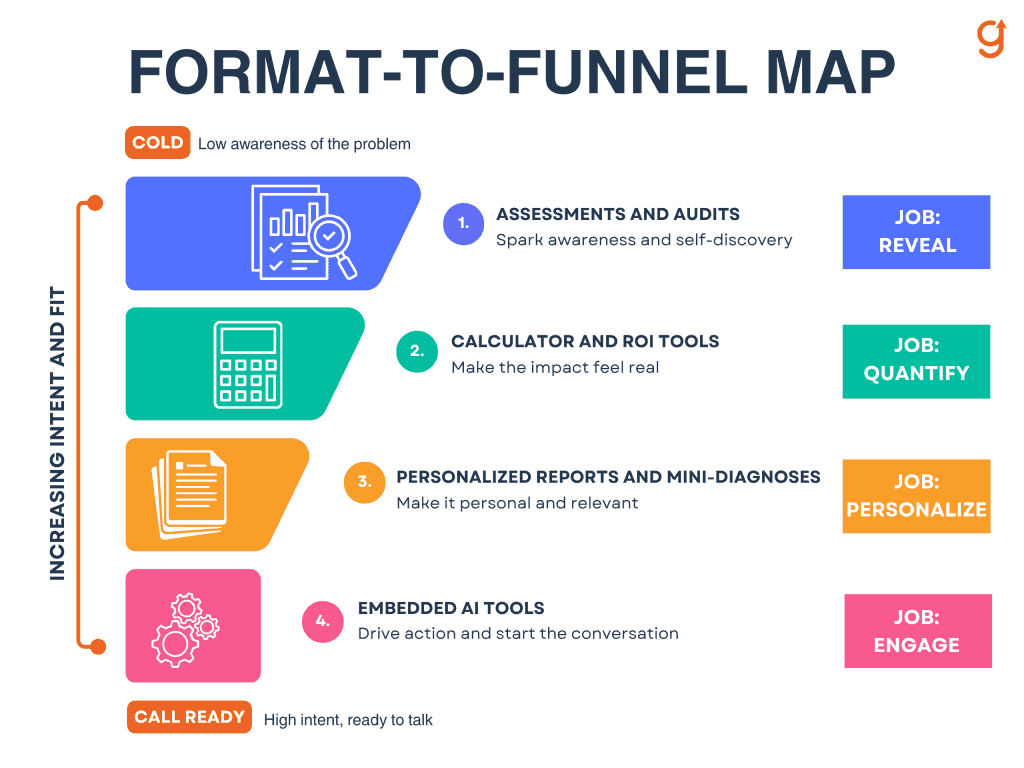
Four formats do the pre-qualification work, and each one belongs at a specific point in the funnel.
Choosing the format is choosing which stage you strengthen. That stage-matching comes from the customer journey methodology I’m licensed to deliver as a DigitalMarketer Certified Partner, applied here to one job: matching the format to the funnel stage and the price point.
Assessments and audits
The assessment is the strongest cold-audience format for coaches. It’s a scored set of questions that tells the prospect where they stand and tells you whether they fit. Think of a business coach’s “growth readiness score” or an executive coach’s “leadership bottleneck diagnostic.”
The qualifying happens at the exact moment of capture, before you’ve spent a minute on a call.
The quiz variant of this format runs deep enough that I’ve given it its own playbook on this site. If a quiz is your pick, that guide is where to go next.
Calculators and ROI tools
A calculator makes the cost of the prospect’s problem concrete. It’s what churn in a client base costs a consultant, or what an unfilled cohort costs a program founder.
A few things make this format work at mid-funnel:
- The prospect already knows the problem exists and needs a number to justify premium help
- The output is personal to their business, not a generic industry figure
- The follow-up email can quote the prospect’s own result back to them, which no broadcast sequence can fake
Personalized reports and mini-diagnoses
A generated report takes a short intake and returns a structured read on the prospect’s situation, plus one recommended next step. This is the closest format to a first coaching session, so I place it late-funnel, right in front of the call booking, at the highest price points.
The mechanism behind why this works shows up in the Edelman-LinkedIn B2B thought leadership research: 75% of decision-makers say strong thought leadership led them to research a product they weren’t already considering because it spoke directly to their situation.
A generated report compresses that mechanism into a single asset.
Two things matter for execution here:
- Keep the intake short
- Keep the recommendation single, not a menu of options
A report that ends in three options is a report that ends in no booking.
Embedded AI tools
The newest format is a small AI-powered tool embedded on your site: a prompt-driven generator or checker scoped to one narrow job your audience does weekly. It runs top-of-funnel like the assessment, but it positions you differently.
You come across as the coach who builds working things, which suits practitioners selling systems rather than mindset.
Scope it narrowly. A tool that does one thing well beats a chatbot that does everything vaguely.
How do you build your first AI lead magnet in a weekend?
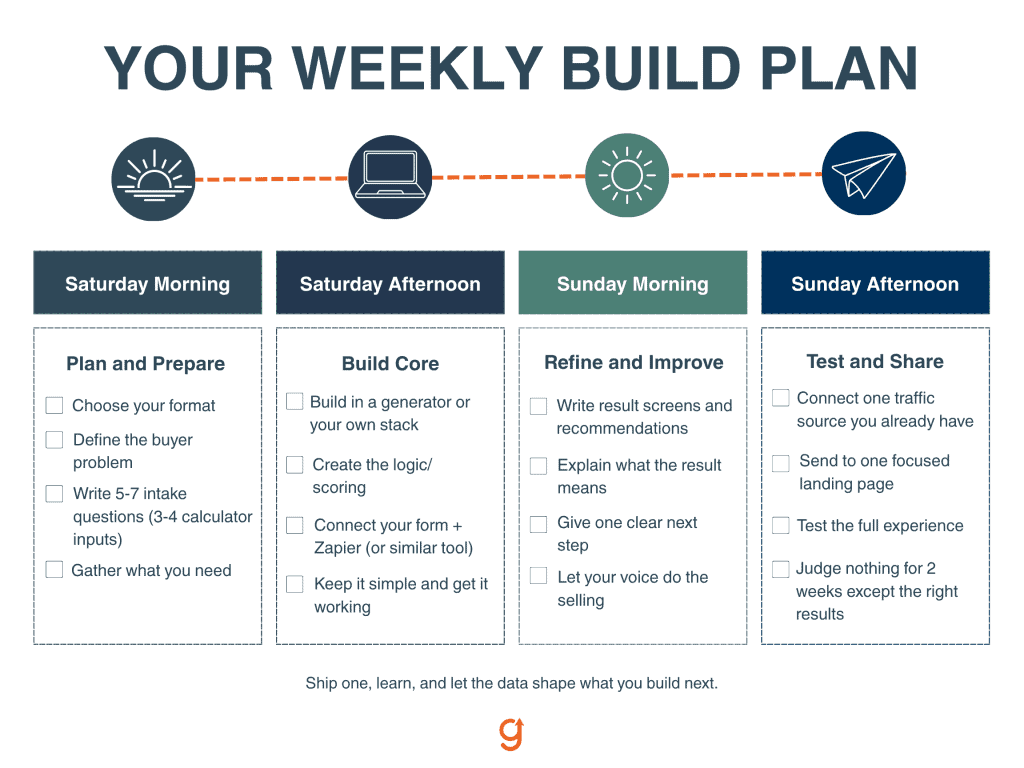
You build your first AI lead magnet by picking one format from the map, one buyer problem, and one traffic source, then shipping a rough version in four half-day blocks over a single weekend.
I taught myself digital marketing from a book and built a profitable business before it was ever my job, and this build asks far less of you than that. The four steps:
- Saturday morning: script the questions. Five to 7 intake questions for an assessment or report, or the three inputs for a calculator. Pull the language from real discovery calls, and write the questions your best clients wish someone had asked them earlier.
- Saturday afternoon: build in a generator or assemble your own stack. A dedicated builder gets you live fastest. A ChatGPT-drafted scoring logic plus a form tool and Zapier or a similar connector into your email platform does the same job with more control.
- Sunday morning: write the result screens. Each score band or output gets two paragraphs: what the result means and the single next step. This is where your coaching voice does the selling, so write it yourself even if AI drafted the scaffolding.
- Sunday afternoon: connect one traffic source and go live. One channel you already have (your newsletter, your best-performing social platform, a partner’s audience) is pointed at one landing page. Judge nothing for two weeks except whether the right people are reaching the result screen.
The discipline that matters is shipping one, not planning four. The magnet earns its keep when its data changes your first sales conversation.
What should you look for in an AI lead magnet generator?
You look for four things the vendor marketing pages skip: data ownership, brand voice control, email platform integration, and honest pricing at real list sizes.
The generator category is genuinely useful and largely interchangeable at the low end. That is why every vendor page sounds alike, and why these criteria should decide instead of the demo.
The four:
- Data ownership and export. Your list and your response data must export cleanly. A generator that holds your subscribers hostage is a liability dressed as a convenience.
- Brand voice control. You must be able to overwrite every AI-drafted sentence. Prospects are buying your judgment, and a magnet that sounds like every other AI tool undercuts the premium positioning it exists to support.
- Email platform integration. Native connection to your existing platform, or clean automation through a connector, so segmentation data actually reaches your sequences.
- Pricing that scales with list size honestly. Read the tier you will need at 5,000 subscribers, not the teaser tier.
Where the generator sits in your broader toolkit is its own decision, and the AI tools guide for high-ticket coaches covers those choices.
Where does the lead magnet fit in your ascension funnel?
At the front, doing the sorting. The magnet is stage one of the automated client ascension funnel: it qualifies attention from channels like answer-engine-optimized content into a segmented list, and everything downstream inherits the quality of that sort.
Build the one magnet the map points to, ship it this weekend, and if you want to know which stage of your client journey is actually capping growth before you build anything, take the Growth Gap Scan.
It finds the constraint, so your next build strengthens the stage that is holding the rest back.
Frequently Asked Questions
Do lead magnets still work?
Yes, but the bar moved. Static PDF downloads still collect addresses, and interactive formats that personalize (assessments, calculators, generated reports) do the job that matters for premium offers: sorting real prospects from freebie seekers at the moment of capture. If your magnet is underperforming, the format is the first suspect, not the channel.
What is a lead magnet used for?
A lead magnet trades free value for an email address, which starts the relationship your funnel then develops. For a high-ticket coach it carries a second job: pre-qualification. A well-designed magnet tells you who the subscriber is, what problem they have, and whether they fit your offer before the first conversation.
What are the best lead magnets for coaches?
Match the format to the funnel stage. Assessments and audits qualify cold audiences, calculators make the cost of the problem concrete mid-funnel, personalized reports warm up call-ready prospects at the highest price points, and small embedded AI tools build authority with audiences who buy systems. One format done well beats four done thinly.
How do I create a lead magnet with AI?
Script five to 7 intake questions from real discovery-call language, build the logic in a generator or with a form tool plus an automation connector into your email platform, write the result screens in your own voice, and connect one traffic source. The whole sequence fits in a weekend, and the result screens are the part worth writing yourself.
What is a smart lead magnet?
The phrase is used two ways: generically, for interactive lead magnets that adapt to each prospect, and as a product name by a couple of software tools. In the generic sense it is the same idea this guide covers: an assessment, calculator, or generated report that personalizes the result, sorts your list, and starts the sales conversation with real information.
How long should a lead magnet take to build?
A weekend for the first version. Half a day to script questions, half a day to build, half a day to write result screens, half a day to connect a traffic source and launch. Two weeks of live traffic tells you more than two more weeks of polishing, so ship the rough version and refine from real responses.