BrandWell Review 2026 (Formerly Content At Scale): Worth It?

By Brian Shelton — Founder of GrowPredictably.com
TL;DR: Content At Scale rebranded to BrandWell in August 2024, then repositioned again in February 2026 into what it calls an Intent-Led GTM Platform. Most reviews have caught neither shift. This review covers what actually changed, what it costs now that pricing is no longer public, and whether content produced at this scale still ranks. It does, but only if a team edits and differentiates the output first. That gap is what most reviews skip.
Key Takeaways
- Content At Scale rebranded to BrandWell in August 2024, then repositioned again in February 2026 into an Intent-Led GTM Platform. Nearly two years of drift means most competing reviews and directory listings have caught neither change.
- Only 7 percent of marketers publish AI content without revising it, according to HubSpot’s own 2025 State of AI research. That editing pass is the real cost behind any scaled content promise.
- TrafficID, once a bolt-on feature, is now the entry layer of the platform. BrandWell’s own February 2026 relaunch organizes the product around identifying buyer intent first, then serving content to it, not the other way around.
- Scaled, undifferentiated content is a real Google target regardless of how it was produced. Search Engine Journal reported Google Search Liaison Danny Sullivan’s position, paraphrased from the outlet’s own notes rather than a verbatim quote: Google does not care whether scaled content comes from AI, automation, or human beings, it is going to be an issue either way.
- The honest verdict: worth trying for a team that will actually edit and differentiate the output, not worth it as a hands-off volume machine, and pricing now requires a custom quote rather than a public tier.
I checked this tool against its current status twice before writing this review, once for the August 2024 rebrand most competing pages still miss, and again for a second, newer change: a February 2026 platform relaunch almost nobody reviewing this tool has caught yet.
This is for the CMO, VP of Marketing, or fractional CMO evaluating whether a scaled AI content tool is worth the spend. They are likely still searching it under the name it dropped nearly two years ago, and comparing it against a product shape the company itself moved past in February.
The work that follows treats the decision the way any real evaluation should. Name what actually changed, twice. Then judge the tool on the constraint it can actually solve: production speed. It cannot solve differentiation for you.
Why does most AI content scaling fail to actually rank?
Most AI content scaling fails to rank because volume gets treated as the goal instead of a means. A team buys a scaled content tool and publishes a large batch of articles fast. Traffic barely moves, or the pages sit crawled but never indexed.
The pattern is visible inside the first few months. A team ships twenty, thirty, fifty articles in a fraction of the time it used to take. Each one reads competently. None of them says anything the top-ranking page on that topic doesn’t already say. The tool did exactly what it was built to do: produce content fast. The team mistook that for the actual job, which was never speed alone.
The root cause sits one level up. A page that reads the same as everything else already ranking adds nothing for a search engine to reward. More undifferentiated volume just produces more pages competing with each other for the same thin signal, not more pages that win it. A search engine has no reason to promote the fortieth generic answer to a question over the first thirty-nine.
The common fix is publishing even more to compensate for weak per-page performance. Doubling the volume of pages that all say the same generic thing does not fix the underlying problem. It just multiplies it, and it multiplies the monthly bill for the tool producing it right alongside.
The scale of the underlying gap is measurable. Only 7 percent of marketers publish AI content without revising it, according to HubSpot’s own 2025 State of AI research. The other 93 percent understand something a pure speed pitch leaves out: raw AI output is a draft, not a finished page.
This review judges BrandWell on that basis. Can its output actually carry the editing and differentiation that makes scaled content rank, not just how many words it produces per hour.
What is BrandWell, and what changed from Content At Scale?
BrandWell is the current name for the AI content platform formerly known as Content At Scale, and it has changed twice since that name applied. The company rebranded in August 2024, positioning itself as a broader brand-growth platform rather than a single writing tool.
Then, in February 2026, it repositioned again, describing itself as an Intent-Led GTM Platform that connects visitor intent to content to revenue rather than a content tool with extra features attached.
The rebrand is nearly two years old and the relaunch five months old, and most competing reviews still have not caught either change. When I checked the pages ranking for this exact search, several, including a page-one directory listing, still titled themselves under the old name.
Many still describe a product shape the company itself moved past. That gap matters for more than accuracy. A buyer who compares old pricing pages, old feature lists, or old screenshots against today’s platform is comparing against a product that no longer exists in that shape, twice over.
The name change and the platform relaunch both reflect a real shift in scope, not just marketing refreshes. The original tool did one thing, long-form blog content generation, and did it narrowly. The August 2024 rebrand signaled the company’s decision to build outward from that core.
The February 2026 relaunch went further. It reorganized the product around identifying buyer intent first, then serving content to it second, instead of treating content production as the main event. What that actually looks like for a buyer is evaluated honestly, feature by feature, next.
What does BrandWell actually do in 2026?
BrandWell’s current product is built around four connected layers, organized under what the company calls an Intent-Led GTM Platform since its February 2026 relaunch:
- Audiences (TrafficID): buyer-intent and visitor identification, now positioned as the platform’s starting point rather than a bolt-on. It identifies who is already showing intent before any content gets served to them.
- Content (RankWell and WriteWell): the long-form and short-form AI writing core that built the original Content At Scale reputation. RankWell still handles long-form articles with built-in keyword research, SEO and NLP analysis, and internal linking through knowledge-graph technology. The company says this engine got a substantial upgrade as part of the relaunch. It is now one layer inside a larger system, not the product itself.
- AIMEE: an AI agent layer the company positions as connecting the audience and content layers. It is part of what BrandWell calls a complete go-to-market system, not a standalone writing assistant.
- Reporting: attribution and revenue reporting tying the earlier layers back to results, per the company’s own description of the platform.
The practical effect for a buyer still researching this tool under its old name: the writing engine that made Content At Scale’s reputation still exists, but it is no longer the product being sold. A team buying BrandWell today for long-form content alone is buying into a platform built first around identifying who is already showing intent.
Content and follow-up get served to that audience second, whether or not the team ever touches the audience or reporting layers directly.
The honest limitation is that scope has grown twice now, first with WriteWell and TrafficID, then with the full platform relaunch. A team that only wants a long-form writing tool is evaluating something considerably broader than that today.
Confirm directly with the company which layers actually apply before assuming pricing and onboarding match a simple writing subscription.
How much does BrandWell cost in 2026?
BrandWell no longer publishes public tier pricing. The cost now depends on market coverage, lead volume, TrafficID needs, and dashboard scope, priced through a custom quote instead of a fixed monthly tier. The company positions that cost as a fraction of the $60,000 to $120,000 a year enterprise buyer intent data platforms typically charge, and it offers a free seven day trial to evaluate it first.
A buyer comparing this against the fixed monthly tiers still listed on older reviews is comparing against pricing the company itself has moved past.
That shift changes the honest framing of cost. Against a single freelance writer’s per-article rate, any content tool at scale looks expensive on a single-article basis. Against the enterprise intent-data platforms BrandWell now positions itself alongside, the same tool can look inexpensive.
Which comparison is fair depends on which layers a team actually plans to use. Request a quote scoped to those specific layers, and do not assume either comparison by default.
Even well-funded marketing teams do not have unlimited tool budget. Gartner’s 2026 CMO Spend Survey, covering 401 CMOs and marketing leaders, found that marketing budgets averaged 7.8 percent of total revenue.
A tool at this price point has to earn a real share of that fixed budget, not just a trial period, and that math only works if the output genuinely replaces work a team would otherwise pay a writer or an agency to do.
Is BrandWell’s AI content actually safe to publish at scale?
BrandWell’s AI content is as safe as the editing and differentiation a team actually applies to it. A polished-sounding draft does not make it automatically safe to publish. Google’s actual policy treats undifferentiated, mass-produced content as a real target, regardless of how it was produced.
Danny Sullivan, Google’s Search Liaison, said it this way:
We don’t really care how you’re doing this scaled content, whether it’s AI, automation, or human beings. It’s going to be an issue.
Danny Sullivan, Search Liaison, Google
Search Engine Journal’s own coverage prefaces this as a paraphrase reconstructed from the reporter’s notes, not a verbatim transcript. The wording above follows that same paraphrase. The substance is not in dispute either way. A tool named around scaling content invites exactly the question Sullivan is answering.
A review that skips it is not doing its job. The practical test ties back to where this review opened: BrandWell’s draft is a starting point that still needs the editing 93 percent of marketers apply before anything goes live. It is not a finished, safe-by-default page the moment it generates.
Nothing in BrandWell’s current platform description replaces the judgment call a real editor makes about whether the page says something the top-ranking competitor doesn’t already say. That judgment call is the part no AI content tool, this one included, can fully automate, no matter how many layers sit around the writing engine.
A platform can tell you who is showing intent and serve content against it. It cannot tell you what would make that content actually different, the specific example, the named source, the operator detail that only someone who has done the work would know to include.
Who does BrandWell actually fit, and is it worth it?
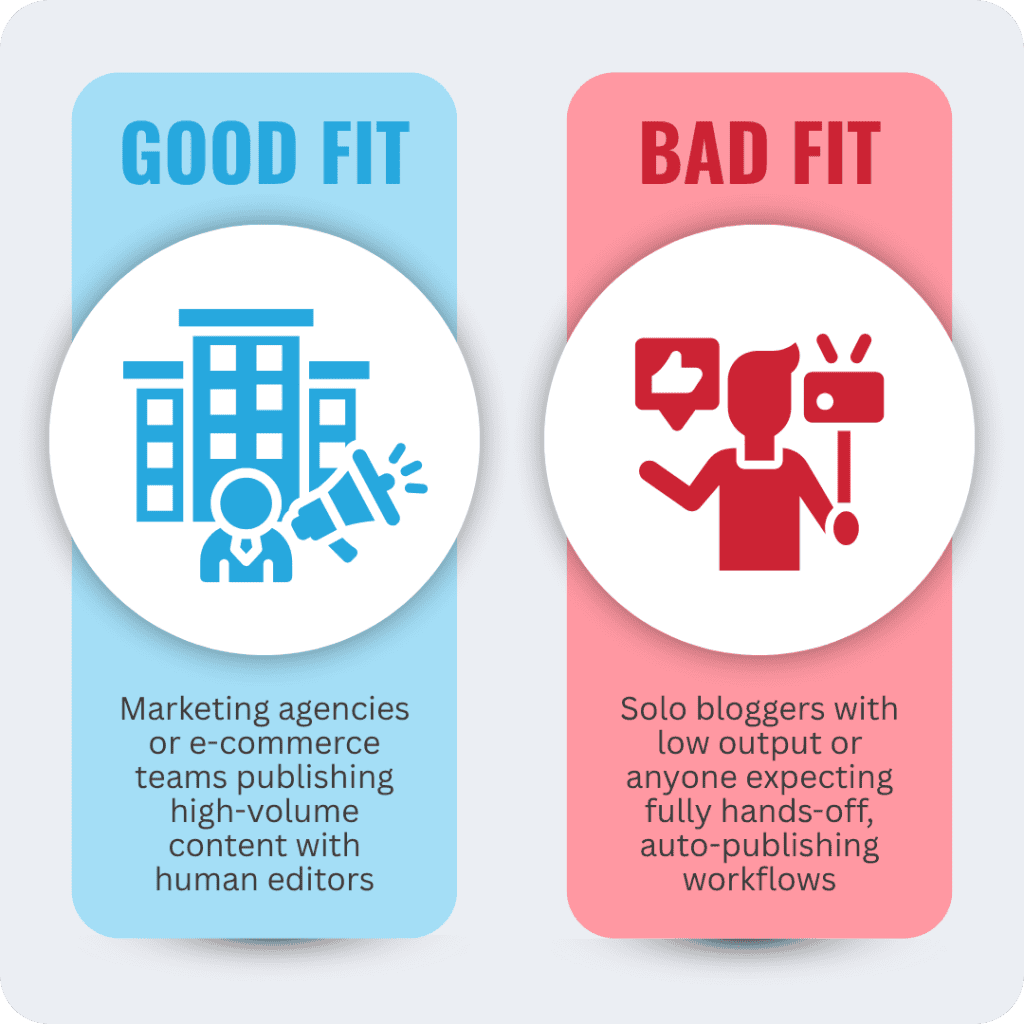
BrandWell fits a marketing agency or e-commerce team publishing high volume with a real editor in the loop. It does not fit a solo blogger or a team wanting fully hands-off publishing.
- Good fit: an agency managing multiple client content calendars, where RankWell’s speed multiplies one strategist’s output across several accounts. An e-commerce team that needs consistent product and category content at volume also fits well, provided someone reviews every draft before it ships rather than auto-publishing.
- Poor fit: a solo blogger publishing occasionally, where the monthly cost outweighs the volume they’d ever need. Any team expecting to buy the tool and skip the editing step entirely is also a poor fit, since that is exactly the use pattern Sullivan’s caveat above is warning against.
The honest verdict: worth trying if your team will actually edit and differentiate the output. Not worth it as a hands-off volume machine. That is the same discipline behind evaluating any AI marketing tool without creating more subscription sprawl.
BrandWell solves a production-speed constraint well. It does not solve the differentiation constraint for you, the same test that applies across all-in-one marketing platforms and KPI software alike.
Where do you start if you’re considering BrandWell?
Confirm the tool solves your actual constraint, production speed, before you buy it. It will not solve differentiation for you, and no amount of monthly article volume fixes a page that reads like everything else already ranking. Name who on your team will actually edit every draft. Let that answer decide whether the subscription is worth it, not the demo.
That same discipline, score honestly before you fix anything, is what Rate My Funnel applies to your whole customer journey.
Score your funnel honestly before you buy another content tool
Frequently Asked Questions
Is BrandWell (Content At Scale) worth the money?
Worth trying if your team will actually edit and differentiate the output before publishing. Not worth it as a hands-off volume machine. The tool solves a production-speed constraint well, but it does not solve the differentiation constraint that actually determines whether content ranks.
How much does BrandWell cost?
BrandWell no longer publishes public tier pricing. As of its February 2026 relaunch, pricing moved to a custom quote, positioned as a fraction of what enterprise buyer-intent data platforms typically charge, with a free seven day trial to evaluate first. Older figures around $249 to $499 a month reflect pricing the company has since moved past.
What is BrandWell?
BrandWell is the current name for the AI content platform formerly known as Content At Scale, now organized as an Intent-Led GTM Platform with four connected layers: Audiences (TrafficID), Content (RankWell and WriteWell), AIMEE, and Reporting.
What happened to Content At Scale?
It rebranded to BrandWell in August 2024, then repositioned again in February 2026 into a broader Intent-Led GTM Platform. The original long-form AI writing core is still the platform’s foundation, now named RankWell, but it is one layer inside a larger system rather than the product itself.
Does AI content from BrandWell actually rank on Google?
It can, if it’s edited and differentiated before publishing. Google does not ban AI content, but it does treat undifferentiated, mass-produced content as a real target regardless of how it was produced, a caveat Google’s own Search Liaison has addressed directly.
What are the limitations of BrandWell?
Scope has grown twice now, first with WriteWell and TrafficID, then with the full February 2026 platform relaunch. A team that only wants a long-form writing tool is evaluating something considerably broader than that today, and still needs a real editor reviewing every draft before it publishes.
Personal Opinion
Content At Scale is packed with features that are sometimes lacking from the more mainstream SEO tools being marketed, and I was able to dabble in a number of them extensively.
What’s cool about this tool is the variety of ways it helps you create content from scratch.
Sources for Content Creation
Whether it’s a keyword, a YouTube video, a podcast episode, or even a document, this tool has got you covered.
I personally tried creating posts straight from keywords, and the process was pretty straightforward.
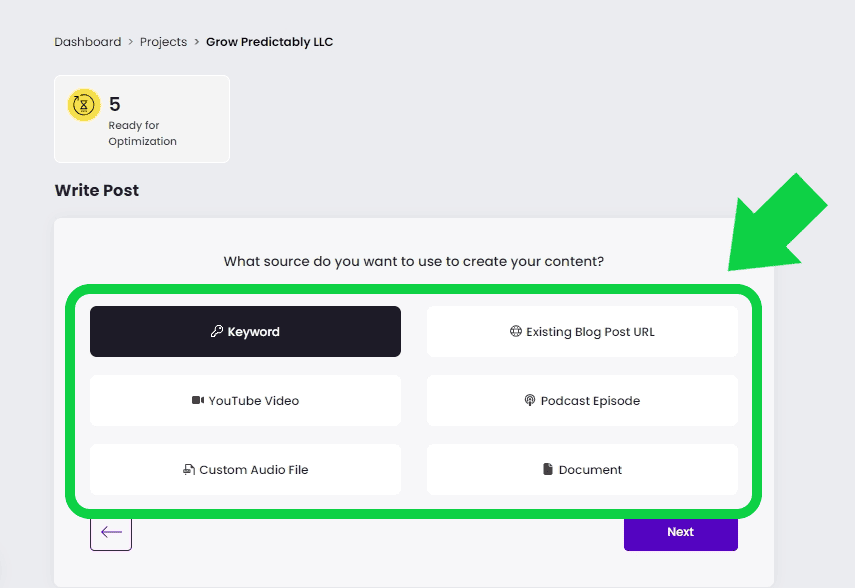
I dabbled in creating articles from a variety of sources. Uploading a document for the growth scorecard article was a breeze, and it generated an article based on that document.
For other articles, I stuck to keyword-based creation, like “SaaS marketing strategy” and “SaaS digital marketing.”
It’s pretty nifty how it adapts to different content formats.
SEO-Boosting Features
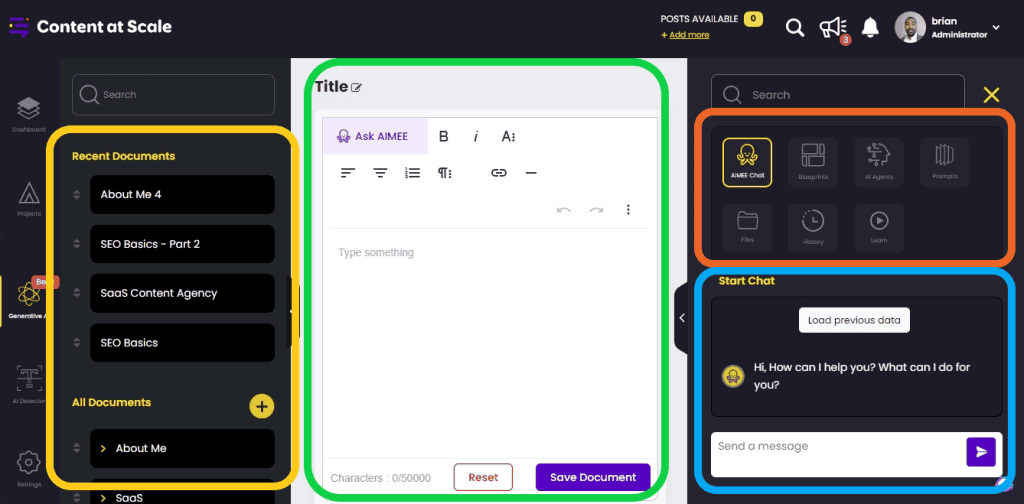
The content calendar planner and keyword research tools are handy additions. While it may not replace tools like Ahrefs, having these features integrated into one platform is convenient.
Plus, the topic cluster feature is a gem for SEO-focused writers.
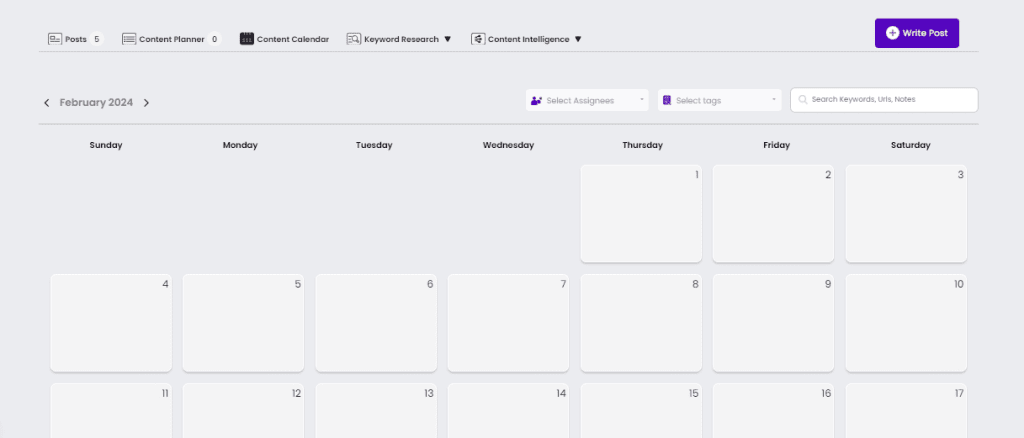
The AIMEE Chat feature, still in beta, works similarly to Chat GPT. It’s a neat addition for quick interactions.
The blueprints feature, akin to templates, is great for specific content types like email campaigns or sales letters.
Some Poor UI
However, it’s hard to ignore how confusing it can be sometimes to navigate the ‘Generative AI’ tab—especially if you’re a beginner.
It’s not easy to navigate with all the panels on both sides of the screen.
But aside from that, kudos to Content At Scale for including so many tools under Generative AI, including chat, history, and prompts.
These three are among what I found to be most useful under Generative AI.
Using Content At Scale has been an insightful experience. The variety of content creation methods, combined with planning and research tools, makes it a versatile platform for content creators.
While it’s not without its quirks, like any tool, it’s packed with features that make content creation more streamlined and efficient.
For anyone diving into content creation, particularly with a focus on SEO and variety, Content At Scale is worth exploring.
Price
1. RankWell® Essentials – $249/month
- 1 user
- RankWell content suite
- 4 premium optimized blog posts
- 100 keyword research & clusters
- 25 topic reports
- 25 optimization audits
- 25k undetectable rewrite words
2. RankWell® Starter – $499/month
- 3 users
- 5 or more brands
- 12 premium optimized blog posts
- 200 keyword research
- 50 topic reports
- 50 optimization audits
- 50k undetectable words
- Community & courses access
- White label for clients
3. RankWell® Standard – $999/month
- 5 users
- 15 or more brands
- 30 premium optimized blog posts
- 400 keyword research
- 100 topic reports
- 100 optimization audits
- 100k undetectable words
4. RankWell® Scaling – $1499/month
- 10 users
- 30 or more brands
- 60 premium optimized blog posts
- 1000 keyword research
- 250 topic reports
- 250 optimization audits
- 250k undetectable words
5. RankWell® – Custom
- Volume discounts
- Increased posts and research credit limits
- Better client experience with white label
- Team building tools such as agency certificate courses, team collaboration, and reporting
Features Breakdown
Now, let’s take a closer look at the Content At Scale features that really stood out to me.
These aren’t all the features of Content At Scale, but they’re worth highlighting because they really add to the score.
Dashboard
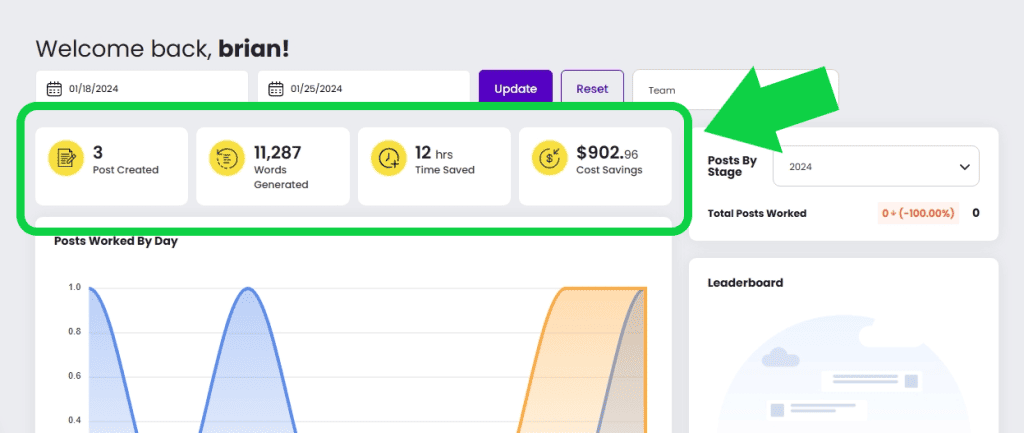
The dashboard displays a lot of data about the number of posts you’ve created and how many are still in draft.
It’s also very neat that the dashboard shows you how much time and money you saved by creating content using Content At Scale – something that other platforms can’t show.
The dashboard can also show you how much content, in percentage, has been published, scheduled, and completed.
With this dashboard, I get a comprehensive view of how much I’ve used the platform to automate my content creation processes.
Sources for content creation
When you create content using Content At Scale, you have the rare option to source your content from six different choices—something very unique to the platform.
You can choose a keyword, a YouTube video, an audio file, an existing URL, a podcast, or a document from your computer.
This feature is among my favorites when it comes to using the platform because it stays true to the tool’s name.
These sources help you repurpose content more efficiently. With it, I was able to create a blog about my scorecard just by giving it a copy of the document. Pretty neat, huh?
Topic cluster
The topic cluster feature is also one of my favorites. It’s under Projects > Keyword Research.
All you need to do is provide a seed keyword, and then the tool will give you a list of short-tail and long-tail keywords that you can write about to help you cover an entire topic.

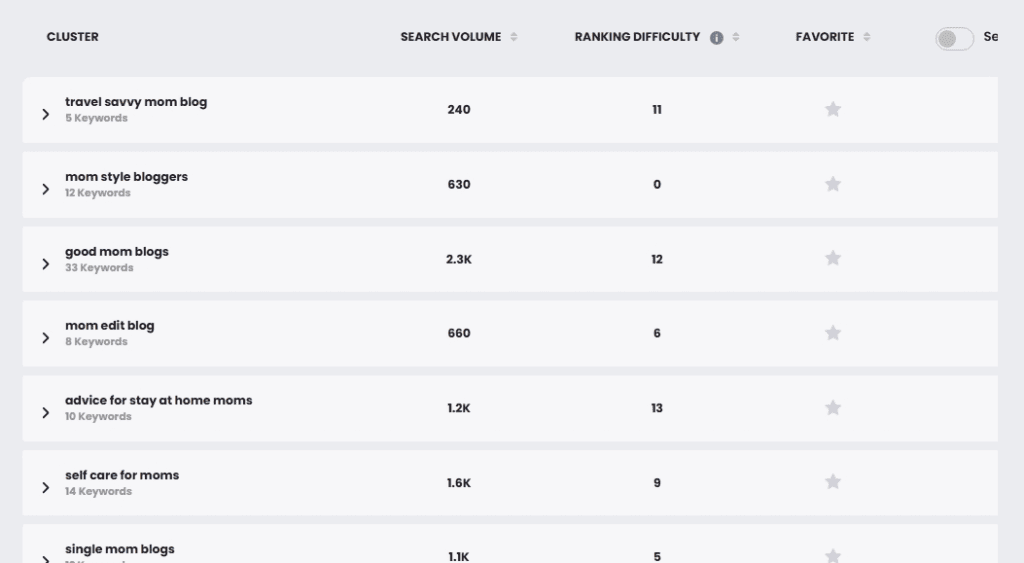
This is another feature of Content At Scale that not a lot of content creation platforms offer.
I found it very convenient and insightful because the cluster list includes data about search volume and ranking difficulty, which makes it easier for me to target the next topic for my blog.
AI Agents
Content At Scale’s AI agents are similar to ChatGPT’s Bots and Magai’s Chat Personas.
Agents embody different roles with different expertise. Pre-made personas are available, but you can also create your own for various fields like business, coding, finance, etc.
Before, when bots weren’t yet a thing in ChatGPT, users had to specify in the prompt what role they wanted the AI to play.
But with Content At Scale’s Agents, I saved a lot of typing. For example, choosing an agent who’s an expert in LinkedIn helps me create better copy for LinkedIn outreach.
AI detector
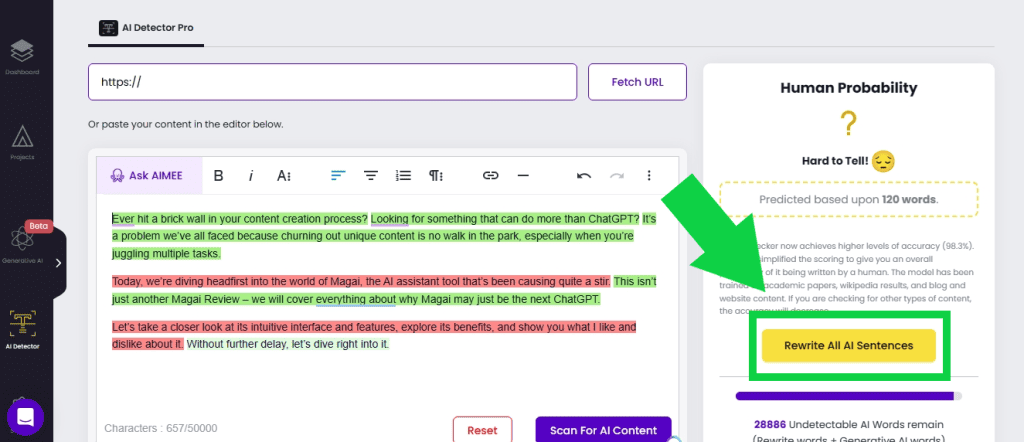
The AI Detector is another handy feature inside the platform. You can type your content and have the tool scan it for traces of AI, or you can paste a URL that you want to scan.
AI detectors are common. However, Content At Scale’s AI detector goes the extra mile to bring you ease.
Unlike other tools that detect AI content, what I love about Content At Scale’s AI Detector is the ‘Rewrite All AI Sentences’ button.
With this feature, making AI content sound more human just got more convenient. It doesn’t just stop at telling you, “This sounds very AI.” It helps you improve it, too.