B2B SaaS Inbound Marketing: Get Found Before the Buyer Calls

TL;DR: B2B SaaS inbound marketing means earning attention from buyers who are already researching a problem. It turns that attention into pipeline through content, search visibility, and nurture, rather than cold outreach. Gartner found that 67% of B2B buyers prefer a rep-free experience. This guide builds a five-stage inbound engine and fixes whichever stage is furthest behind plan, rather than adding more content everywhere at once.
Key Takeaways:
- B2B SaaS inbound marketing earns attention from buyers who are already searching for a solution. Then it turns that attention into qualified pipeline.
- Gartner found that 67% of B2B buyers prefer a rep-free experience. In the same survey, 45% had used AI during a recent purchase.
- The five-stage inbound engine gives one metric per stage: get found, earn the visit, capture, convert, and nurture. A B2B SaaS team can use it to find and fix the stage capping the pipeline.
- SparkToro’s zero-click search study found that just under 60% of US searches end without a click. B2B SaaS inbound content has to be useful even when the buyer never visits the site.
- Dreamdata’s aggregated B2B deal data puts the average B2B customer journey at 211 days. B2B SaaS inbound marketing needs a multi-quarter plan, not a one-month test.
When pipeline stays flat while website traffic climbs, inbound as a whole is rarely the problem. One stage of the inbound engine is failing, and the work is finding which one.
That matters because a B2B SaaS buyer can get deep into research before any sales rep hears their name. Gartner survey data shows most B2B buyers prefer to buy without a rep. Picture a CMO looking at rising sessions next to a stagnant pipeline report.
The question stops being whether to invest in inbound and becomes where the funnel actually breaks.
This guide covers what B2B SaaS inbound marketing means now and how zero-click search and AI answers change the work. It then lays out a five-stage inbound engine for diagnosing a stalled funnel. It closes with an honest timeline for results, a test for inbound versus outbound, and the one metric per stage worth tracking.
A year of funded content with no clear read on where the funnel breaks is a diagnosis problem. This guide is built to solve it.
What is B2B SaaS inbound marketing?
B2B SaaS inbound marketing is the practice of earning attention from buyers who are already searching for a solution, then turning that attention into qualified pipeline. Content, search visibility, and social posts are the methods. The channel is not what matters. What matters is whether attention becomes a qualified, known contact.
Outbound marketing reaches people who have not started looking, through cold calls, cold email, and paid outreach lists. In inbound, the buyer starts the search. The company’s job is to be visible, useful, and credible at the moment they look.
That makes inbound one lever inside a broader B2B SaaS lead generation plan, not a replacement for it.
Treating inbound as a content calendar misses the point, and it is where I see many teams stop. Content, SEO pages, and social posts are inputs. The outputs are qualified leads, pipeline, and the revenue the business keeps. Each piece earns its place only if it moves a real buyer further along that path.
Why does B2B SaaS inbound marketing matter more when buyers avoid sales reps?
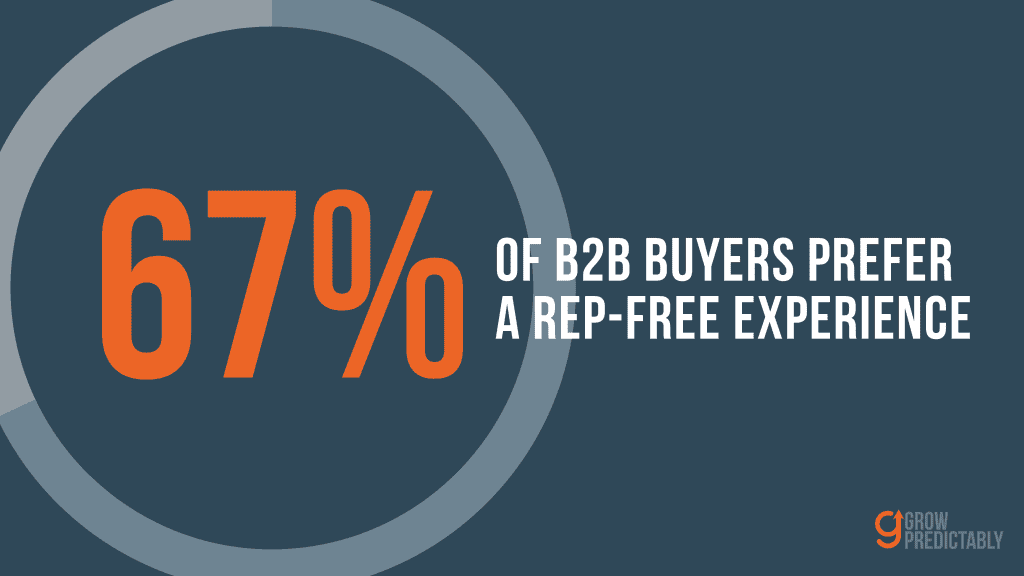
B2B SaaS inbound marketing matters more because buyers are doing the research without you. Gartner found that 67% of B2B buyers prefer a rep-free experience. Gartner surveyed 646 B2B buyers, and 45% of them had already used AI during a recent purchase. A company buyers cannot find during that research is not on the list they build from it.
Alyssa Cruz, Senior Principal Analyst in the Gartner Sales Practice, described buyers working through critical buying tasks in more autonomous ways. She added that sellers cannot rely on static collateral to carry influence in those moments. For inbound, that puts the weight on content buyers can use on their own, before anyone from sales is involved.
Separate research backs the same pattern. 6sense surveyed 557 B2B buyers in North America and 209 in the UK. In 2025, buyers made first contact with a seller 61% of the way through the buying journey, down from 69% in the prior survey. Buyers initiated 79% of engagements, and 6sense found the vendor buyers contact first wins the deal about 80% of the time.
I read that as an association, not proof that any one piece of content wins a deal. It does show that most of the buying journey happens before a seller is involved.
The symptom shows up as a steady stream of demo requests from buyers who already compared the market before they arrived. The upstream cause is not a lack of sales effort. It is a lack of visibility earlier in that research, while the buyer was still forming a shortlist.
The fix is making the company easy to find and easy to trust at that research stage, through content and search visibility. The anti-pattern is adding sales headcount or outreach to reach a buyer who has already decided to research alone.
How do AI answers change B2B SaaS inbound marketing?
AI answers change B2B SaaS inbound marketing by moving part of the buyer’s research onto the results page itself. Many searches now end without a visit to any website, so inbound has to work inside the results page and inside AI answers, not only through a ranking.
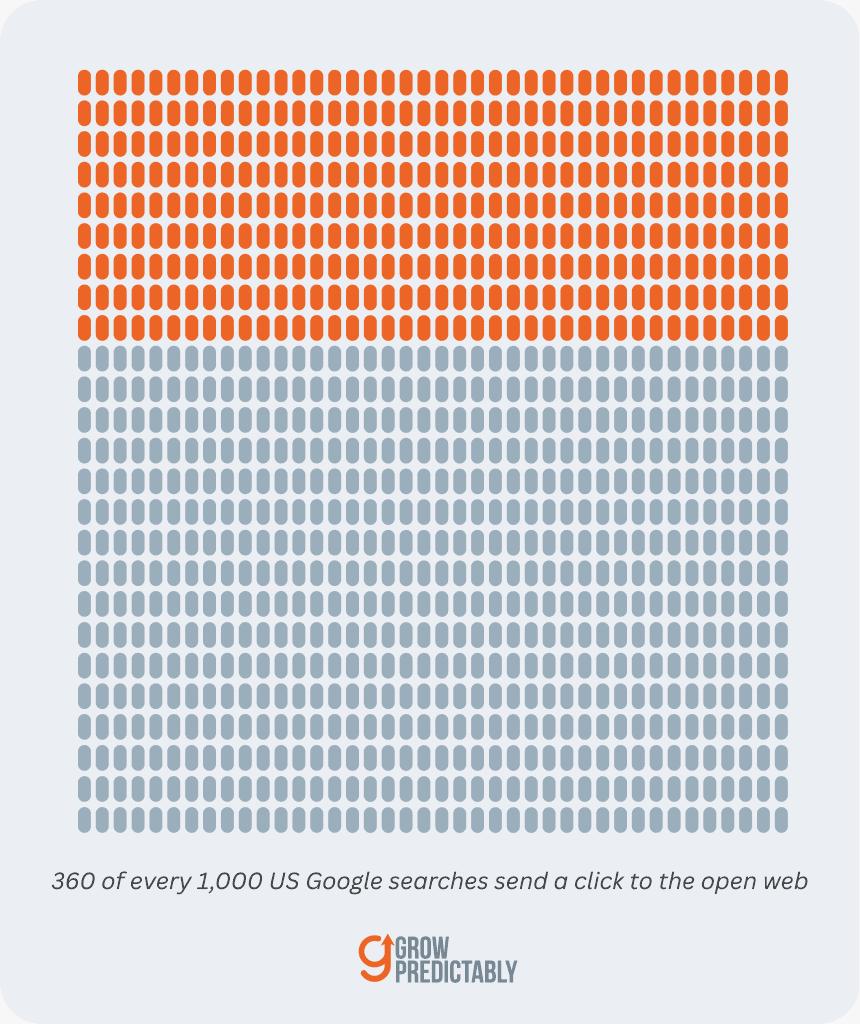
SparkToro’s analysis of Datos clickstream data found that just under 60% of US searches end without a click. For every 1,000 Google searches in the United States, 374 clicks go to the open web. In the EU, that number is 360. SparkToro also notes that nearly two-thirds of searches stay inside the Google ecosystem after the query.
Rand Fishkin, co-founder and CEO of SparkToro, defines the pattern this way:
“Zero-click searches are defined as those that end without clicking on any of the results presented.”
Rand Fishkin, co-founder and CEO of SparkToro, in 2024 Zero-Click Search Study
For a B2B SaaS team, inbound content now has two jobs. It has to rank well enough to earn a click when the buyer wants to go deeper. It also has to answer clearly enough that an AI tool can cite it correctly when the buyer does not click at all.
Earning that citation is covered in depth on the AI search visibility page. The point here is that it is now part of being found, the first stage of the inbound engine, not a separate project.
How does a B2B SaaS inbound engine turn attention into pipeline?
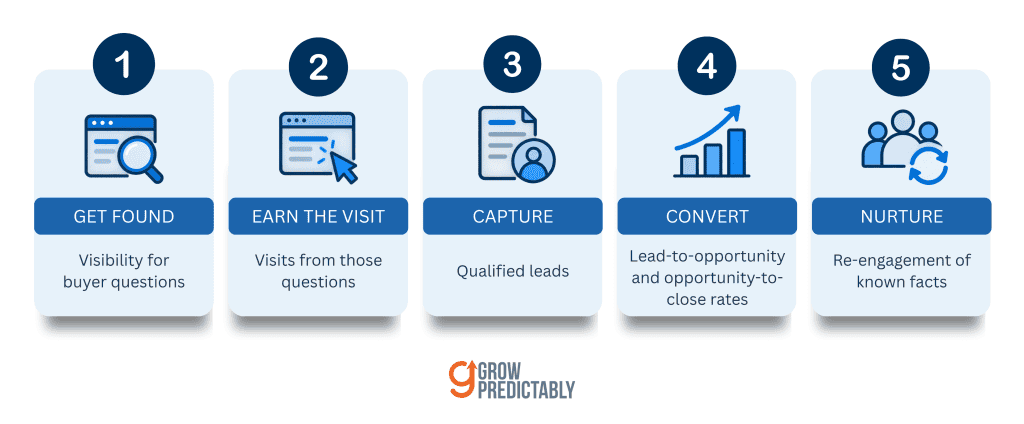
A B2B SaaS inbound engine turns attention into pipeline through five stages: get found, earn the visit, capture, convert, and nurture. Each stage has one metric worth reading. Fix the stage furthest behind plan first, not the one already getting the most attention.
| Stage | Job | Metric to read | First fix when it stalls |
|---|---|---|---|
| Get found | The buyer encounters the company while researching through search, AI answers, social, or referrals. | Visibility for the buyer’s problem questions | Publish content that answers the exact questions buyers ask early. |
| Earn the visit | The buyer chooses to click through to the site. | Visits from those problem questions | Rewrite the title and opening sentence to match buyer intent. |
| Capture | The buyer raises a hand or shares contact details. | Qualified leads | Simplify the offer and form at the point of capture. |
| Convert | The lead becomes an opportunity, then a customer. | Lead-to-opportunity and opportunity-to-close rates | Fix the page or follow-up losing qualified leads before close. |
| Nurture | Buyers who are not ready yet stay in contact until they are. | Re-engagement of known contacts | Build a simple follow-up cadence instead of letting contacts go cold. |
Here is what the capture stage looks like in practice. At a B2B software company, qualified-lead volume across inbound streams grew 58% year over year in the first half of 2025. That beat both the 20% goal and the 25% stretch target.
The convert stage works the same way. At that company, I helped lead a paid-search landing page redesign, and an A/B test showed an 83% increase in conversion rate.
One failure pattern is adding more content at the get-found stage when the engine is actually stalling at capture or convert. More blog posts will not fix a capture page that buries the offer. They also will not fix a follow-up sequence that lets a qualified lead go cold.
The recovery move is to read the metric at each of the five stages, find the one furthest behind plan, and fix that stage first.
This stage-by-stage read is one version of the four growth levers view of a B2B SaaS funnel, narrowed to the inbound engine specifically.
How long does B2B SaaS inbound marketing take to produce pipeline?
Plan in quarters, not weeks. B2B SaaS inbound marketing takes time to produce pipeline because the B2B buying journey itself is long.
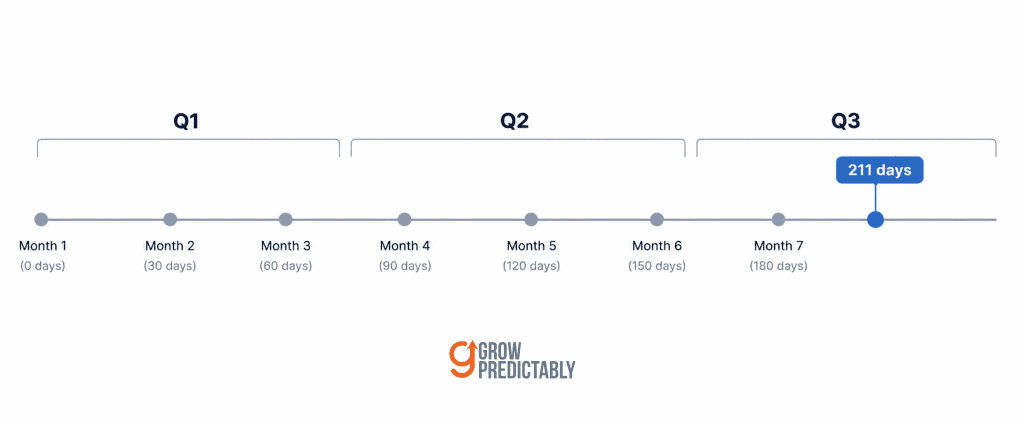
Dreamdata’s aggregated data, drawn from thousands of deals across hundreds of B2B customers, puts the average B2B customer journey at 211 days. That is more than two full quarters.
Customers of larger companies take 49% longer on average to buy, per Dreamdata. Selling into enterprise accounts means planning a longer runway than selling to smaller buyers.
Read the leading metrics (visibility, visits, qualified leads) well before closed revenue, the lagging metric, moves.
The same patience applies to an SEO program built for B2B SaaS, since search visibility is the first stage of the inbound engine.
When should a B2B SaaS team choose inbound over outbound?
A B2B SaaS team should lean on inbound when buyers in its market already search for the problem it solves. It should lean on outbound when the market does not yet know it has that problem. Neither approach fixes a conversion or retention constraint sitting elsewhere in the funnel.
If buyer research volume exists, inbound has something to earn. If that demand does not exist yet, as in a genuinely new category, outbound and direct outreach can start conversations that inbound alone cannot generate.
The choice is not permanent. A company can run both at once and shift the mix as the category matures.
A simple three-step test shows which one fits:
- List the questions a buyer asks before they know your product exists. These are the problem questions, and they show where buyers start.
- Check whether people search for those questions and whether AI answers already cover them. This tells you whether demand exists.
- Read the result. If the questions have search demand, inbound has a job to do. If nobody asks them yet, outbound has to start the conversation.
Whichever channel you lean on, the rule is the same. Find the one constraint in the system and fix it. Do not add spend to a channel that is not the constraint.
B2B outbound marketing covers that approach in full, including how to pair it with the inbound engine above.
How do you measure B2B SaaS inbound marketing?
Measure B2B SaaS inbound marketing by qualified leads and pipeline, not by traffic or rankings. Those two numbers are the engine’s outputs, so report them first, against plan. Traffic, rankings, and visits still matter, but as leading indicators that explain why qualified leads and pipeline moved.
The five-stage inbound engine gives one metric per stage: visibility, visits, qualified leads, conversion rates through the pipeline, and re-engagement of known contacts who are not ready yet.
As 6sense’s 2025 B2B Buyer Experience Report found, buyers initiated 79% of engagements in 2025. The first move sits on the buyer’s side, so inbound needs metrics that work before a sales conversation starts.
Traffic and keyword rankings are visible and easy to report, but they are not what the business keeps. Pipeline and revenue are, read back through, which inbound stage produced them. A team that tracks only sessions and rankings can look busy while the capture or convert stage quietly stalls.
Reading all five metrics together, on a regular cadence, is what shows which stage is capping growth.
Where should a B2B SaaS team start with inbound marketing this quarter?
Start by finding the stage of your inbound engine that is stuck. Read the five-stage metrics against plan: visibility, visits, qualified leads, lead-to-opportunity and opportunity-to-close rates, and re-engagement.
Whichever stage is furthest behind plan is the one to fix this quarter, not the stage that is easiest to add more content to.
Then set one quarter-end target for that stage’s metric, and leave the other four at maintenance until it moves.
Re-read all five at the end of the quarter, because the constraint can shift once the first one is fixed.
Take the Growth Gap Scan to find the one constraint capping growth across the full customer journey, inbound included.
Frequently Asked Questions
What are examples of inbound marketing for B2B SaaS?
B2B SaaS inbound marketing examples include content that answers a buyer’s research questions, search visibility work that helps pages rank for those questions, and social posts placed where buyers already research. Each example is a method inside a five-stage inbound engine (get found, earn the visit, capture, convert, nurture), not an end in itself. A method only counts as inbound marketing if it moves a buyer toward becoming a qualified lead.
What is the difference between inbound and outbound marketing?
Inbound marketing earns attention from buyers who start the search on their own. Outbound marketing reaches people who have not yet started looking, through cold calls, cold email, or paid outreach lists. A B2B SaaS team should lean on inbound when buyers in its market already search for the problem it solves, and lean on outbound when the market does not yet know it has that problem.
How long does inbound marketing take to work?
Dreamdata’s aggregated data, drawn from thousands of deals across hundreds of B2B customers, puts the average B2B customer journey at 211 days, more than two full quarters. Customers of larger companies take 49% longer on average to buy. A B2B SaaS team should budget inbound marketing in quarters, not weeks, and read visibility, visits, and qualified-lead metrics well before closed revenue moves.
Does SEO still matter for inbound when AI answers searches?
SparkToro’s analysis of Datos clickstream data found that just under 60% of US searches end without a click, and only 360 of every 1,000 US Google searches send a click to the open web. Search visibility is still the first stage of the inbound engine. Content has to rank well enough to earn a click, and answer clearly enough for an AI tool to cite it correctly when the buyer never clicks.
What metrics should a B2B SaaS company track for inbound marketing?
A B2B SaaS company can track one metric for each stage of its inbound engine: visibility for buyer problem questions, visits earned from those questions, qualified leads captured, lead-to-opportunity and opportunity-to-close rates, and re-engagement of known contacts during nurture. Pipeline and revenue are the outcomes. Traffic and keyword rankings are inputs, not results.
Do B2B buyers still want to talk to sales reps?
Gartner surveyed 646 B2B buyers between August and September 2025 and found that 67% prefer a rep-free buying experience, and 45% had used AI during a recent purchase. Separately, 6sense found that B2B buyers initiated 79% of engagements in 2025 and made first contact with a seller 61% of the way through the buying journey. Buyers still talk to sellers, but later and on their own terms.