SEO Basics for B2B SaaS: Google and AI Search

TL;DR: SEO basics for a B2B SaaS team now cover Google results and AI-generated answers. Choose one buyer question, make the page discoverable, answerable, and citable, connect it to a focused authority cluster, then measure both surfaces. The mechanism is one feedback loop that fixes the current constraint instead of launching separate SEO, AEO, and GEO projects.
Key Takeaways
- Start with a buyer question that can influence a real decision, then validate its language and demand with search evidence.
- A page must be discoverable before it can rank, answerable before a search system can extract it, and citable before another source should trust it.
- Internal links should connect a useful decision path, not satisfy a link quota.
- Google Search Console and a fixed set of AI questions reveal different constraints, so read them together.
- Run the loop on one primary page for 90 days before adding more tools, channels, or content volume.
SEO basics can look deceptively healthy on a B2B SaaS dashboard. A page may be indexed, earn impressions, and still sit too low to win qualified clicks. An AI assistant may omit the company or describe it without citing the page. Those symptoms often get split among technical SEO, content, AEO, and GEO workstreams, which leaves nobody responsible for the complete path.
This guide is for a B2B SaaS founder, CMO, VP of Marketing, or hands-on marketing leader facing that split. It uses Google Search Console, Decision-First Content, and a 90-day operating cadence to show where the system breaks. The job is to find the current visibility constraint and repair it before the team adds another tactic.
What are SEO basics for a B2B SaaS company now?
SEO basics for B2B SaaS are the minimum practices that help search systems find, understand, and trust a page, then help the right buyer use it. That includes choosing the question, enabling discovery, structuring a direct answer, supporting important claims, connecting related pages, and measuring performance across Google and AI answers.
The minimum job SEO must do
Google defines SEO as helping search engines understand content and helping users decide whether to visit through search.
Its SEO Starter Guide also makes an important point: there are no secrets that automatically rank a site first. The basics create eligibility and clarity. They do not guarantee attention.
For a B2B SaaS team, the useful unit is a buyer question with a page built to answer it. Traditional SEO helps the page become crawlable, indexable, and relevant. Answer engine optimization makes the response easy to extract. Generative engine optimization strengthens the evidence that makes a source worth citing. These are connected jobs on the same page.
What belongs outside this beginner layer
This guide does not replace a complete B2B SEO strategy. It also does not cover every technical audit, content format, or AI platform.
The beginner layer needs one reliable loop and clear handoffs to deeper methods. Once the loop exposes its weakest step, your team can add sophistication with a reason.
Why do disconnected search tactics fail B2B SaaS pipeline?
Disconnected search tactics fail when each activity produces its own output, but no owner connects those outputs to a buyer decision.
The page can pass a technical check, gain impressions, and appear in a content calendar while still producing no qualified movement. Activity rises because the system never identifies its current constraint.
The visible symptom
This page provides a useful receipt. During the 90 days before this rewrite, it earned 3,095 Google impressions. Yet its top query reached a best average position of 45. That is visibility without competitive placement. The symptom does not justify publishing more beginner pages. It justifies diagnosing why this page does not earn stronger selection.
The wider web shows how common nonperformance can be, although one study cannot diagnose a specific page. Ahrefs studied about 14 billion pages in its Content Explorer index and estimated that 96.55% received no organic traffic from Google. Because the authors disclose sample and traffic-estimation limits, the figure is context rather than a promise about your site.
The vast majority of published pages never rank in Google and never get any search traffic.
Tim Soulo, CMO at Ahrefs
The upstream constraint
The failure starts when one person handles crawling, another writes content, and a third checks AI mentions after publication. Each task can be correct by itself. Even so, the handoffs fail because nobody owns the path from buyer question to measurable visibility.
The recovery move is operational. Give one owner one primary page, one fixed Google view, one fixed AI-question set, and one next review date. That owner does not perform every task. They make sure every task improves the same buyer decision and that the evidence selects what happens next.
The B2B SaaS search visibility operating loop
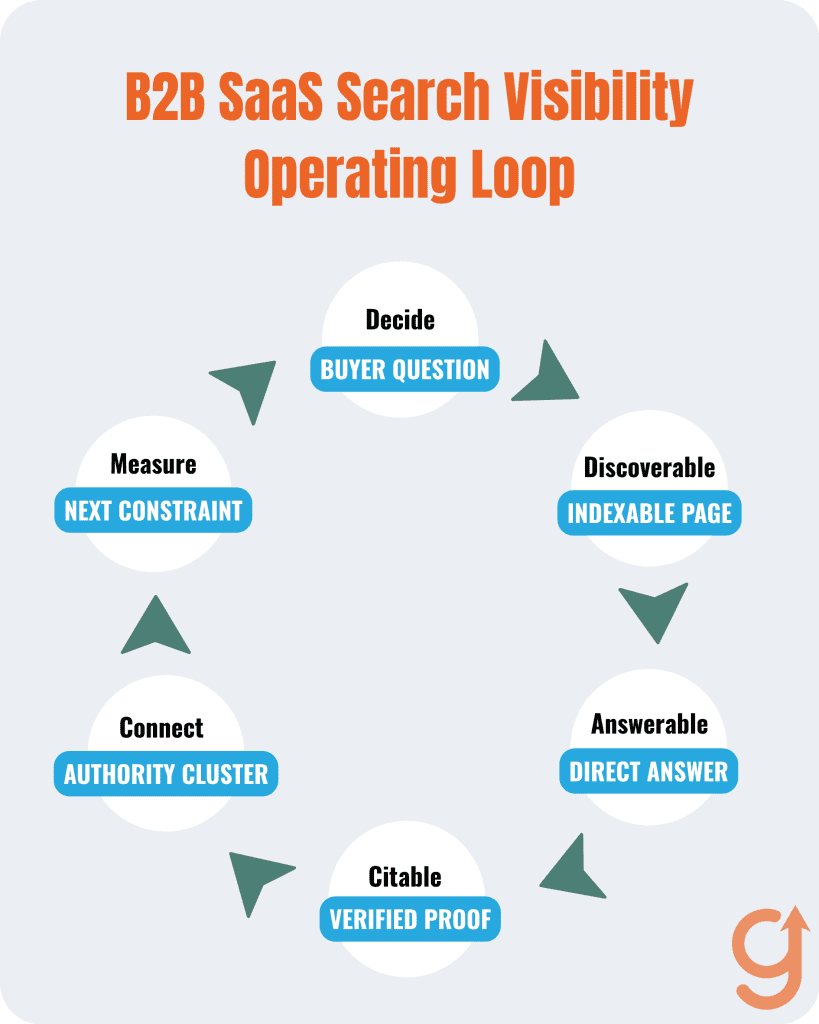
The B2B SaaS search visibility operating loop is a six-step cycle: decide, make discoverable, make answerable, make citable, connect, and measure.
Each step has one observable output. One owner reads the outputs together, identifies the weakest step, and directs the next improvement there.
- Decide. Name the buyer question, the decision behind it, the intended reader, and the page that will own the answer.
- Make discoverable. Give crawlers an indexable URL, a descriptive title, a clear H1, a clean canonical, crawlable links, and usable mobile rendering.
- Make answerable. Put a direct response at the start of each major section, then use question-shaped headings, short paragraphs, and explicit definitions.
- Make citable. Support important claims with primary sources, named expertise, current data, and clearly labeled first-hand evidence.
- Connect. Link the page up to its decision page and across only when another page owns the reader’s next question.
- Measure. Compare Google evidence with repeatable AI-answer tests, then repair the current constraint.
The Decide step follows Decision-First Content. Start with the buyer decision, then use search research to test demand, wording, and page shape. The decision prevents empty traffic. Research prevents the team from mistaking internal language for buyer language.
Use this paste-ready operating card for one page:
| Field | Entry |
|---|---|
| Buyer question | The exact question a qualified buyer asks |
| Decision | What the reader should be able to decide |
| Owner and URL | One accountable person and one primary page |
| Direct answer | A 40 to 60 word response that stands alone |
| Proof | Primary sources, named experts, and approved first-hand evidence |
| Connections | One decision page and the next useful supporting pages |
| Google measures | Impressions, clicks, CTR, position, and qualified actions |
| AI test | The same buyer questions, assistant names, citations, and answer captures |
| Next review | A date and the single constraint to inspect |
Suppose the buyer asks, “How should a B2B SaaS company choose its first SEO topic?” One page can target that search query, open with an extractable answer, cite current research, and link into a broader strategy cluster.
The same page can then support a Google result and give an AI assistant a clear, evidenced passage. If it earns impressions but few clicks, work on selection. If AI answers omit it, inspect answerability, evidence, and authority connections.
How does a B2B SaaS team choose the first buyer question?
A B2B SaaS team should choose a question that comes from a real buyer decision, appears in first-party conversations, and has search evidence behind it. The best starting topic sits where ICP relevance, decision value, and the company’s ability to provide a more useful answer overlap.
Start with the decision
Begin with sales calls, support tickets, CRM notes, onboarding questions, and win-loss interviews.
Write the question in the buyer’s language and name the decision that follows. “What is SEO?” may attract learners. “How should a B2B SaaS team choose its first SEO topic?” points toward an operating decision.
Run three tests before approving the page:
- Is the person asking inside the target ICP?
- Does a meaningful business decision sit behind the question?
- Can this company add a clearer method, stronger evidence, or more useful artifact?
Validate the language with search evidence
Keyword research validates demand, search intent, related language, and the likely page type. It does not choose the business priority by itself.
Google’s Yolyn Ang reported that 15% of daily searches are queries Google has never seen before. That makes exact-volume lists incomplete by design.
Use the B2B SaaS keyword research method to inspect the result page, related questions, competitor coverage, and language variants. If search evidence contradicts the original idea, change the page shape or reject the topic. If it supports the buyer decision, freeze the brief before writing.
How does a B2B SaaS page become discoverable, answerable, and citable?
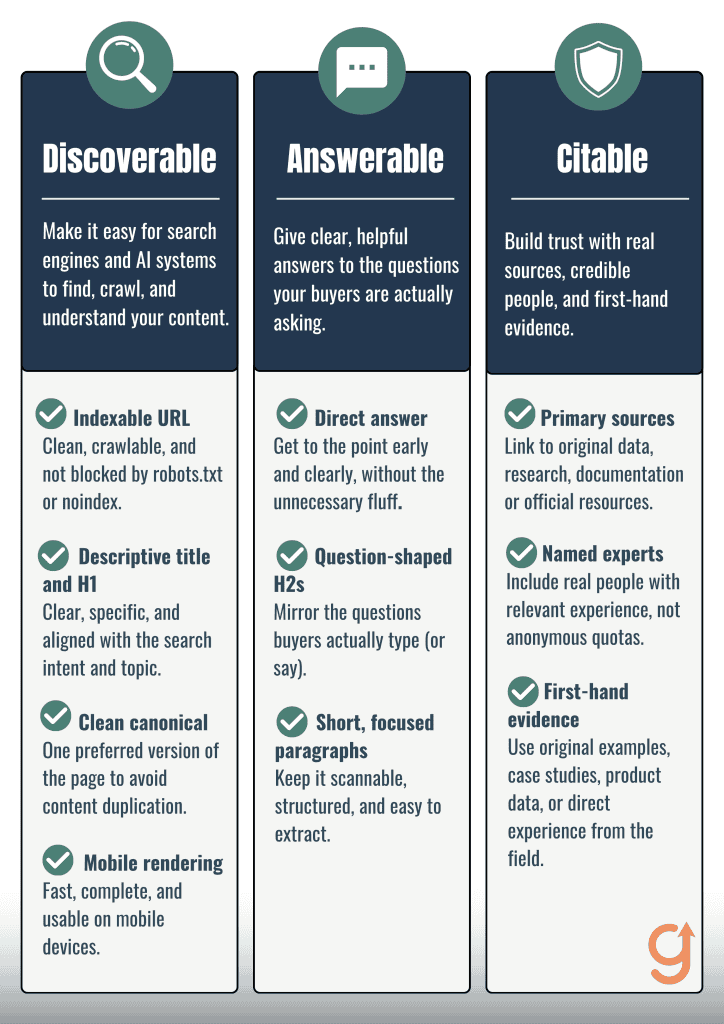
A B2B SaaS page can compete only when three conditions hold. Search systems must reach and index it. They must extract a clear answer from it. They must also find enough evidence and accountable expertise to treat the answer as trustworthy.
Passing one condition does not compensate for failing another.
Make it crawlable and indexable
Google Search Essentials reduces technical eligibility to a small core: Googlebot must not be blocked, the page must return a successful response, and the content must be indexable. Check the canonical URL, robots directives, sitemap inclusion, internal crawl path, mobile rendering, title, H1, and page response before editing prose.
A page that is not indexed has a discovery problem. Adding more citations or rewriting the introduction cannot solve it. Fix the failed condition first, request recrawling when appropriate, and verify the indexed result before moving down the loop.
Create an extractable answer
Answerability is a writing and information-design job. Open every major section with a self-contained response. Keep the paragraph focused on one question. Use lists for parallel criteria and numbered steps for sequences. Descriptive headings help readers and search systems identify where one answer ends and the next begins.
The direct answer still needs a useful body behind it. A 50-word summary cannot replace the mechanism, limits, evidence, examples, and next actions a qualified buyer needs. Extraction is the doorway, not the whole room.
Give search systems evidence worth citing
Citability requires more than a concise sentence. Link important facts to their original source, name the expert behind a quotation, show the method behind first-hand evidence, and remove claims that cannot be verified.
The Ahrefs zero-traffic study is useful here because it reports both the finding and its limitations. That transparency helps a reader judge the claim instead of merely repeating it.
Use this pre-publish check:
- The URL is indexable and uses a clean canonical.
- The title, H1, and H2s describe the buyer question precisely.
- Each major section begins with a direct answer.
- Every statistic and quotation links to the supporting source.
- Named expertise and approved first-hand evidence are clearly attributed.
- The page works on mobile, and its internal links resolve.
How does a B2B SaaS team connect one page into topical authority?
A B2B SaaS team builds topical authority by connecting pages around buyer decisions, not by publishing every keyword variation.
The primary page should link up to the broader decision page and across to supporting pages only when they own the reader’s next question. Each link should clarify the relationship.
Link up to the decision page
The basics page is an execution layer inside a larger search strategy. It should help the strategy page explain implementation without forcing that page to repeat beginner guidance.
As a result, crawlers gain a clear path between the broad decision and its supporting method.
Google advises site owners to use crawlable links and descriptive anchor text in its Starter Guide. That guidance supports a simple rule: the anchor should tell the reader what answer waits on the next page.
“Learn more” hides the relationship. A precise phrase exposes it.
Link across only where the buyer needs the next answer
This page connects to deeper material on keyword selection, the differences among SEO, AEO, and GEO, and earning AI citations through GEO. Those links prevent duplication because each page keeps a defined job.
Avoid linking by quota. If two pages answer the same question for the same reader, the problem is ownership, not link volume. Merge, redirect, or redefine the pages before adding more anchors.
How should a B2B SaaS team measure Google and AI visibility?
A B2B SaaS team should read Google impressions, clicks, CTR, position, and qualified actions alongside a repeatable record of AI mentions, citations, and description accuracy.
Google provides query-level performance data. AI assistants provide sampled answers, so preserve the questions, responses, dates, and cited sources behind every assessment.
Read impressions, clicks, and CTR together
Google’s Search Console and Analytics guidance separates pre-click search behavior from on-site behavior. Search Console shows how people found the site. Analytics shows what they did after arrival. A page needs both views to connect visibility with qualified action.
Read the sequence diagnostically:
- No impressions: inspect indexing, demand, intent match, and the page’s connection to the site.
- Impressions without clicks: inspect position, title, description, and whether the result matches the buyer’s intent.
- Clicks without qualified action: inspect the promise, page experience, CTA, and alignment with the buying decision.
- Qualified action without scale: inspect the size of the addressable query set and supporting cluster.
Backlinko’s analysis of roughly four million Google results found that the first organic result averaged a 27.6% click-through rate. Treat that as study context. Your CTR varies by query, result features, device, brand familiarity, and intent.
Test AI answers without inventing a universal ranking
AI visibility is a sampled observation, not one stable rank. Choose five to ten questions tied to the buyer decision. Run the same set in the same assistants on a recorded cadence. Capture whether the company appears, whether its page is cited, whether the description is accurate, and which competing sources appear.
An AI omission suggests a different investigation from an inaccurate mention. Omission can point toward weak coverage, evidence, or authority. Inaccuracy points toward unclear entity signals or conflicting source material. Preserve the actual answers because a score without its evidence cannot guide a repair.
What should the first 90 days of B2B SaaS search visibility look like?
The first 90 days should install one complete visibility loop around one buyer question and one primary page.
The goal is operational evidence, not a large publishing count. Each 30-day phase should produce one owned output and end with a decision about the next constraint.
Days 1 to 30: decide and instrument
- Choose the buyer question and name the decision behind it.
- Select the primary URL and assign one accountable owner.
- Record the current index status, Google performance, qualified actions, and AI-answer captures.
- Approve the brief, evidence plan, cluster boundary, and fixed AI-question set.
The baseline prevents retrospective storytelling. Use Google Search Console and Analytics to separate pre-click search performance from on-site behavior.
Without that record, the team cannot tell whether an edit changed visibility or merely changed the page.
Days 31 to 60: publish and connect
- Make the page discoverable, answerable, and citable.
- Add the decision-led internal links defined in the brief.
- Verify the published bytes, canonical, mobile rendering, links, and structured FAQ output.
- Submit or request recrawling when the technical state warrants it.
Do not start three separate optimization backlogs during this phase. One page should complete the entire loop before the team expands the system.
Days 61 to 90: test both surfaces and improve
- Compare Google impressions, clicks, CTR, position, and qualified actions with the baseline.
- Repeat the fixed AI-question set and preserve every response and citation.
- Diagnose the first failed condition in the loop.
- Make one bounded improvement and record the next review date.
The first cycle may reveal a technical block, weak selection, unclear answers, thin evidence, or a missing authority connection. That result is progress because the team now knows where to act. Do not bury it under a larger tool stack or dozens of new pages.
How do you find the first B2B SaaS search visibility constraint?
Start with the operating card and find the earliest failed condition. Confirm that the page is discoverable, then inspect answerability, citability, connection, Google selection, and AI-answer evidence in that order. The first clear failure becomes the next bounded repair.
If the evidence is scattered or the constraint is unclear, use the assessment to identify which part of the system should be addressed first.
Run the AI Search Assessment to diagnose whether discoverability, answerability, citability, connection, or measurement is limiting your visibility.
Frequently Asked Questions
What are the basics of SEO?
SEO basics help search systems find, understand, and evaluate a page, then help the right person decide whether to visit it. The practical foundation includes an indexable site, clear page structure, useful answers, verified evidence, descriptive internal links, and measurement through Google Search Console. For B2B SaaS, those basics should also support answer extraction and AI citations.
How do I start SEO for a B2B SaaS website?
Start with one buyer question tied to a real business decision and assign one page to own the answer. Record its current index status, Google performance, qualified actions, and AI-answer presence. Then make that page discoverable, answerable, citable, and connected before expanding the content plan.
How can I learn SEO as a beginner?
Learn SEO by applying one complete loop to a real page. Use Google Search Essentials and the SEO Starter Guide for the technical foundation, then practice writing direct answers, checking sources, adding useful internal links, and reading Search Console data. A live page reveals the relationships between those skills faster than isolated tactic lists.
How long does SEO take to work?
SEO has no guaranteed timeline because crawling, competition, site authority, query demand, and page quality vary. Use a 90-day operating cycle to establish a baseline, publish or improve one primary page, and collect enough Google and AI-answer evidence to identify the next constraint. Treat the cycle as a decision window, not a ranking promise.
Which SEO metrics should a B2B SaaS company track?
Track Google impressions, clicks, click-through rate, average position, qualified conversions, and assisted pipeline together. Add a fixed AI-question test that records company mentions, cited-source presence, description accuracy, and competing sources. The useful metric set connects visibility to buyer action and preserves the evidence behind every AI score.
Is SEO still worth it when buyers use AI search?
Yes. Google results and AI-generated answers both depend on discoverable, understandable, and trustworthy web sources. The work now extends beyond rankings into extractable answers, verifiable evidence, entity clarity, and citation tracking. A strong page can support traditional search visibility and become a source that AI assistants use.