
Why B2B SaaS Growth Strategies Fail

TL;DR: Most B2B SaaS growth strategies fail because the five usual mistakes are not five problems. They are five disguises worn by one binding constraint that usually hides right after the sale. The deeper failure is that the fix gets installed as tools and dashboards but never as team habits, so it stops being used inside a quarter. A growth system survives only when it is installed, automated so it runs itself, and held by designed habits.
Key Takeaways:
- The five common B2B SaaS growth mistakes are symptoms of a single binding constraint, so fixing the wrong one first never moves the number.
- The constraint usually sits downstream of the sale, where nobody owns it, which is why more acquisition just spins faster to stay flat.
- Acquiring a new customer costs five to 25 times more than keeping one, so piling on top-of-funnel rarely fixes a stall driven by a retention leak.
- A strategy that worked for a quarter and then quietly died is the most common failure, because the tools changed and the team behavior did not.
- A growth system lives only when it is installed as a connected engine, automated so it runs without a babysitter, and anchored to habits the team already has.
I have spent years inside B2B SaaS growth, first building and instrumenting the systems as an operator, then diagnosing why they stalled. The pattern is almost always the same. A team reads its flat pipeline as five separate problems and goes hunting for five separate fixes.
They borrow the language of bottlenecks without ever finding their own, and they treat each quarter’s new tactic as the answer. It almost never is.
This is for the founder or marketing leader who already typed the diagnosis question because something is broken and the obvious moves did not work. You have added channels, raised budget, and shipped a new playbook, and the number still will not move.
Maybe worse, you paid for a strategy once, it worked for a quarter, then it quietly decayed and you cannot say exactly when. The honest read is not that you picked the wrong tactic. The real move is to find the one thing actually capping growth, then install a system that survives after the kickoff energy leaves.
Why do most B2B SaaS growth strategies fail?
Most B2B SaaS growth strategies fail for two reasons that stack on each other.
First, the five common mistakes everyone names are symptoms of one underlying constraint, so teams fix the visible thing and leave the real one untouched. Second, even a good fix gets installed as tools and dashboards but never as team behavior, so usage decays and the number drifts back to flat.
Here is the symptom you actually see:
- You add a channel, raise the budget, and ship the new playbook the consultant left behind.
- Ninety days later, the pipeline reads about the same.
- The leading indicators looked fine for a few weeks, then they faded.
- Nobody decided to stop. The work just slid back to whatever the team did before.
That gap between effort and result is the whole story. When five different teams describe five different failures, and every one of them ends in a flat pipeline, the smart bet is that you are looking at one problem in five outfits.
Acquiring a new customer is anywhere from five to 25 times more expensive than retaining one, so when a stall is really a retention leak, spending more to acquire is the most expensive way to stay where you are.
The rest of this piece names the five costumes, shows you the one constraint underneath, then hands you the fix that does not die in a quarter.
Why does fixing one failure never seem to move the number?
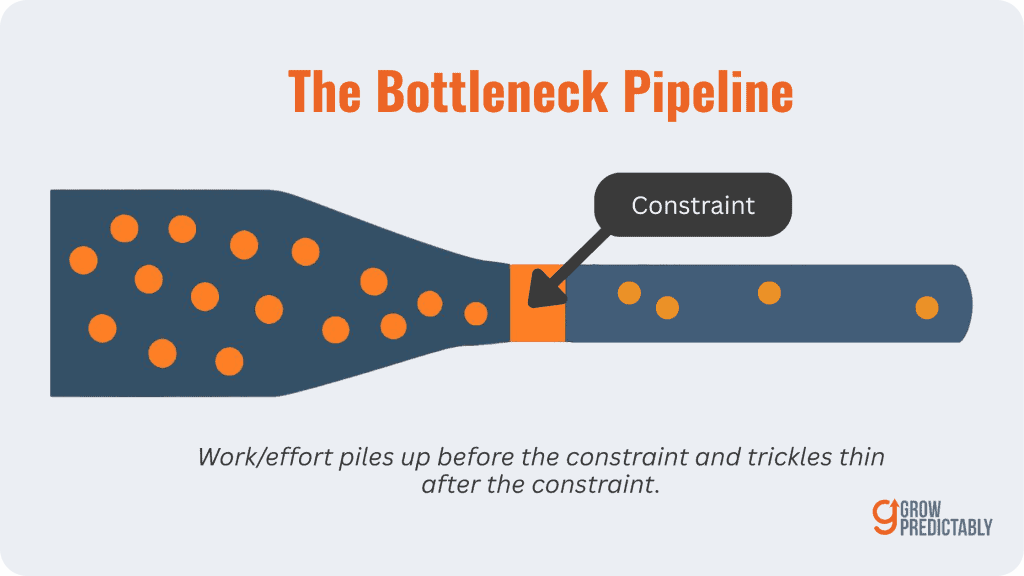
Fixing one failure rarely moves the number because at any moment there is usually a single binding constraint, and effort spent anywhere else just stacks up in front of it.
You can pour work into a part of the system that already has spare capacity, and all you get is buildup. The bottleneck stays exactly as tight as it was.
That is the core of one-constraint thinking, which is the plain version of what Eliyahu Goldratt called the Theory of Constraints. One stage caps the whole system. Speed up a non-constraint, and nothing downstream moves faster, because the slow stage still rations the flow.
In my own words to clients: unlock the constraint, or you are just stacking inventory before a bottleneck. You feel busy. You are spinning, not growing.
The five named failures are not five independent mistakes. They are how that one constraint shows up in different parts of the funnel:
- Sometimes it wears the random-acts costume at the top of the funnel.
- Sometimes it wears the retention costume right after the sale.
- The costume changes. The binding stage does not.
The tempting anti-pattern is to chase the newest tactic each quarter: a new channel, a new tool, a new playbook. It feels like progress because there is motion and a fresh dashboard.
It changes nothing, because it treats a symptom and leaves the constraint alone, and it quietly raises your cost per outcome while the leak stays open. The job is to find the one stage that caps everything, then treat that.
Costume one and two: are you chasing channels and pouring budget on a downstream leak?
The first two costumes both live at the top of the funnel, and both feel productive while doing nothing for a downstream constraint. They are the random-acts costume and the acquisition costume.
The random-acts costume
This is what happens when channel choice comes before the diagnosis. The team picks three or four channels, runs all of them at half strength, and does each one poorly because attention is split. It looks like a strategy. It is really a guess wearing a calendar.
The tell is that no one can say which stage of the buyer’s path each channel is supposed to fix. The fix here is upstream of any channel:
- Get specific about who you actually serve and what they need to see.
- Then publish content that earns trust instead of chasing volume.
Channel selection is the last decision, not the first.
The acquisition costume
This one is more seductive because it usually shows real activity. Leads go up. Demos go up. Revenue does not. The team responds by spending even more to acquire, so the acquisition engine spins faster just to stay flat.
If the binding constraint sits after the sale, every extra dollar at the top buys you more prospects who hit the same downstream leak. More top-of-funnel raises your cost per outcome and hides the real problem behind a busy dashboard.
If you genuinely need a more qualified pipeline, the move is to build a connected lead generation engine that is sized to the stage that actually constrains you. Until then, pouring budget on top of a leak is the most expensive non-fix in the playbook.
Costume three and four: is your real constraint hiding right after the sale?
For most stalled B2B SaaS companies, the binding constraint is downstream of the sale, in the messy handoff where a buyer crosses from prospect to customer and waits to find out whether the promise was real. Two costumes hide here: the retention costume and the wrong-target costume.
The retention costume
This is the one that masquerades hardest as an acquisition problem. Growth feels slow, so the instinct is more leads. The actual leak is the 48 to 72 hours right after the sale, the handoff that nobody owns, where great onboarding cannot fix a broken promise. Your growth is not the problem. Retention is.
The numbers back this up plainly:
- SaaS businesses with net retention over 100% grow 43.6% per year, versus 13.1% for those under 60%.
- They grow at least 1.5 to 3 times faster than peers.
- When expansion revenue compounds, you barely need to win the acquisition race. When it leaks, you can win that race every month and still stand still.
This section does not own the repair work itself. For that, see the renewal and retention strategies piece.
The wrong-target costume
The fourth costume is the sneakiest, because every downstream number reads like a marketing failure when the real failure is fit.
Serve the wrong buyer and your content underperforms, your demos stall, your churn climbs, and your team chases each of those as a separate fire. They are one fire. The wrong people came in the door.
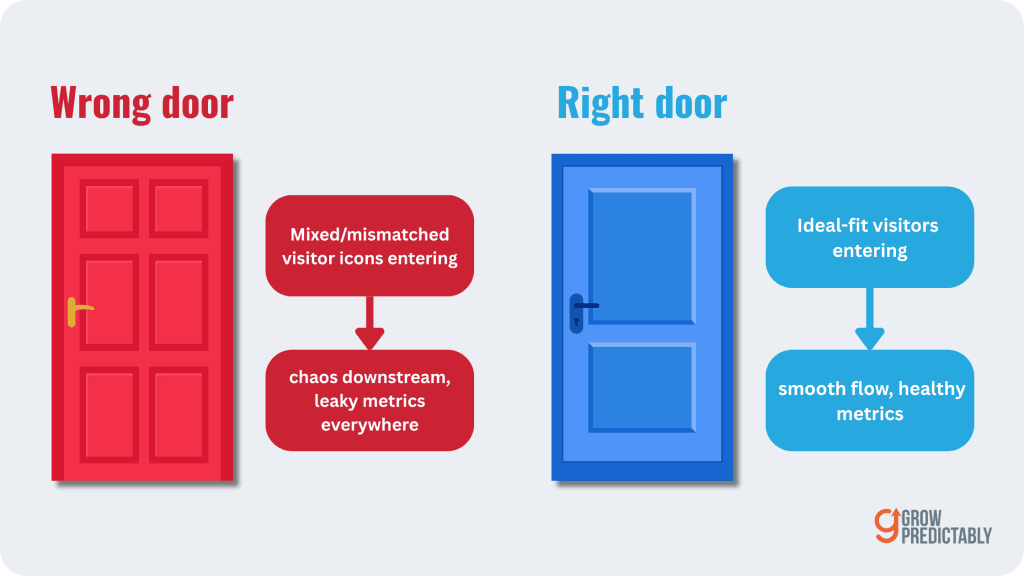
The diagnostic move is to trace the symptom upstream to the one fit gap that explains all of it, rather than treating each leaking metric on its own:
- Start by getting honest about who you actually serve and where the strongest-fit customers already cluster.
- Once the right buyer is in the full path a buyer takes from stranger to fan, the downstream metrics usually stop looking broken on their own.
Costume five: did the strategy work and then quietly die?
The fifth costume is the one almost nobody diagnoses, and it is the reason this is the pillar of the whole cluster. The strategy was sound. It even worked for a quarter. Then usage decayed once the kickoff energy faded and the consultant left, and one day you noticed the dashboard had not been opened in weeks and the weekly review had quietly stopped happening.
The real cause is not the strategy. It is that the tools changed and the team behavior never did. A new process is a behavior change, and behavior change is hard to make permanent:
- Training builds knowledge.
- Habits shape results.
A team can know the new playbook cold and still drift back to the old motion the moment outside pressure lifts, because nothing anchored the new behavior to something they already do every day.
The data on this is sobering. Only 32% of business leaders report that the last change they led achieved healthy adoption by employees, and the organizations that do adopt well report two times higher year-over-year revenue growth. Read that twice. Two-thirds of change efforts fail at the adoption step, which is exactly the step a strategy document ignores.
This fifth costume is usually upstream of the other four:
- The reason last quarter’s retention fix is gone is that it was never installed as a habit.
- The reason last quarter’s content engine went quiet is the same.
Which is the bridge into the only fix that survives.
What does a growth system that survives actually look like?
A growth system that survives looks like three things working together, not a strategy document. It is installed as one connected engine the company owns, automated so it runs without a babysitter, and held in place by designed team habits so it keeps running after the kickoff energy is gone.
Strategy is a plan. A system is the plan plus the machine plus the behavior that runs the machine.
Install the connected engine
Installing means putting one connected engine in place, owned by the company, with a single named owner per part. Not a stack of disconnected tactics that each report to a different tool and a different person.
I have seen what installing and instrumenting connected systems does to the numbers. At one enterprise B2B SaaS company, that work produced results across three areas:
- Bad URLs cut by 84.1%
- Landing page conversion rate lifted by 83%
- Contact Sales pipeline grown by 68%
Those are install-and-instrument outcomes. They came from connecting the pieces, measuring the right stage, and keeping one person accountable for each.
Automate so it runs without a babysitter
Automating means the repetitive running of the engine happens on its own. The scorecard updates itself. The weekly review pulls its own numbers instead of waiting on someone to build a spreadsheet by hand on a Friday.
With today’s AI and no-code tooling, most of the manual upkeep that used to kill these systems can be handled by the machine.
Automate the routine, amplify the strategic. That is also where a single well-placed change can swing real money. One isolated A/B test I ran at a major airline drove a 14.1% sales lift, the kind of result you only find when the system measures cleanly enough to trust the test.
Automation is not set-and-forget. It is removing the babysitter so the humans spend their attention on judgment, not maintenance.
Design the habits that make it stick
This is the layer every competitor skips and the reason most installed systems die. You design the team habits that keep the engine running once the outside energy leaves. The method comes from behavior science, not willpower.
As a DigitalMarketer Certified Partner since 2020 and a trained behavior-design practitioner, the move I install is the one Stanford behavior scientist BJ Fogg, author of Tiny Habits, describes:
When you make the change really small, you stop relying on high levels of motivation to sustain it.
In practice, that means two things:
- Anchor each new behavior to a routine the team already does.
- Make the step small enough to do on a bad week.
A paste-ready example: “After the Monday standup, the owner opens the scorecard and reads the one downstream number out loud.” It is tiny, it is anchored to something that already happens, and it survives a busy week. The right cadence is the cadence you will actually do consistently.
The honest boundary here is that this is method and credential, not a promised result. The authority for the habit layer comes from the science and the Gartner adoption data above, which is exactly why a designed habit is the difference between a system that lives and one that dies.
How do you find your own binding constraint in the next 90 days?
You find your binding constraint by watching where the number stops moving even when the input goes up. That is the whole test. Pour more into a stage and see if anything downstream changes. If it does not, you have found a non-constraint, and the real bottleneck is somewhere you have been ignoring.
Run three plain checks:
- Is a downstream metric flat while traffic or leads climb? That points the leak past the sale, into retention or expansion, the way the net-retention gap above predicts.
- Is the new behavior still happening 30 days after kickoff, or has the dashboard gone quiet? If the behavior stopped, the constraint is adoption, not strategy.
- Is one person clearly accountable for the constrained stage, or is it everyone’s job and therefore no one’s? Shared ownership is no ownership.
You do not need the giant audit spreadsheet or a seven-step weekly ritual to do this. They hand you a worse, slower version of a real diagnostic and send you off to build it yourself.
What a real diagnostic looks for is exactly those three signals: where input rises and output does not, whether the behavior survived 30 days, and whether anyone owns the constrained stage. Make it owned by one person and measurable within 30 to 90 days. That is a diagnosis you can act on, not a tool you have to buy.
Where does your failing B2B SaaS growth strategy go from here?
Here is one idea to carry out of this. The five failures are one constraint wearing five costumes, and the fix only survives when it is installed as a connected engine, automated so it runs itself, and held by team habits that outlast the kickoff. The first action is not another tactic, and it is not a new tool.
It is the diagnosis. Find the single stage that caps everything before you spend another dollar treating a symptom. Everything I have built that lasted started there, with naming the one constraint and putting one owner on it.
Skip that step, and you are back here in a quarter, reading flat pipeline as five problems again. So start with the constraint, and let the system you build around it be the kind that does not quietly die.