
B2B SaaS Marketing AI Tools: Choose by Constraint

TL;DR: B2B SaaS marketing AI tools should be chosen by the growth constraint they can remove, not by the length of their feature list. Start with the capability already inside your system of record, give one candidate the customer context it needs, and require a measurable 30-day result before it earns a permanent place in the stack.
Key Takeaways
- Diagnose the constrained growth job before comparing B2B SaaS marketing AI tools.
- Score every candidate on context, integration, proof, and a written kill criterion.
- Test the AI already inside your CRM, analytics, or product platform before adding a point tool.
- Measure one business outcome against a baseline for 30 days. Faster output alone is not proof.
- Keep the tool only when it improves the constrained job without creating a larger data, workflow, or governance problem.
The market keeps giving B2B SaaS leaders more AI choices. The work has not become simpler. Marketing still has to help a buying committee recognize a problem, understand a category, build internal confidence, and move a decision across sales, finance, security, and the executive team.
That creates four practical jobs for an AI-enabled marketing stack. It must help the team see demand, turn expertise into useful content, move buyers and users through the right next step, and learn from customer behavior. A tool that accelerates the wrong job can increase activity while the real constraint stays put.
That is the symptom to watch: more tools and more output, with no meaningful change in acquisition, activation, retention, or pipeline. The root cause is not weak AI. It is a buying process that began with a product category instead of a constrained job.
The answer is a constraint-first decision, followed by a bounded pilot and an explicit keep, change, or kill call.
Why do more B2B SaaS marketing AI tools rarely fix a growth constraint?
More software rarely fixes an unclear diagnosis. It usually gives the team more ways to produce, route, and measure work that was already disconnected from the customer decision.
Salesforce’s 2026 State of Marketing research makes the gap visible. In a double-anonymous survey of 4,450 marketing decision makers, 75% said they were turning to AI, while 84% said they still ran generic campaigns. Another 98% reported barriers to personalization. The study also found that only 56% had complete access to sales data and 69% struggled to respond to customers promptly.
Adoption was high, but usable context was not. Salesforce reports the population, method, and findings on its State of Marketing page.
Every marketer has access to the same AI models. So what separates the winners? Relevant context.
Bobby Jania, Salesforce Agentforce Marketing CMO
That observation matters more than another ranked list. A writing assistant cannot repair a weak point of view. A lifecycle agent cannot personalize around events the product does not capture. A visibility platform cannot improve a brand’s answer if the underlying expertise is generic. A support agent cannot make a clean handoff when customer state is missing.
The right opening question is not, “Which AI tool is best?” It is, “Which growth job is limiting the system right now?” A B2B SaaS team should locate the constraint in the customer journey, name the observable failure, and decide what information a tool would need to change it.
That is the same diagnostic principle behind a constraint-first B2B SaaS marketing strategy.
If the constraint is weak acquisition, test whether the problem is discovery, message relevance, or conversion. If it is activation, find the missing behavior between signup and first value. If it is retention, identify the customer signal that arrives too late. The tool comes after that diagnosis.
The Constraint-First Scorecard for B2B SaaS marketing AI tools
The Constraint-First Tool Scorecard turns a product demo into a decision. Use one row for one candidate. Do not score a suite as if every capability will be implemented at once.
The order matters. A team that starts with integration tends to ask whether the software can connect. A team that starts with the constrained job asks whether connecting it would change anything valuable.
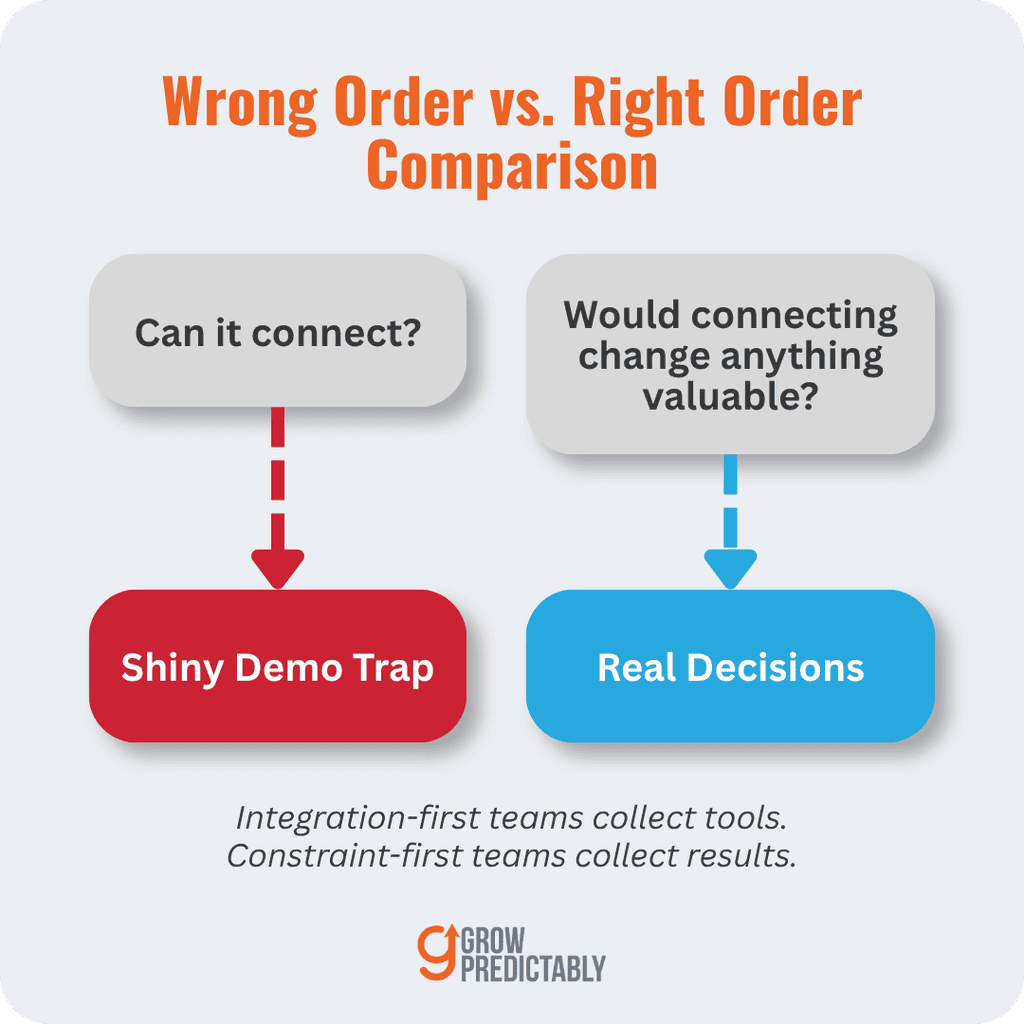
The context field is where impressive demos often fail. Vendors can demonstrate generation with clean sample data. Your pilot has to work with your taxonomy, permissions, account structure, buying committee, content, and handoff rules.
If those inputs are incomplete, the scorecard should say “not ready,” not give the product credit for a future data project.
The proof metric must be closer to business value than tool activity. Drafts created, prompts run, and summaries generated can explain adoption. They are not the decision metric. Useful proof looks like qualified activation, accepted opportunities, time to first value, retained revenue at risk, or cycle time for a defined workflow.
The kill criterion protects the team from a sunk-cost story. Write it before the pilot begins. Include the minimum result, the decision date, the unacceptable data or governance failure, and the owner who can stop the test.
I helped one market save $5,000 a year on an SEO tool after a feature comparison showed that an existing global platform covered the required job. The lesson was not that consolidation is always better.
It was that a new tool has to prove distinct value against capability the company already owns.
What belongs in the B2B SaaS foundation layer before another point tool?
The foundation layer is the system that holds customer identity, consent, commercial history, product behavior, and the rules for acting on that information. For many B2B SaaS teams, that means a CRM or customer platform, a product and web event layer, an analytics environment, and an approved AI workspace.
McKinsey’s 2025 global survey of 1,491 participants found that 71% said their organizations regularly used generative AI in at least one business function. Marketing and sales were among the most common uses. Yet fewer than one in five respondents said their organizations tracked well-defined KPIs for generative AI solutions, and more than 80% said they were not seeing tangible enterprise-level EBIT impact.
McKinsey’s research separates broad adoption from value capture.
That is why the existing-system-first test belongs in the scorecard. If the company already runs HubSpot, inspect what Breeze can do with CRM context before buying a disconnected writing, enrichment, or service tool. If Salesforce is the system of record, evaluate the relevant Marketing Cloud and Agentforce capability against the same proof metric.
These are conditional examples, not universal recommendations.
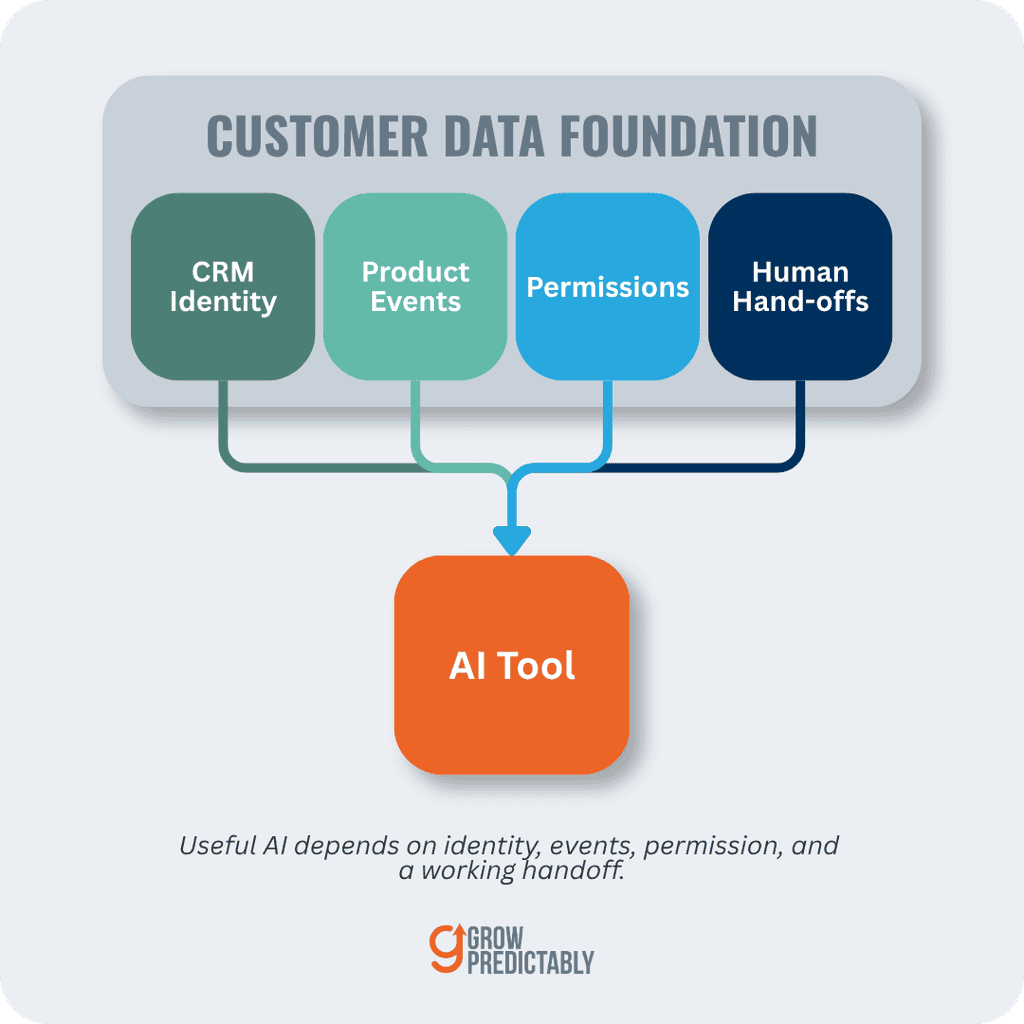
The foundation must pass four checks before a point tool gets a pilot:
- Identity: Can the team connect the person, account, buying role, and product user without guessing?
- Events: Are the behaviors that define the constrained job captured consistently?
- Permission: Is the proposed data use approved, limited, and visible to the right owner?
- Handoff: Can a useful output reach the person or system that will act on it?
For a general AI workspace, verify business-data terms and administrative controls instead of assuming the consumer product has the same boundary. For example, OpenAI states that it does not use inputs or outputs from ChatGPT Business, Enterprise, Edu, or its API to improve models by default.
Its current help article documents that business-data boundary. The broader governance decision still belongs in the team’s responsible AI marketing standard.
If identity, events, permission, or handoff is missing, repair the foundation first. Adding a point tool simply moves the same constraint into a new interface.
The acquisition and content layer for B2B SaaS marketing AI tools
The acquisition and content layer should help a B2B SaaS team discover the questions buyers use, convert real expertise into clear answers, distribute those answers, and learn which ones influence a decision. It should not be judged only by how many assets it produces.
SurveyMonkey’s marketing trends report reached 707 US workers in January 2024, including 507 marketing professionals and 200 market researchers. Among the marketers surveyed, 51% used AI to optimize content, 50% used it to create content, and 49% named changes in software and tools as a top challenge. The primary report provides the population, fielding period, and use-case breakdown.
The useful inference is not that every team needs another content generator. It is that content is already a crowded AI use case while tool change is itself creating operational pressure.
For a team constrained by slow research synthesis or first-draft cycle time, an approved general AI workspace may help. The required context is an approved brief, verified evidence, buyer language, brand voice, and a human owner.
The proof metric should measure time saved without a decline in factual accuracy, editorial acceptance, or contribution to the customer decision.
For a team constrained by search and AI discovery, a visibility tool can help identify where the brand appears and what sources are cited. Semrush says its AI Visibility Toolkit can benchmark mentions, citations, prompts, and competitors across AI-generated answers.
That capability is useful only when the team has already defined the buyer questions worth tracking and can act on the source gaps it finds.
The failure mode is predictable: the team buys generation capacity, output rises, and the content says nothing a buyer could not get from every competitor using the same models. The recovery is to make authority the input.
Build from verified operator experience, primary research, product evidence, and the real objections inside a committee sale. The authority-over-volume argument for AI in B2B marketing explains that boundary in depth.
A compact acquisition pilot might read:
- Constraint: The team takes ten business days to turn one approved expert interview into a decision-stage article.
- Candidate: The approved AI workspace already available to the team.
- Context: Interview transcript, evidence dossier, approved brief, voice rules, and reviewer standard.
- Proof: Cut median production time to six business days while maintaining zero unsupported claims and the same human acceptance rate.
- Kill: Stop if factual repairs exceed the baseline or expert review time increases.
That is a tool decision. “Create more content” is only an activity goal.
Which B2B SaaS marketing AI tools fit activation and lifecycle constraints?
Activation and lifecycle tools should change the next best action for a known user or account. Their value depends on behavioral context. Without a clean event taxonomy, AI merely personalizes around incomplete evidence.
Start with a minimum-signal artifact before evaluating a platform:
| Signal | Definition | Owner | Required action |
|---|---|---|---|
| First-value event | The earliest behavior that proves the user received the promised outcome | Product | Confirm that the event fires once and has an account identifier. |
| Activation window | The time in which a qualified user should reach first value | Growth | Set the baseline by segment. |
| Friction signal | A behavior that predicts delay, confusion, or abandonment | Product analytics | Define the intervention and suppression rule. |
| Commercial state | Trial, paid, expansion, renewal risk, or disqualified | RevOps | Keep the lifecycle message consistent with account status. |
| Human handoff | The condition that requires a person, not another automated message | Sales or Customer Success | Route with full context and a service-level expectation. |
Then compare tools against that artifact. A platform such as Pendo can be a conditional fit when the constraint is in-product guidance and the team has reliable segments and events. Its current product page describes targeted in-app guides, behavioral segmentation, and guide measurement.
A customer-service agent such as Fin can be a conditional fit when the constraint is repetitive support demand and the knowledge, routing rules, and escalation path are ready. Fin documents connections to existing help desks and human handoff with conversation context.
Neither product repairs missing definitions. If “activated” means a login to Marketing, a created project to Product, and a qualified account to Sales, the model will optimize three different outcomes. The recovery is a shared event dictionary, a single pilot segment, and one owner for the intervention.
Integration also includes operational timing. A useful prediction that reaches Customer Success after the renewal call has no value. A perfect segment that triggers three competing messages damages the experience. Test the whole path from event to decision to action, not the AI output in isolation.
The implementation details belong in a fuller B2B SaaS marketing automation workflow.
The retention and customer-insight layer for B2B SaaS marketing AI tools
Retention work begins with a harder question than “Which accounts are at risk?” The team must decide which observable behaviors, support signals, commercial facts, and qualitative feedback are credible enough to change an intervention.
AI can help cluster feedback, summarize calls, surface behavior changes, and make large evidence sets easier to inspect. Product analytics platforms, CRM reporting, support systems, and call intelligence can all contribute. The tool should not be allowed to turn correlation into a confident story.
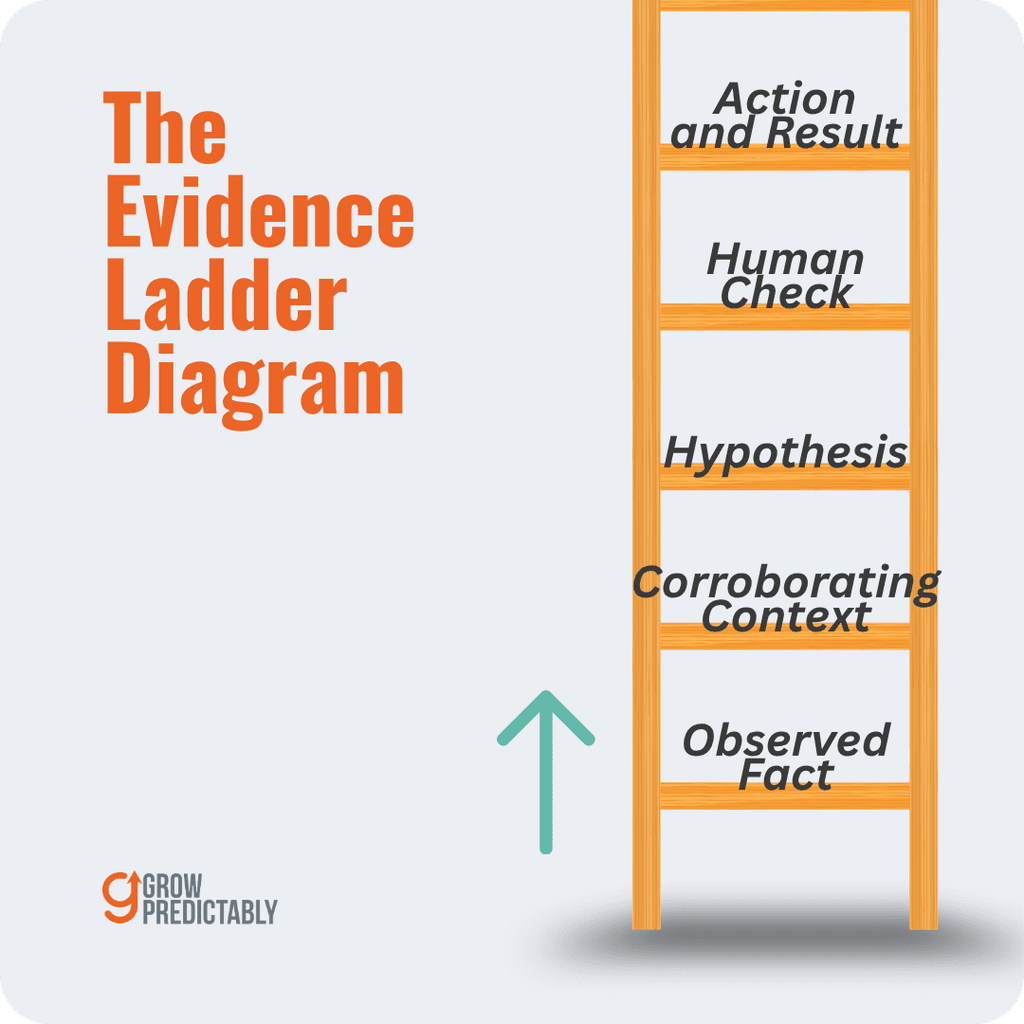
Use an evidence ladder for every retention signal:
- Observed fact: A named account’s weekly active users fell from 18 to 6 over four weeks.
- Corroborating context: Support volume rose, the champion changed roles, or a key workflow stopped completing.
- Hypothesis: The account may be losing operational adoption.
- Human check: The account owner confirms the context before outreach.
- Action and result: Customer Success runs a defined intervention and records whether usage and relationship health recover.
This prevents false precision. A model-generated health score is not an explanation, and a summary is not a customer truth. The team needs the underlying events, the source feedback, and the ability to challenge the model’s interpretation.
The same rule applies to measurement. A dashboard should connect activity to the constrained outcome and show where evidence is missing. In one verified operator example, an anonymized paid-search landing-page test produced an 83% increase in conversion rate and a 26 percentage-point decline in bounce rate from a 58% baseline.
That result was useful because it tied a specific intervention to observed metrics, not because a platform produced a persuasive explanation.
For an AI retention pilot, pick one segment and one intervention. Measure precision at the point of human review, the time from signal to action, and the business outcome after action.
Keep the analytic implementation and attribution model inside a defined AI marketing analytics approach, where assumptions can be inspected rather than hidden in a single score.
How do B2B SaaS teams avoid paying for AI shelfware?
Shelfware begins before procurement. It begins when a team cannot name the workflow, the context, the owner, or the result that would justify renewal.
Zylo’s 2026 SaaS Management Index reports an average portfolio of 305 applications across its enterprise SaaS dataset. The report draws on more than 40 million licenses and more than $100 billion in discovered and categorized AI, SaaS, and cloud spend. It also reports that AI-native application spend rose 108% year over year.
Those figures are directional vendor data from an enterprise-heavy platform dataset, not a benchmark for every B2B SaaS company. They still illustrate why adding AI without an ownership and renewal discipline creates financial risk. Zylo describes the dataset and portfolio findings in its 2026 index.
Run this pre-purchase check before a demo becomes a pilot:
- Constraint: Is one failed growth job documented with a baseline?
- Existing capability: Has the team tested the relevant AI inside its current system of record?
- Context readiness: Can the candidate access the minimum useful data without a separate transformation project?
- Workflow owner: Does one person own the output, handoff, and weekly pilot review?
- Governance: Are access scope, retention, vendor terms, human review, and failure handling acceptable?
- Proof: Is there one outcome metric, one guardrail, and a decision date?
- Exit: Can the team remove the tool without losing the underlying data or breaking a customer workflow?
The recovery path is intentionally conservative. First, test the existing platform against the scorecard. Second, remove unused or overlapping capability. Third, pilot one point tool only if it solves a distinct job. This sequence reduces integration work and gives the point tool a real counterfactual.
Do not let deployment effort rewrite the success criterion. If the pilot misses the proof metric, diagnose whether the failure was the product, the context, the integration, or the intervention. Fix a bounded readiness problem once when the expected value justifies it.
Do not keep renewing a tool because the team has already invested time in connecting it.
Which B2B SaaS growth constraint should you test first?
Test the constraint that is both limiting growth and measurable within one operating cycle. Do not start with the tool that has the most internal enthusiasm.
Use this 30-day pilot card:
| Pilot field | What to record |
|---|---|
| Constrained job | One failure in acquisition, activation, retention, or the revenue handoff. |
| Baseline | The current result, population, measurement window, and known data gaps. |
| Candidate | One existing capability or one point tool. |
| Required context | The exact customer, content, product, and commercial data the candidate may use. |
| Workflow | Trigger, output, human owner, action, and escalation path. |
| Proof metric | One outcome that can move in 30 days. |
| Guardrail | One quality, customer, security, or downstream metric that must not deteriorate. |
| Kill criterion | The minimum result and unacceptable failure that end the test. |
| Decision date | Day 30, with keep, change, or kill as the only valid decisions. |
Week one establishes the baseline and validates the data. Week two runs the workflow with human review. Week three measures failures and makes one bounded correction. Week four compares the result with the baseline and records the decision.
Keep the candidate when it improves the proof metric, respects the guardrail, and has an owner who can operate it. Change the pilot when the diagnosis remains sound but one repairable context or integration issue blocked the test. Kill the candidate when it does not create distinct value, requires context the business cannot responsibly supply, or moves activity without moving the constrained outcome.
The best first test is often not a new purchase. It may be a dormant capability inside the CRM, product platform, analytics system, or approved AI workspace. The scorecard makes that visible and forces every new product to beat the system you already fund.
If the constrained stage is still unclear, take the Growth Gap Scan. It will help identify where the customer journey is limiting growth so the next B2B SaaS marketing AI tool is tested against a real problem rather than a persuasive demo.
Frequently Asked Questions
What are the best AI tools for B2B SaaS marketing?
The best tool is the one that removes the growth constraint your team can document and measure. Compare candidates by the customer context they require, how they enter the existing workflow, and the result a 30-day pilot should produce. A content tool, lifecycle platform, or analytics product can each be right for a different constrained job.
How many AI marketing tools should a B2B SaaS team use?
Use the smallest stack that covers the team’s proven jobs without duplicating capability or ownership. Test the AI already inside the CRM, analytics, product, or support platform before adding a point tool. Add another product only when it solves a distinct constraint and can beat the existing capability against the same proof metric.
Should I add an AI point tool or use the AI in my existing platform?
Test the existing platform first because it may already have the identity, permissions, events, and workflow connections the job requires. A point tool earns a pilot when it offers a distinct capability or materially better result. Score both options on the same baseline, implementation cost, guardrail, and kill criterion before deciding.
How do I calculate the ROI of an AI marketing tool?
Document the current baseline, then count subscription cost, implementation time, integration work, training, governance, and ongoing review as the total cost. Choose one outcome metric close to business value, such as qualified activation, accepted opportunities, or workflow cycle time. On the decision date, compare the measured improvement with total cost and the written kill criterion.
Can AI replace a B2B SaaS marketing team?
AI can automate bounded tasks such as synthesis, drafting, routing, and pattern detection, but it does not replace strategy, customer judgment, accountability, or earned expertise. The team still has to define the decision, supply reliable context, review consequential output, and own the result. Use AI to remove workflow friction, not to erase responsibility.
What data and privacy checks should happen before connecting an AI marketing tool?
Confirm that the data is permissioned, limit the tool to the minimum access it needs, and review retention, model-training, security, and subcontractor terms. Define who can see the output, when a human must review it, and how access will be revoked. Security and legal owners should assess the specific vendor and use case.