
B2B SaaS Product Marketing: Arm the Champion

TL;DR: In a B2B SaaS deal the person who sells your product hardest is your champion, arguing your case in meetings you will never attend. Product marketing’s real output is the ammunition they carry into those rooms. Score every artifact against one question: could your champion forward this, unedited, to someone sceptical?
Key Takeaways
- Your champion repeats your positioning second-hand, with less context and lower stakes than you. If it cannot survive that, it does not work.
- Most guides for this topic use self-serve examples, where one person discovers, decides, and pays in a single session. That is the wrong reference class for a committee purchase.
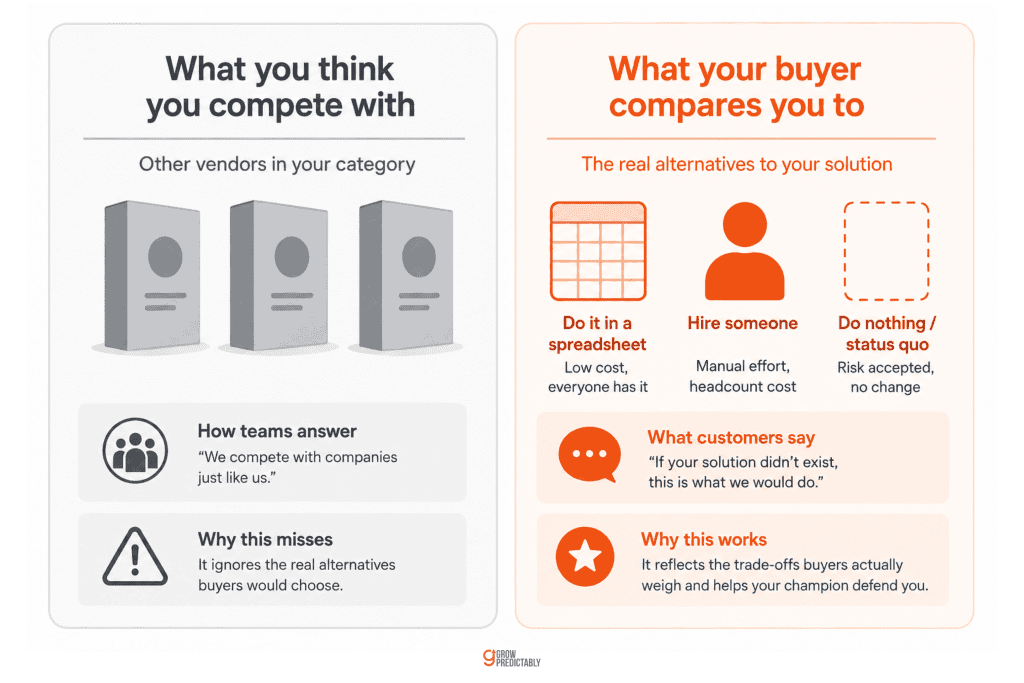
- Buyers often compare you to a spreadsheet, an intern, or doing nothing, rather than to the vendor on your battle card.
- Sales enablement is a first-class deliverable in B2B SaaS and is missing from generic playbooks because a self-serve product has no sales team to enable.
- The tell that nobody owns positioning: three teams describing the product three different ways in the same week.
There is a specific kind of stall that has nothing to do with lead volume. The first meeting went well. The champion was genuinely enthusiastic. Then the deal went quiet for five weeks, and when it came back, the questions were about a comparison you had never heard anyone make.
This is written for a B2B SaaS founder or head of growth who has product marketing happening somewhere but cannot point to what it produces.
Sales keeps asking for better materials, so more materials get made. Product thinks positioning is a naming exercise, so it gets treated as wordsmithing. And three teams describe the product in three different ways in the same week, which everyone notices, and nobody owns.
I have watched marketing leaders hire and fire digital marketing agencies for fifteen years, from both the agency side and the in-house marketing-leadership side, and the pattern underneath most disappointing product marketing is the same. The work was aimed at the wrong person. What follows is who it should be aimed at instead.
What is B2B SaaS product marketing?
B2B SaaS product marketing makes a product understandable and defensible to a group of people deciding together, most of whom you’ll never speak to directly. It owns what the product is for, who it’s for, what it replaces, and why that matters to a buying committee, not just to an individual user.
It’s often confused with two neighboring functions, but the split is clear once you name it:
- Demand generation creates interest and fills the pipeline.
- Product management decides what gets built.
- Product marketing sits between them and owns the words: the positioning, the comparison, and the case a committee has to build for itself.
That ownership isn’t theoretical. The Product Marketing Alliance, the industry body for the discipline, reports that 91 percent of product marketing teams own positioning and messaging. It’s the one responsibility nearly every product marketer shares, which is exactly why it’s worth being precise about what good positioning actually looks like.
Here’s the precise version: In B2B SaaS, positioning is good when it survives being repeated by someone else. That sounds like a low bar until you test it. Most positioning gets written for a motivated prospect reading closely in a quiet moment. In practice, it gets consumed as a half-remembered summary, delivered under time pressure, by someone juggling other priorities entirely.
Why do generic SaaS playbooks mislead B2B teams?
Read the top-ranking guides on this topic, and you’ll find the same shape: six strategies, seven strategies, eighteen examples. They’re competent guides, but they’re written for SaaS in general, which means their examples skew heavily toward self-serve and product-led products.
That distinction matters more than it sounds like it should. In a self-serve product, one person discovers it, evaluates it, and pays for it inside a single session. Every tactic in those guides is tuned for that loop:
- Activation
- Onboarding flows
- In-product prompts
- Trial conversion
None of that resembles your motion. Your buyer is a group, deciding over months, with a sales conversation somewhere in the middle and a procurement review at the end. Copying self-serve plays into that environment produces work aimed at an end user when the decision belongs to a committee.
The expensive part is what happens next. The metrics come back positive because activity always produces metrics, and they confirm that the wrong thing is working. This is a reference-class error, and it sits underneath most product marketing that feels busy and changes nothing.
Meanwhile, the stall has a known location. The Digital Bloom’s 2025 B2B SaaS funnel benchmarks name the marketing-qualified to sales-qualified step as the key bottleneck in the funnel, with an average conversion between fifteen and twenty-one percent. That’s the step where a champion is carrying your case into a room, and it’s precisely the step self-serve tactics can’t reach.
Here’s what that looks like in practice. A team reads that in-product messaging lifts activation, so they build a careful onboarding sequence. It does lift activation, because that’s a real effect. But activation was never the constraint, since the users were already convinced.
The deal was stuck with a finance lead who had never opened the product and never would. Six weeks of good work landed on the one person in the account who didn’t need persuading.
Who is product marketing actually selling to?
Here’s the part the generic guides can’t reach, because it doesn’t exist in a self-serve motion. Somewhere in your best open deal, a person is arguing your case in a meeting you weren’t invited to, to colleagues you’ve never met, using words they half-remember from a call three weeks ago.
That person is your champion. Because you’re not in the room, they’re doing the actual selling.
The champion is the one doing the selling
That reframes the job. Your champion is product marketing’s real customer, and the deliverable is the ammunition they carry. Everything you produce gets relayed second-hand by someone with less context than you, lower stakes than you, and no ability to answer a follow-up question you didn’t anticipate.
You can’t be in that room. Edelman and LinkedIn’s 2025 B2B Thought Leadership Impact Report, now in its seventh year and drawing on nearly two thousand global professionals, found that misalignment inside the buying group makes these hidden buyers a real risk, and that strong thought leadership is what reaches decision-makers you otherwise never see.
So the test of positioning changes. It’s no longer about whether the person reading it is persuaded. It’s whether it survives the relay: whether a moderately motivated champion can repeat it accurately to a skeptical finance lead, four weeks later, without you there to correct them.
Write for repeatability, not impression. That means:
- Short. Long enough to be true, short enough to be repeated.
- Concrete. Specific claims travel better than abstract ones.
- Hard to garble. If a sentence needs your tone of voice to land, it won’t survive the trip.
There’s a cheap way to test this before it costs you a deal. Say your positioning out loud to someone who doesn’t work on the product, wait a day, then ask them to explain it back. What comes back is roughly what your champion will carry into the room.
If the version you hear is vaguer than the version you gave, that vagueness isn’t a communication failure on their part. It’s the actual reach of your positioning, measured honestly.

What are you actually being compared against?
Ask a B2B SaaS team who they compete with, and you’ll get a list of vendors who look like them, usually the ones who show up in the same analyst grid. Ask their customers the same question, and you get a very different answer, which is awkward, because the customers are the ones who actually ran the comparison.
April Dunford, who wrote Obviously Awesome and is the recognized authority on B2B SaaS positioning, gets at it with one question she puts to happy customers:
Look, if my thing didn’t exist, what would you do?”
April Dunford, in a published interview
The answers are rarely a competitor, which is why the exercise is worth doing rather than assuming. In that same conversation, she makes the point directly: B2B software teams tend to assume their competition is other companies that look just like them, when in reality customers often say they’d just handle it in a spreadsheet or hire an intern to do it instead.
That’s the difference between a positioning document that works and one that answers a question nobody asked. If your champion is defending you against a spreadsheet and your materials compare you to a named vendor, you’ve armed them for the wrong argument. Worse, the committee will conclude you don’t understand their situation, which is expensive to recover from.
The fix is available this week and costs nothing:
- Call five happy customers.
- Ask Dunford’s question.
- Write down what they say, word for word.
- Rebuild your comparison around the alternative they actually named.
That comparison is the single most useful thing your champion can carry.
What should product marketing hand to sales?
Sales enablement is a first-class deliverable in B2B SaaS, and it is almost entirely absent from generic guides for an obvious reason.
A self-serve product has no sales team to enable, so the playbooks written for that motion simply do not include it. For you, it is most of the job.
The Product Marketing Alliance’s State of Product Marketing Report 2023 found that 80 percent of product marketers were responsible for creating sales collateral, up from 78 percent the year before, and 75 percent worked most closely with sales. The discipline already knows where its output goes.
So name the artifacts concretely, because “enablement” on its own means nothing and therefore never gets prioritised:
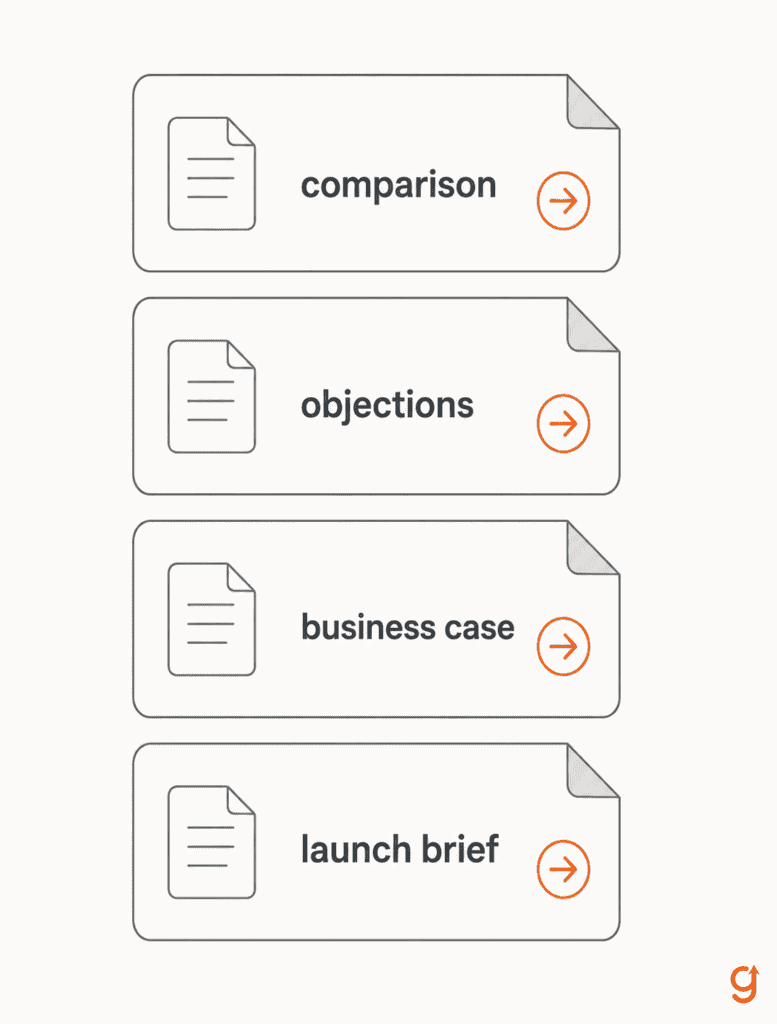
- The real comparison. One page, you against the alternative your customers actually named, written so a non-expert can follow it.
- The objection sheet. The six questions that stall deals, with answers a champion can give without escalating to you.
- The business case. What a finance lead reads when you are not in the room. Numbers, timeframe, what happens if they do nothing.
- The internal launch brief. What sales and customer success need on day one is a different document from anything a user sees.
Score each one against the repeatability test: could your champion forward this, unedited, to someone sceptical? If the answer is no, it is a brochure.
The word unedited is doing real work there. Most collateral fails this test for reasons that have nothing to do with accuracy. It is simply embarrassing to forward. It talks about the vendor rather than the problem; it opens with a company milestone nobody asked about, or it reads as advertising, which makes the champion look credulous for circulating it.
A champion protects their own credibility first, and rightly so. Anything that costs them standing internally will quietly never be sent.
One consequence worth stating plainly. In B2B SaaS, a launch lands internally first. If a release reaches your users but your sales floor cannot explain it, you have not launched; you have published.
The B2B SaaS content marketing side of the house is a separate job from this one, and conflating the two is how enablement quietly stops happening.
Who owns product marketing in a B2B SaaS company?
Almost nobody answers this, which is odd given how often it’s the actual problem.
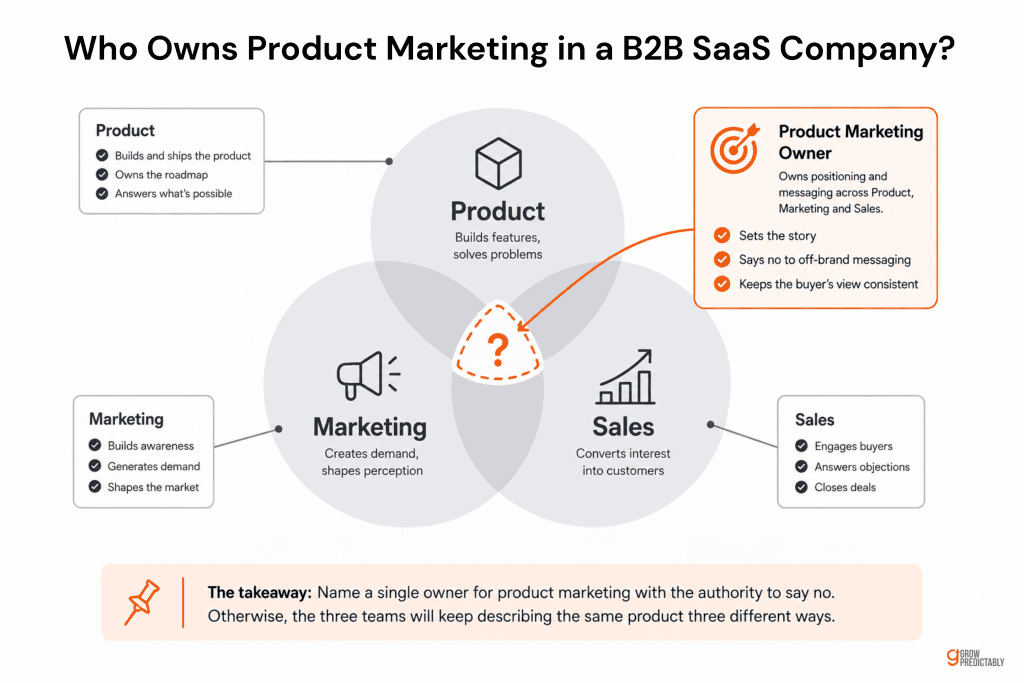
Product marketing sits between product, marketing, and sales. By default, that means everybody edits it, and nobody owns it, so the words drift until three teams are describing the same product three different ways.
Good looks like one named owner for positioning, with the authority to say no. Not consulted. Not a coordinator. Someone who can reject messaging that won’t survive being repeated, including messaging that came from a founder.
That last clause is where this usually breaks. Founder-authored language carries an implicit veto, so it propagates into the deck and the site even when it was written for an investor audience rather than a buyer. Naming an owner only works if that owner can overrule the founder too, which makes this a decision for whoever runs the company rather than something a marketing team can adopt on its own.
Here’s a diagnostic you can run in ten minutes. Pull the three most recent things your company published:
- A sales deck
- A website section
- A release note
Read the first paragraph of each and ask whether they describe the same product to the same buyer. If they don’t, positioning is unowned, and no amount of new collateral fixes it, because every new asset simply inherits whichever version its author happened to prefer.
If you want to know which stage of the journey is actually costing you, which stage is capping growth, the prior question is worth asking.
Where should you start this quarter?
Three steps, none of which need a new budget, new headcount, or a new tool. That is deliberate, because the expensive part of this is the decision about who you are arming and against what, rather than the production. Each one is startable within a normal working week.
- Call five happy customers and ask what they would do if you did not exist. Write down the alternative they name.
- Rebuild one comparison around that alternative, on one page, in language a non-expert can repeat.
- Hand it to sales and ask one rep to use it in a live deal this month. Then ask whether the words came back.
The cost of skipping it is quiet. Your champion keeps improvising your positioning from memory, in a room you will never enter, against an alternative you never accounted for. Nothing fails loudly. The deal just goes quiet for five weeks.
If you want the prior question answered first, the Double Your Sales Assessment scores your growth across attract, convert, ascend, and accelerate. That tells you which pillar is actually holding you back, and therefore whether product marketing is where this quarter’s effort belongs at all.
Frequently Asked Questions
What is B2B SaaS product marketing?
B2B SaaS product marketing is the discipline that makes a product understandable and defensible to a group of people deciding together, most of whom the vendor never speaks to. It owns what the product is for, who it is for, what it replaces, and why that matters to a buying committee rather than to an individual user. Positioning and messaging are owned by 91 percent of product marketing teams.
How is product marketing different from demand generation in B2B SaaS?
Demand generation creates interest and fills the pipeline. Product marketing owns the words that travel through it: the positioning, the comparison against the real alternative, and the case a buying committee makes to itself. Demand generation gets the meeting. Product marketing determines whether your champion can win the argument afterwards, in a room you are not in.
Who owns product marketing in a B2B SaaS company?
In most companies, it sits between product, marketing, and sales, which means everybody edits it and nobody owns it. Good looks like one named owner for positioning with the authority to reject messaging that will not survive being repeated, including messaging from a founder. The tell that it is unowned is three teams describing the product in three different ways in the same week.
What does a B2B SaaS product marketer actually deliver?
Four artifacts carry most of the value: a one-page comparison against the alternative customers actually named, an objection sheet a champion can answer from without escalating, a business case a finance lead reads without the vendor present, and an internal launch brief for sales and customer success. Each is scored on whether a champion could forward it unedited.
How do you position a B2B SaaS product?
Start by finding the competitive alternative your buyers actually weigh, which is often a spreadsheet, an intern, or doing nothing rather than a named vendor. Ask five happy customers what they would do if your product did not exist, then rebuild the comparison around what they say. Judge the result by whether someone else can repeat it accurately.
How do you launch a B2B SaaS product internally?
Launch to sales and customer success before you launch to users, because in a sales-assisted motion, those teams carry the message into deals. An internal launch brief is a different document from anything a user sees: it covers what changed, who it is for, what it replaces, and the objections it will raise. A release users see but sales cannot explain, has not launched.
Does B2B SaaS product marketing work the same way as self-serve SaaS?
No, and treating them the same is the most common and expensive error. In self-serve, one person discovers, evaluates, and buys inside a single session, so the work targets that user directly. In B2B SaaS, a committee decides over months, so the work has to reach people the vendor never meets, through a champion repeating it second-hand.