Topical Authority vs Keyword Stuffing: Why Authority Wins

TL;DR: Topical authority compounds. Every page you add to a well-covered topic makes the whole cluster easier to rank and easier for AI engines to cite. Keyword stuffing is a named spam signal that Google filters out. For a B2B SaaS team this is an investment decision, and the way to make it is to diagnose which failure your site actually has before funding another quarter of content.
Key Takeaways
- Topical authority is an asset. Keyword stuffing is a spam signal. One compounds as you publish; the other is defined in Google’s own spam policy as an attempt to manipulate rankings, with a documented consequence: rank lower or disappear.
- Keyword research stays. Stuffing goes. Choosing target queries with real demand is legitimate and necessary. Repeating those queries past the point of usefulness is the anti-pattern, and the two keep getting confused.
- AI search raises the price of the wrong choice. Peer-reviewed research on generative engines found that quality signals like citations and statistics can boost visibility by up to 40%. Stuffed pages carry none of those signals.
- Your site has one of two diseases, and they need different treatments. Thin topical coverage and over-optimization leave different fingerprints in Google Search Console. Diagnose before you spend.
- Legacy stuffed pages get one of three verdicts. Prune what earns nothing, consolidate thin duplicates, rewrite pages with real impressions. That sequence turns a stuffed estate into an authority estate without starting over.
If you run marketing for a B2B SaaS company, you have probably lived this pattern: months of publishing, rankings stuck past page 3 for topics you have covered repeatedly, and AI assistants that answer your buyers’ questions without ever citing you.
I have watched marketing leaders hire and fire agencies over exactly this result for 15 years, from both the agency side and the in-house side, and the argument that follows the firing is always the same: one camp wants more keywords per page, the other wants a bigger content budget. Both camps are treating a symptom.
The real question is whether your content demonstrates depth on the topics your buyers decide with, and that question has a testable answer.
What is topical authority (and what is keyword stuffing)?
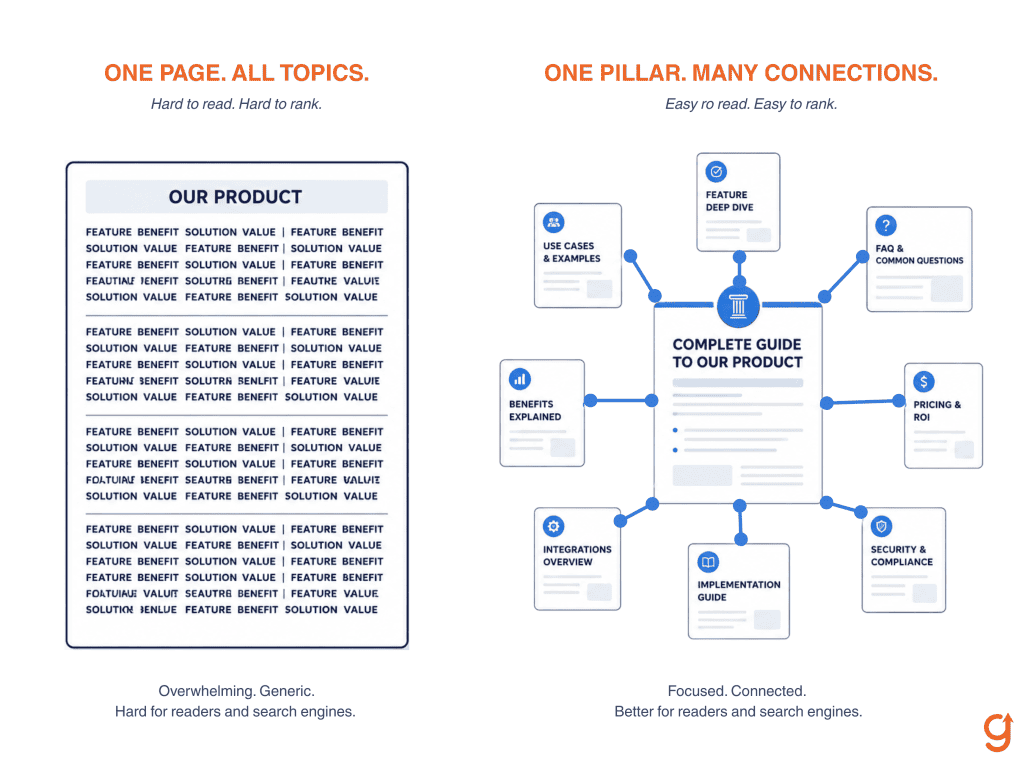
Topical authority is demonstrated by interlinked depth on one subject. When you have enough pages answering enough of a topic’s real questions, search engines start treating your site as a source for that whole topic, and they rank the cluster together rather than one page at a time.
Keyword stuffing is the opposite bet. Google’s spam policy defines it plainly: it’s the practice of loading a page with keywords or numbers to try to manipulate rankings.
Here’s the distinction I think matters most for a B2B SaaS content strategy:
- Keyword research is still legitimate and still necessary. Knowing which queries your buyers actually type and how much demand sits behind each one is how you size and sequence a content cluster.
- Stuffing is what happens when that research stops informing the writing and starts replacing it. The keywords take over the sentence instead of supporting it.
So the comparison at the heart of this article is really a comparison between an asset and a liability. Topical authority compounds with every page you add to the cluster. Keyword stuffing doesn’t compound at all.
It’s named, defined, and actively policed by the search engine you’re trying to rank on.
Why does keyword stuffing still feel like it works?
Keyword stuffing survives because density is easy to measure and easy to bill for. A density score moves the same day you edit the page, while coverage takes weeks to build and a full quarter to show up in Search Console. That’s why the fast, visible metric keeps winning budget arguments it should actually lose.
Here’s what Google does with a stuffed page, straight from the person who answers these questions publicly:
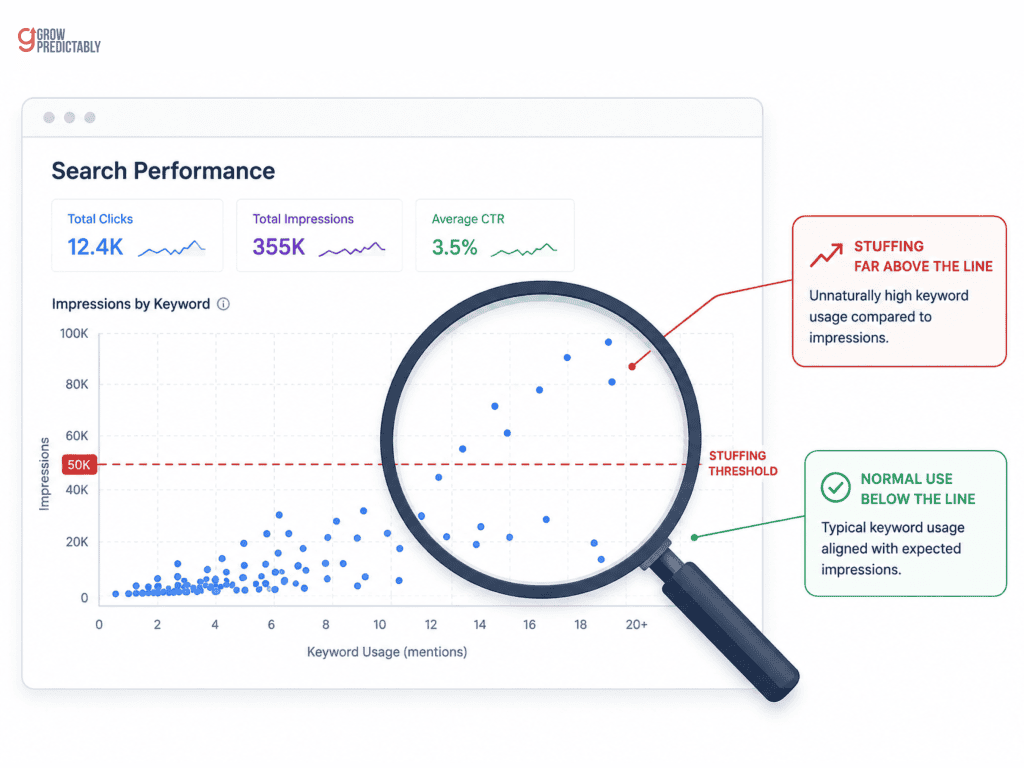
“It’s just that when I run across pages where I worry about keyword stuffing, it’s usually on the order of 3-500+ mentions on a page. I wouldn’t worry about 10-20 mentions on a page just for SEO, but I would check if users think it’s ok.”
John Mueller, Google Search Advocate
I’d read that carefully, because it cuts both ways:
- Normal keyword use is safe. The fear-driven version of this argument, that mentioning your keyword twice will get you penalized, just isn’t true.
- Past the threshold, Google’s documented response is to ignore the stuffed portion or demote the page. The spam policy is direct about the consequence: sites that violate it “may rank lower in results or not appear in results at all.”
The real cost is quieter than a penalty, though. Every hour spent tuning density is an hour taken away from covering the topic. That opportunity cost compounds in the same silent way topical authority does, just in the wrong direction.
What does topical authority do that keyword stuffing can’t?
A single optimized page competes for one query. A covered topic competes for hundreds. That is the core mechanical difference, and it shows up in three ways.
Cluster-level reach. When you cover a topic’s real questions across a pillar and its supporting pages, each page ranks for its own long-tail queries while the internal links concentrate relevance on the pillar. The cluster wins positions no single page could reach alone, including the head term the stuffed page was chasing.
Durability. Authority survives algorithm updates because it is the thing the updates optimize for. Google’s spam-fighting work, from the 2022 helpful content update through the current spam policies, keeps targeting manipulation patterns. Content that demonstrates real depth has no pattern to target.
Trust that transfers. Once a site ranks for enough of a topic, new pages on that topic index faster and rank higher from day one. Publishing becomes cheaper over time. A stuffed estate gets the mirror image: every new page starts from the trust deficit the old pages created.
Make it concrete. A B2B SaaS selling to customer success teams could stuff one page with “customer retention software” 60 times, or it could publish a pillar on retention strategy supported by pages answering the questions that surround the purchase: how to measure churn by cohort, when expansion revenue offsets logo churn, what a healthy net revenue retention band looks like by segment, how to run a save-offer playbook.
The second estate ranks for every one of those long-tail questions, feeds the pillar with internal links, and gives an AI engine four citable, specific answers where the stuffed page offered one repeated phrase.
None of this requires writing forever, and it does not require abandoning keyword data. It requires pointing the same effort at coverage instead of repetition.
How do AI search engines raise the stakes?
AI engines answer buyers directly and cite the sources they trust, which makes citability the new distribution channel. This isn’t a hunch; the evidence is peer-reviewed.
The GEO study presented at KDD 2024 tested content modifications across thousands of queries and found that GEO techniques can boost visibility in generative engine responses by up to 40%. The modifications that actually moved the needle were authority signals like citations, quotations, and statistics. Keyword density was never one of them.
There’s also a technical floor most B2B SaaS teams haven’t checked. When I tested my own site with a GPTBot user-agent request, the client-side app returned only the sitewide head, with no per-page titles, no descriptions, no structured data.
Googlebot renders JavaScript, so my rankings looked fine. AI crawlers don’t render it, so every article looked identical to them.
A few things worth knowing about this gap:
- A page can be invisible to search engines for reasons that have nothing to do with its prose. That’s worth ruling out before you judge your content.
- Rendering issues hit AI crawlers differently than they hit Googlebot, so a site that looks healthy in Search Console can still be blank to GPTBot.
- The fix is technical, not editorial. No amount of rewriting solves a rendering problem.
What the engines extract once they can actually see you is the same set of E-E-A-T signals that topical depth produces naturally. Stuffing produces none of them.
Which problem does your site actually have?
Underperforming content estates fail in one of two ways, and Search Console tells you which one you have in a single session. Treat this as the decision gate because the two failures need opposite first moves.
Here is the session, step by step. It takes about 20 minutes:
- Open Search Console, Performance report, last three months, compare to the prior three.
- Filter queries to your core topic (the head term plus its obvious variants).
- Note three numbers: how many distinct queries earn impressions, the average position of the head term, and how many different pages earn those impressions.
- Then read the shape against the two profiles below.
Symptoms of thin topical coverage
Open the Performance report, filter to your core topic’s queries, and look at the shape:
- Impressions scatter across dozens of queries, each with a handful of impressions and an average position past 30.
- No two pages on the topic rank near each other. There is no cluster, only strays.
- The head term you care about sits past page 3 and has for months, while long-tail variants you never wrote about show zero impressions.
That shape means the engine sees fragments, and the fix is to build: map the topic’s questions, then cover them deliberately.
Symptoms of over-optimization
The same report tells a different story on an over-optimized estate:
- A page earns impressions almost exclusively for its exact-match target phrase. The long tail around it is missing.
- Positions swing hard after spam and core updates, then partially recover.
- Word count is high, and keyword density is high, and clicks stay flat because titles read like the phrase was installed rather than written.
That shape means the engine sees manipulation, and the fix starts with cleanup, because new pages inherit the estate’s trust. The recovery move that works is unglamorous: strip the repetition from the highest-impression page first, rewrite its title as the question buyers actually ask, and leave the URL alone.
Recovery shows up as the long tail returning around the exact-match term over the following weeks, which is the engine re-reading the page as an answer instead of a target.
The diagnosis decides the sequence. Building on top of an over-optimized estate wastes the new pages. Cleaning a thin estate wastes a quarter you should have spent covering the topic.
How do you build topical authority without writing forever?
The build is a diagnosis-first sequence, and it is deliberately smaller than most content retainers want it to be.
Map the cluster before writing
Pick one topic tied to a revenue decision your buyer actually makes, then list the questions a buyer asks on the way to that decision.
Keyword data sizes each question and settles the order. That is the legitimate use of keyword research that the stuffing debate keeps obscuring: it tells you what to cover, never how many times to repeat a phrase.
Cover entities and answer questions
Search engines model topics as entities and relationships, so depth means addressing the concepts a topic implies. A cluster on customer retention that never touches churn measurement, cohort analysis, or expansion revenue reads as shallow no matter how long each page runs.
Write each page to answer its question directly in the opening block, the way AI-era content has to serve both readers and engines.
Link the cluster deliberately
Every supporting page links up to the pillar at first mention, and the pillar links down to each supporting page. Industry guides like Search Engine Land’s topic cluster overview document the same mechanism. Internal links are how the cluster’s relevance concentrates instead of dissipating.
A focused pillar with four to six supporting pages, published over a quarter, beats 40 thin pages published over a year. Depth per page wins over page count, and a team of one can run this cadence.
The pattern I keep seeing on B2B SaaS estates that turn around is the same: the team stops spreading effort across every keyword the tool exported, picks the one topic their best customers decide with, and ships the cluster end to end before touching anything else.
The estate that tries to cover twelve topics at once ships none of them deep enough to register.
What should you do with keyword-stuffed legacy content?
Old stuffed pages are not one problem, so give each page one of three verdicts instead of one blanket treatment.
- Prune. No impressions in twelve months, no backlinks, off topic. Retire it and let the crawl budget go somewhere useful. A page that earns nothing dilutes the estate’s average quality for free.
- Consolidate. Three thin pages circling one question are competing with each other. Merge them into the strongest URL, redirect the others, and let one page carry the combined relevance.
- Rewrite. A page with real impressions and a stuffed execution is the best asset on this list. The demand is proven. Keep the URL, strip the repetition, and rebuild the content around the question that the impressions prove people are asking.
Run the verdicts inside the cluster you are actively building first. Cleaning the whole estate at once is the kind of project that stalls. Cleaning one cluster while you build it compounds with the new work immediately.
Where should a B2B SaaS team start this quarter?
Start with the diagnosis, because everything downstream depends on it.
Run the Search Console session from the two-failure section, name the problem your estate has, then pick one revenue-linked topic and build its pillar plus four to six supporting pages, applying the prune, consolidate, or rewrite verdicts to the legacy pages inside that cluster as you go.
If you want the diagnosis done for you first, take the Growth Gap Scan. It locates the stage of your customer journey that is actually capping growth, so you invest this quarter’s content budget where the constraint is instead of where the noise is.
Frequently Asked Questions
What is the difference between domain authority and topical authority in SEO?
Domain authority estimates the ranking strength of your entire site, primarily based on backlinks, and applies to everything you publish. Topical authority is subject-specific: it measures whether your site demonstrates enough depth on one topic to rank for its full range of queries. A high-authority domain can still lose to a smaller site with deeper coverage of a specific topic.
What do you mean by keyword stuffing?
Keyword stuffing is filling a page with keywords or numbers to manipulate rankings, as defined by Google’s own spam policy. It covers unnatural repetition of a target phrase, blocks of city or phone-number text, and copy written for a density score instead of a reader. Google’s documented response is to ignore the stuffed portion or rank the page lower.
How many times should a keyword appear on a page?
There is no target number, and normal use is safe. Google’s John Mueller has said he only worries about keyword stuffing at hundreds of mentions on a page, and that 10 to 20 mentions are fine for SEO. Write the phrase where it naturally belongs, in the title, the opening answer, and wherever the topic genuinely calls for it, then stop counting.
Does Google penalize keyword stuffing?
Yes, keyword stuffing violates Google’s spam policies, and sites that violate them may rank lower or not appear in results at all. In practice, the more common outcome is quieter: Google ignores the stuffed portion, and the page simply underperforms. Either way, the tactic costs the time it took, plus the coverage you did not build with that time.
What does topical authority mean in the context of SEO?
Topical authority means search engines treat your site as a source for an entire subject because you have published interlinked pages answering the topic’s real questions. It shows up as the whole cluster ranking together, faster indexing for new pages on the topic, and increasingly as citations in AI-generated answers.
Can you build topical authority and still do keyword research?
Yes, and you should. Keyword research tells you which questions your buyers actually type and how much demand each carries, which is exactly how you size and sequence a topic cluster. Topical authority replaces keyword stuffing, never keyword research. The data informs what to cover. It stops being useful when it dictates how many times a phrase repeats.