B2B SEO Strategy: How to Win Search and AI Answers in 2026

TL;DR: A B2B SaaS SEO strategy wins by pointing the same authority work at two targets at once: ranking in classic search and getting cited in AI answers, for the few buyer-intent terms that actually convert. Intent over volume, authority over output, pipeline over rankings.
Key Takeaways
- The default B2B SEO strategy chases volume and “more content.” The win is the few low-volume terms that uniquely signal a buyer.
- Search and clicks have split. AI summaries now answer many queries without a click, so being the cited source matters as much as ranking.
- GEO and AEO are mostly good SEO done well. The same E-E-A-T and citability work earns both blue-link rankings and AI citations.
- Diagnose the constraint before you produce anything. More content at the wrong place is inventory, not pipeline.
- Measure on pipeline. Rankings and traffic are useful inputs, but organic leads close far better than outbound, so intent-led SEO compounds into revenue.
A B2B SEO strategy that works in 2026 is a growth system, not a volume chase. You target the low-volume, high-intent terms that uniquely signal a buyer, build the authority that Google and AI engines both reward, optimize for classic search and AI answers at once, and measure the whole thing on the pipeline it produces.
For a B2B SaaS company, that is the difference between traffic and revenue.
Most B2B SEO advice still treats the work like a volume game inherited from B2C: find big keywords, publish more posts, watch the traffic line. That playbook is quietly failing, for two reasons.
The buyers you want search rarely, in small numbers, with very specific intent. And a growing share of those searches now get answered by an AI summary before anyone clicks anything.
This guide is the operator version: how to build a B2B SEO strategy that earns the right visibility, in both search and AI answers, and turns it into pipeline.
Why most B2B SEO strategies stall
Most B2B SEO strategies stall for the same reason: they optimize for volume and output instead of the constraint. The plan becomes “rank for the big keywords” and “publish more,” and a year later you have a lot of traffic, a lot of content, and very little pipeline. The activity went up. The revenue did not.
The core problem is that more content at the wrong place in the funnel does not speed anything up. It just creates inventory. If your constraint is that you are invisible for the handful of terms a real buyer uses, publishing twenty more top-of-funnel posts about industry trends does nothing to fix it. You have poured effort into a stage that already had plenty of capacity, and the bottleneck is still sitting there untouched.
There is now a second way to be invisible, and it is worse. Buyers increasingly research inside AI tools, and most companies do not show up there at all. According to the 2X AI Visibility Index reported by Demand Gen Report, which analyzed 70 B2B companies, 96% of B2B companies are invisible in AI-driven buyer discovery, appearing only in late-stage queries.
This means the typical B2B SEO program is fighting hard for blue-link rankings while being completely absent from the place buyers now form their shortlist. A modern strategy has to fix both. Two failure modes are worth naming here:
- Optimizing for volume over constraint. Publishing more content into stages that already have capacity, while the actual bottleneck goes untouched.
- Ignoring AI-driven discovery. Treating SEO as a search engine problem only, while buyers are increasingly building their shortlists inside AI tools before they ever click a link.
Getting this right starts by being honest about which one is actually your constraint.
Start with the buyer-intent keyword, not the search volume
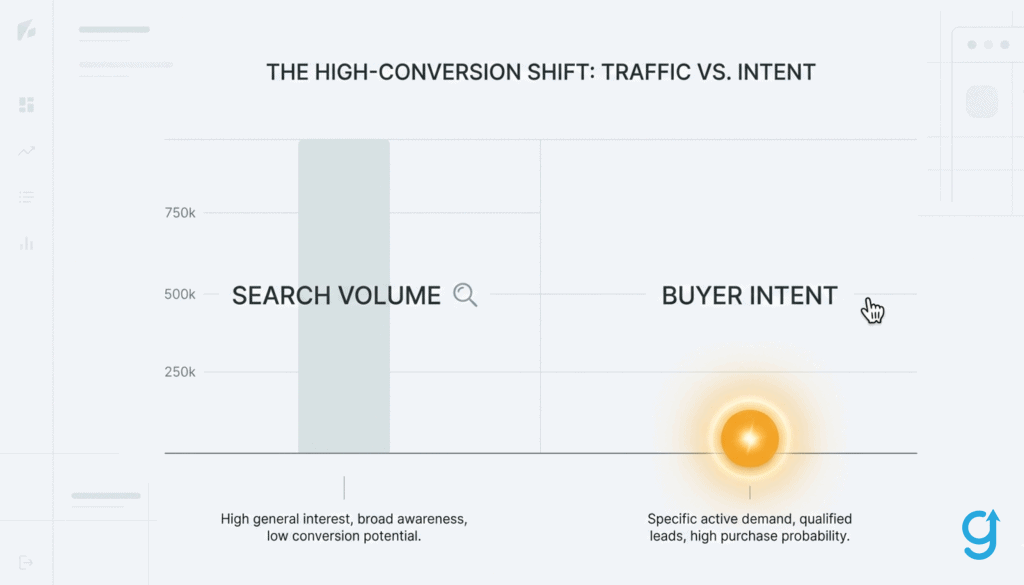
The single most important shift in B2B SEO is what you optimize for. Stop chasing search volume. Start chasing intent. The terms worth ranking for are the ones that uniquely tell you the searcher is looking for what you sell, even if only a few hundred people search them a month.
Why low volume is a feature in B2B
In B2B, low volume is not a problem to solve. It is the signal. A keyword that only a buyer with your specific problem would ever type is worth far more than a popular term that anyone in your category might search out of idle curiosity. Consider the difference:
- Ten searches a month from people actively scoping a solution like yours will out-earn ten thousand searches from students, job seekers, and competitors.
- The popular keyword feels like a win in a traffic report and converts like a stranger.
- The narrow one feels small and converts like a buyer.
This is the principle to organize the whole strategy around. When you sort your keyword list by intent instead of volume, the priorities invert, and the small, unglamorous, bottom-of-funnel terms move to the top where they belong.
A quick example makes the trade obvious. “Marketing automation” gets tens of thousands of searches a month, and almost none of them are a buyer ready to evaluate your platform. They are students, job seekers, marketers writing their own posts, and the occasional curious executive.
Now compare a term like “Salesforce to ad platform MQL sync” or “best lead routing tool for B2B SaaS.” A few hundred searches at most, and nearly every one is a person with budget, a stack, and a problem you can solve this quarter. The first term wins the traffic report. The second term wins the deal.
A B2B SEO strategy that knows the difference spends its limited content budget on the second kind, every time.
How to spot a buyer-intent keyword
A buyer-intent keyword usually names a problem, a category, a comparison, or a job to be done that only someone evaluating a purchase would search. The patterns to look for:
- Problem-framed terms: “how to automate Z” or “why is X not working”
- Category and comparison terms: “alternative to Y” or “best tool for B2B SaaS”
- Outcome-specific terms: the exact result your product delivers, phrased the way a buyer describes it, not the way a marketer does
Once you have your list, map each keyword to the buying committee, because a B2B deal involves several people. The economic buyer, the technical evaluator, and the end user all search differently, and each one is at a different point in the decision. Then map the keyword to the specific decision that person is trying to make, not just a generic funnel stage.
The question is never “how big is this keyword.” It is “does this term tell me a real buyer is on the other end of it.” That single filter does more for a B2B SEO strategy than any tool or tactic you will find in a best-practices list.
B2B SEO is now two games: Classic search and AI answers
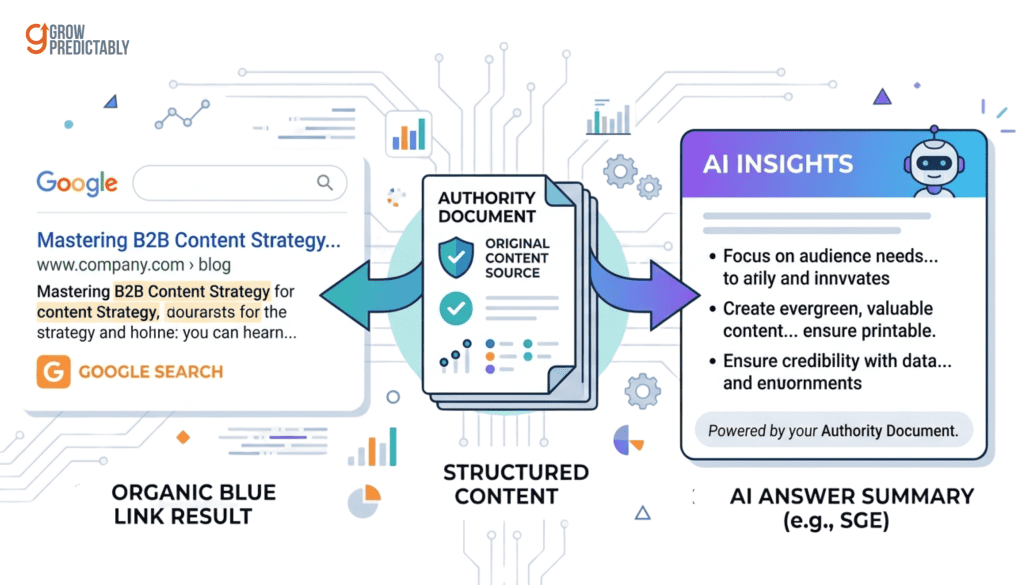
Even with a perfect intent-led keyword map, there is a structural change you cannot ignore. Search and clicks have come apart. A large and growing share of queries now return an AI summary that answers the question on the page, and the user never clicks through to anyone. Ranking first and getting the visit are no longer the same thing.
The data is stark. The Pew Research Center, studying real browsing behavior in March 2025, found that users who encountered an AI summary clicked on a traditional search result only 8% of the time, compared to 15% for users who saw no AI summary. That is roughly half the clicks, gone. And this was not a fringe experience: about one in five Google searches in that study produced an AI summary.
That finding reframes the win condition entirely. Two things now have to be true for your content to do its job:
- Rank the blue link for the buyer-intent queries where clicks still happen and where traditional search still drives pipeline.
- Be the cited source inside the AI answer so that when the model summarizes your category, your perspective and your brand appear in the summary, not a competitor’s.
This is what generative engine optimization (GEO) and answer engine optimization (AEO) actually mean in practice. For B2B, neither is a separate channel with its own budget. Both are extensions of the same SEO program, just pointed at two different output formats.
Ranking and being named are different outcomes, and the second one turns on four decisions made in order: which buying decision to compete on, whether your pages use the buyer’s language or the product’s, what to measure first, and who owns that measurement afterwards. I walk through those four in AI search visibility for B2B SaaS: the four judgments that decide whether you get named, and they belong before the authority work in the next section.
The practical move is to make your content the thing AI engines want to quote: answer-first, specific, and genuinely expert. It also means showing up on the surfaces AI systems draw from. That is exactly why a deliberate presence on Reddit as an AI-citation surface now belongs inside a serious B2B SEO strategy, not as a social media play, but as a citation surface that AI models actively pull from.
Build the authority Google and LLMs both reward
Here is the good news hiding inside the AI disruption: you do not need two separate programs. The signals that win classic search rankings and the signals that earn AI citations are largely the same authority work. Clear answers to real questions. Genuine evidence. Named experts. First-hand experience. Content structured so a machine, or a busy human, can lift a clean, correct passage.
This is the heart of E-E-A-T, Google’s framework of experience, expertise, authoritativeness, and trust, and it turns out to be exactly what large language models reward too.
Lily Ray, Vice President of SEO Strategy and Research at Amsive, made this point directly after auditing the wave of GEO advice flooding the industry. She concluded that most of the advice being sold as novel GEO strategy was, word for word, what SEO teams had been recommending to clients for years, if not decades. In other words, most of GEO is just good SEO done well.
What that looks like in practice:
- Lead with the direct answer, then the reasoning. Both a reader and an AI model need to be able to lift a clean, correct passage from your content without needing the surrounding paragraphs for context.
- Back claims with real, attributed data. Vague assertions do not earn citations from anyone, human or model.
- Quote named experts rather than paraphrasing the internet. A generic content mill can produce summaries. It cannot produce genuine expert perspective.
- Write from first-hand experience. This is the one signal that AI-generated content structurally cannot fake, and it is increasingly what both Google and LLMs weight most.
- Use clear headings, defined terms, and self-contained passages. If a section only makes sense inside the full article, an AI engine cannot extract and cite it cleanly.
The strategic implication here is to resist the temptation to buy a separate, expensive GEO program bolted onto your existing SEO. Do the authority work once, and do it properly. That single body of work earns both the ranking and the citation.
The same test applies to backlinks. A monthly link quota bought from a vendor is the link-building version of the bolted-on GEO program, and I have set out how to judge one in link building for B2B SaaS: how to judge the offer, including which links actually reach a buying committee.
The teams that win the AI-answer game are not the ones who found a clever new hack. They are the ones who were already building genuine authority and simply kept going.
The diagnose-and-build B2B SaaS SEO system
This is the system I build when I run GEO and AEO strategy for a B2B SaaS marketing team. It is deliberately not a list of tactics. It is a sequence that starts with diagnosis, because the order is what makes it work.
The system is written for a software company. The parts that are specific to SaaS, what makes B2B SaaS keyword research different, how to build a content strategy that drives signups rather than traffic, and how to measure SEO success for a SaaS company, are covered in SEO for B2B SaaS: why the generic playbook fails and what works.
Diagnose the constraint first
Before producing anything, name the constraint and the decision the SEO work is meant to improve. The problem matters because each one has a different fix:
- Are you invisible for buyer-intent terms?
- Absent from AI answers entirely?
- Ranking but not converting?
- Converting but not measured, so nobody on the team trusts the channel?
Producing more content only helps one of those. Starting with the decision the buyer is making, rather than the dashboard, is what keeps the strategy from becoming a content treadmill. If a metric or a page does not change a decision, it is decoration.
In practice, the diagnosis almost always surprises people.
The first time I audited an organic program that everyone assumed needed “more content,” the actual constraint was the opposite. The site had hundreds of posts and ranked for plenty of category terms, but those terms pulled in non-buyers. The handful of pages that actually targeted buyer intent were thin and buried.
The fix was not another content sprint. It was to stop, re-map the existing pages against buyer intent, rebuild the few that actually mattered into genuine authority pages, and wire them together.
Output went down, and pipeline went up. That only happens if you diagnose before you build.
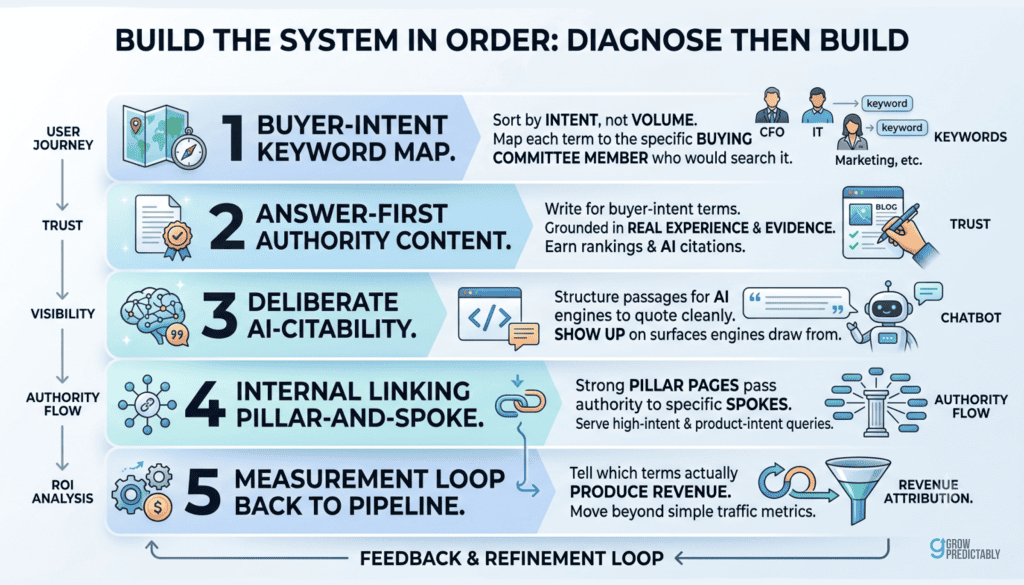
Build the system in order
Once you know the constraint, build in this sequence:
- Buyer-intent keyword map. Sort by intent, not volume, and map each term to the buying committee member who would actually search it.
- Answer-first authority content. Write for the buyer-intent terms you identified, grounded in real experience and evidence, so the content earns both rankings and AI citations.
- Deliberate AI-citability. Structure passages so AI engines can quote them cleanly, and show up on the surfaces those engines draw from.
- Internal linking into a pillar-and-spoke structure. Strong pillar pages pass authority to the specific spokes that serve high-intent and product-intent queries.
- A measurement loop back to pipeline. The system needs to tell you which terms actually produce revenue, not just which ones drive traffic.
Then productize the whole thing so it runs predictably as a system, rather than as a pile of one-off posts that depend on someone remembering to write them.
This is the work that a dedicated B2B SaaS digital marketing function or an organic SEO consultant should own end to end. If you are weighing whether to build that capability in-house or bring in outside help, that is ultimately the agency-hire decision.
Measure B2B SEO on pipeline
A B2B SEO strategy is only as good as what it is measured on, and most are measured on the wrong things.
Rankings and traffic are inputs. They are useful diagnostics, not the scoreboard. The scoreboard is pipeline. The real question is which organic and AI-answer visibility produced qualified pipeline, so you can double down on the terms that convert and stop investing in the ones that only produce traffic.
This matters because intent-led organic traffic is unusually good at becoming revenue. According to FirstPageSage, the average organic search lead closes at 14.6%, compared to just 1.7% for outbound channels like cold calls, trade shows, and paid ads.
A lead who found you by searching the exact problem you solve is already most of the way to a decision. That is the whole reason intent-led SEO compounds over time in a way that paid acquisition does not.
When you measure on pipeline, two things happen that do not happen when you measure on traffic:
- The buyer-intent terms you prioritized early reveal their actual value, because you can see which ones produced conversations, not just clicks.
- The high-volume terms that looked impressive in a traffic report quietly fall away, because the pipeline data shows they were not producing anything worth the content investment.
That feedback loop, from pipeline back to keyword priority, is what turns a B2B SEO strategy from a cost center into a growth system that gets smarter every quarter. It is also one of the highest-leverage systems inside a broader B2B SaaS growth strategy.
Frequently Asked Questions About SEO B2B Strategy
What is a B2B SEO strategy?
A B2B SEO strategy is a plan to earn visibility in search and AI answers for the specific, often low-volume, high-intent queries your buyers use, then convert that visibility into pipeline rather than just rankings or traffic. In B2B SaaS it functions as a growth system: intent-led keywords, authority content, and measurement that loops back to revenue.
How is B2B SEO different from B2C SEO?
B2B keywords are lower volume but higher intent, the buying committee has several people, sales cycles are long, and the product is complex. So you optimize for the few terms that uniquely signal a real buyer rather than for the biggest search numbers, and you write for multiple decision-makers, not one consumer.
How do you build a B2B SEO strategy in 2026?
Diagnose the constraint first, then build in order: a buyer-intent keyword map, answer-first authority content, deliberate AI-citability, internal linking into a pillar-and-spoke structure, and a measurement loop back to pipeline. Optimize for classic search and AI answers at once, since they reward the same authority work.
What is GEO or AEO and how does it relate to B2B SEO?
Generative engine optimization (GEO) and answer engine optimization (AEO) are about earning citations inside AI answers. For B2B they are an extension of good SEO, not a separate discipline. The same E-E-A-T and citability work that earns rankings also earns AI citations, so you do the authority work once and win both.
How do you measure B2B SEO success?
Measure on pipeline and revenue influence, not rankings or raw traffic. Rankings and traffic are inputs. Track which organic and AI-answer visibility produces qualified pipeline, then double down on the terms that convert. Organic leads close around 14.6% of the time versus 1.7% for outbound, so intent-led SEO compounds into revenue.
Does SEO still work for B2B with AI search?
Yes, but the job changed. Fewer clicks come from search now that AI summaries answer many queries on the page, so the win is being the cited, trusted source inside the AI answer. That is built on the same authority signals as classic SEO, which is why intent-led B2B SEO still drives pipeline.
Where to Start With Your B2B SEO Strategy
A B2B SEO strategy for 2026 comes down to three moves. Choose intent over volume, so you rank and get cited for the terms that signal a real buyer. Build the authority that wins both classic search and AI answers, because they reward the same work. And measure on pipeline, so the system optimizes toward revenue instead of vanity traffic.
The starting move is always diagnosis, not production. Before you brief a single article or chase a single keyword, figure out which of these is actually your constraint, because the wrong fix applied to the right enthusiasm is how SEO budgets get wasted.
If you want a fast read on where your growth system is leaking and whether SEO is even your highest-leverage constraint right now, run the Growth Gap Scan and start from the constraint, not the tactic.