
How to Build an Irresistible Offer for B2B SaaS

TL;DR: An irresistible B2B SaaS offer names one buyer, promises a measurable outcome, and removes the two things a buying committee always asks: why should we believe this, and what happens if it does not work. Generic offer advice skips the buying committee entirely, and a real B2B SaaS offer has to survive being repeated by someone who was not in the room when you pitched it. The fix is building the offer around one buyer, one promise, and one guarantee, specific enough that your champion can carry it to the other people in the room without you.
Key Takeaways
- Treat an offer as a package: the promise, the path to value, the price framing, and the proof all have to survive being repeated by someone who never heard you say it directly.
- A B2B SaaS purchase runs through six to ten stakeholders on average, so an offer that only works in the room it was pitched in was never going to close.
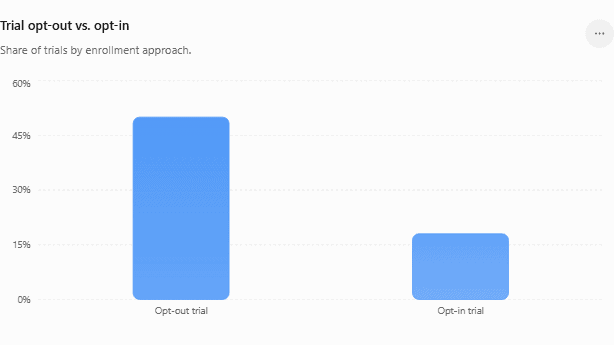
- SaaS benchmark data covering 86 companies shows opt-out trials converting to paid at roughly 3 times the rate of opt-in trials (around 50% versus 18%), because asking for a card up front pre-qualifies people who are already committed.
- Risk reversal has to match how B2B SaaS actually buys: phased commitments, milestone-based guarantees, or an extended pilot, shaped for a subscription rather than copied from e-commerce.
- A differentiated promise is the load-bearing part of an offer.
- Grade the finished offer against a real checklist before it ships. A quarter of the flat pipeline is a far more expensive way to learn it was weak.
Most B2B SaaS teams treat their offer as whatever the sales deck happens to say that quarter.
I have watched marketing leaders hire and fire agencies for 15 years, from both sides of that table, and the offers that actually closed were never the loudest ones. They were the ones a champion could repeat correctly to five people who never sat in the room.
That is the part most irresistible offer advice skips. It treats the offer as something you say once, to one person, in a demo.
A B2B SaaS purchase does not work that way. This article builds the offer in four parts: promise, plan, package, and proof, specifically for a buying committee that will hear about your product secondhand before they hear it from you.
What makes a B2B SaaS offer irresistible?
An irresistible B2B SaaS offer comes down to a specific, believable promise paired with a package that removes the buyer’s real risk. A bigger discount or a longer feature list rarely gets you there. Most offer-writing advice conflates an offer with a value proposition, but those two things answer different questions.
A value proposition explains why you’re different. An offer packages that difference into something a buyer can say yes to this quarter. That means:
- A named outcome
- A timeframe
- A price
- A way to reduce the risk of getting it wrong
Generic offer checklists were built for e-commerce carts and solo-coach funnels, and they break down fast once you bring them into B2B SaaS. That’s because B2B SaaS deals don’t follow the same shape:
- No impulse buy
- No single decision-maker
- No one-time purchase you can de-risk with a simple refund
Instead, you’re dealing with a buying committee, a procurement process, and a recurring contract. An offer built for a single consumer won’t survive contact with any of that.
The tool decision versus the offer decision
Most teams start by picking pricing tiers or writing feature comparisons. That’s a packaging decision. The offer decision comes first: who exactly this is for, what they get, and why they should believe it.
It’s one piece of the broader B2B SaaS marketing strategy that the rest of your funnel depends on, and it’s usually the piece that gets skipped.
Many teams mix up value proposition and offer. They sound similar but answer different questions and serve different jobs in a buyer’s journey.
| Value Proposition | VS | Offer |
|---|---|---|
| Answers the “why us” question Why we’re uniquely qualified to help and what makes us different. | Purpose | Answers the “why now” question Why it makes sense to move forward with us this quarter. |
| Broad and enduring Speaks to the category, the problem, and your point of view. | Scope | Specific and time-bound Clear on who it is for, what’s included, and by when. |
| Builds preference Creates belief over time through proof, POV, and positioning. | Outcome | Removes buying risk Reduces uncertainty with guarantees, proof, and low-friction terms. |
Why do strong B2B SaaS products still lose on a weak offer?
The symptom is familiar. Demos land well, the room nods, and the deal still stalls in procurement or goes quiet after the trial ends. Sales calls it a “maybe.” The product team assumes it is a pricing objection. Neither is usually the real cause.
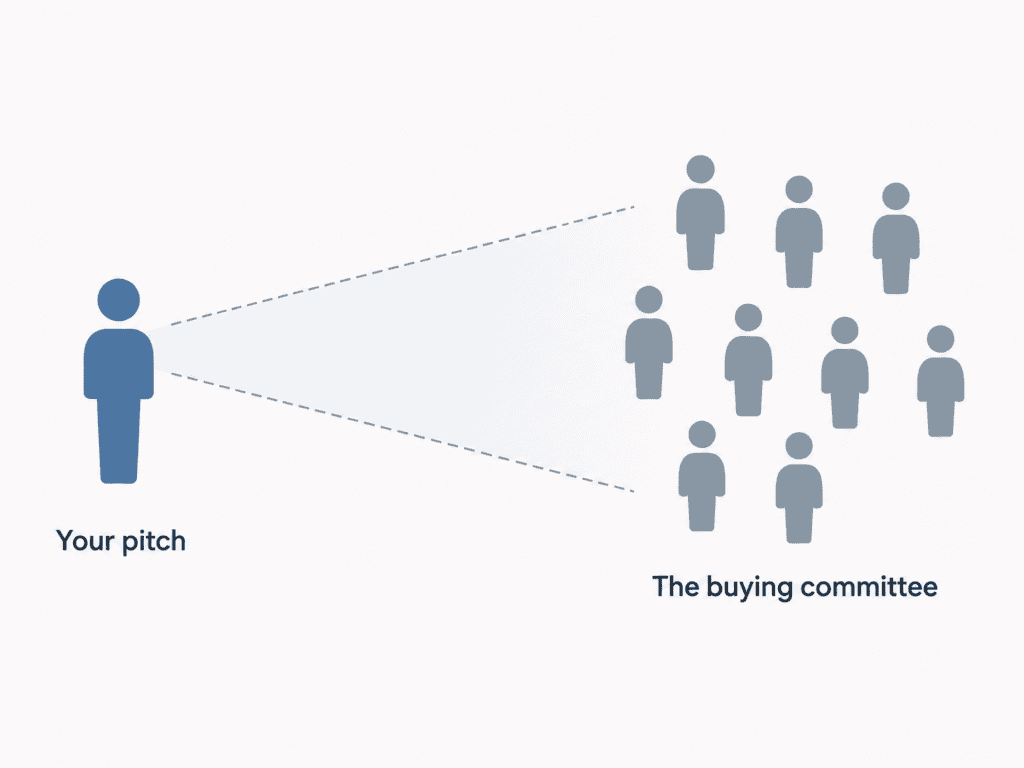
The real cause is that the product got pitched, but nothing about it got packaged. A pitch works on the person in the room. An offer has to work on the five to nine people who were not.
A B2B purchase runs through six to ten stakeholders on average, according to Gartner’s buying-journey research. Your champion becomes the one repeating your pitch internally, from memory, without your slides. If the promise was not specific enough to survive that retelling, the deal was never going to close, regardless of how well the demo went.
This is why the fix is not a better pitch. It is a rebuilt offer, in four parts:
- A promise that survives being repeated.
- A plan the buyer can picture themselves following.
- A package that removes the specific risk a committee carries on a recurring contract.
- Proof consistent enough to hold up across every surface the buying group checks.
Those four parts, taken together, are what the rest of this article builds.
The promise: who it is for, what they get, and why it is different
The promise is the part of the offer that has to survive a secondhand retelling. It answers four questions:
- Who is the buyer?
- What do they get?
- What stands in their way?
- Why does this approach work when others haven’t?
A champion who can repeat all four accurately, without your slides, is carrying an offer strong enough to close. One who can’t is carrying a pitch.
Name one buyer
“B2B SaaS companies” is not a buyer. “A VP of Sales at a 50 to 200 seat SaaS company whose reps are missing quota because pipeline is thin” is. The more specific the buyer, the more the rest of the promise writes itself, because a specific buyer has specific metrics they already report on.
Make the outcome measurable
Tie the outcome to a number the buyer already tracks, whether that’s pipeline coverage, win rate, time to close, churn, or net revenue retention. “Improve your sales process” isn’t measurable. “Cut discovery-to-demo time from 12 days to 3” is.
Say the objection out loud
Every buyer has a reason they haven’t already solved this. In B2B SaaS, the most common ones are:
- Time to value
- IT approval
- Switching cost
- “We tried something like this before”
Naming the objection in the promise itself, rather than hoping it doesn’t come up, is what makes the promise feel honest instead of pitched.
Explain why this works differently
This is the piece most offers skip, and it’s the one that decides whether a buyer believes any of the rest. Teams that can describe what they do but can’t explain why it works differently have a positioning gap, and no amount of urgency or bonuses fixes that underneath it.
“I believe it’s impossible to do anything great in marketing or sales without clearly defined differentiated value,” writes positioning consultant April Dunford, author of Obviously Awesome, on her own Substack.
A promise with no mechanism behind it is just an adjective.
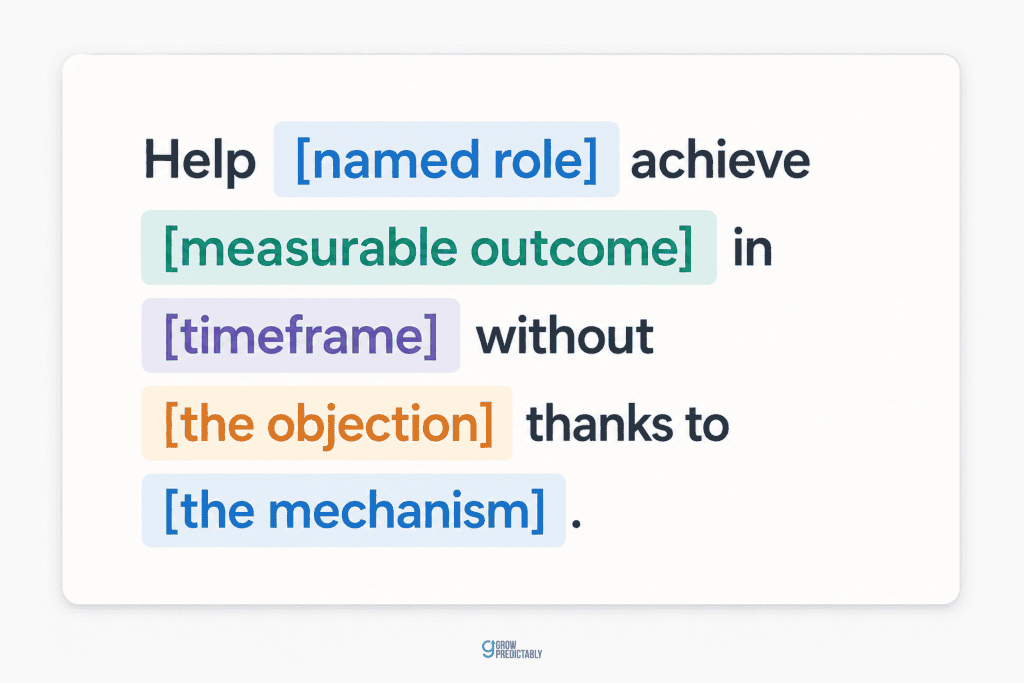
Put together, a B2B SaaS promise reads like this: help [named role] achieve [measurable outcome] in [timeframe] without [the objection] thanks to [the mechanism].
For example, help VPs of Sales at 50 to 200-seat SaaS companies cut discovery-to-demo time from 12 days to 3 in the first 30 days, without adding headcount, because the qualifying questions run automatically before the call is booked.
Brian is a DigitalMarketer Certified Partner, and this promise-plan-package-proof structure draws on that training, adapted here specifically for a B2B SaaS buying committee rather than a single buyer.
The plan: what does saying yes actually feel like?
A promise gets someone interested. A plan is what makes them believe they can actually get the outcome. It shows the path from “I’m interested” to “I see the value” in steps they can picture: how the trial or demo is structured, who they talk to, and what they see by day 3 and by day 30.
One decision inside the plan matters more than most B2B SaaS teams realize: whether the trial is opt-in or opt-out. Opt-in trials ask for nothing but an email and get more people in the door. Opt-out trials ask for a credit card up front and get fewer people started, but those who do start are already leaning toward paying.
A 2025 benchmark study of 86 SaaS companies found opt-out trials converting to paid at roughly 50%, compared with roughly 18% for opt-in trials. The two models are not solving the same problem: opt-in wins on volume, opt-out wins on commitment, and the right choice depends on whether your bottleneck is too few trials starting or too few trials converting.
A workable plan for a B2B SaaS offer usually runs three to five steps:
- A short discovery step that confirms fit.
- An activation step where the buyer sees the specific outcome from the promise inside their own data.
- A review step with a real person.
- A decision step with a clear next action.
Each step should move the buyer measurably closer to the outcome itself.
The package: pricing, risk reversal, and what tips the buying committee
The package turns the promise into something a buyer can actually purchase. That means three things working together: a price framed around real value, risk reversal shaped for how B2B SaaS contracts actually work, and bonuses that earn their place instead of padding the offer.
Pricing is usually the first place these offers go generic, defaulting to a bare number with nothing behind it.
Price framed as a bare number invites comparison shopping. Price framed against a cost the buyer already feels works better, whether that’s the cost of the status quo or the cost of the problem compounding for another quarter. That framing gives the internal champion something to say when someone on the committee asks, “Why this much?”
Risk reversal is the second piece, and it can’t be copied wholesale from e-commerce. A flat money-back guarantee reads differently on a $50,000 annual contract than it does on a $40 purchase. What works instead is a guarantee shaped around how B2B SaaS actually buys:
- A milestone-based commitment
- A phased rollout with an exit point
- An extended pilot with defined success criteria agreed up front
The mechanism behind why any of this works comes from general risk psychology, not B2B SaaS-specific research.
A conversion case study on an Australian computer-repair service, not a B2B SaaS company, found that adding a bold guarantee grew sales by 49%. Two things made it work: the guarantee reduced the buyer’s perceived risk, and it signaled that the seller believed its own claim enough to back it. That same mechanism, risk reduction plus a confidence signal, is what a B2B SaaS guarantee has to do, just structured for a contract instead of a single purchase.
Bonuses round out the package. The useful ones increase speed, ease, or certainty of the outcome:
- An implementation sprint
- A dedicated onboarding slot
- A pre-built integration
Each of these does more work than a generic “bonus training” nobody asked for.
Supporting elements: proof, urgency, and the one call to action buyers actually take
Promise, plan, and package cover what the offer says. Supporting elements cover whether the buying committee believes it. That comes down to three things: specific proof tied to the same outcome the promise names, genuine urgency instead of a manufactured deadline, and one call to action stated the same way everywhere a stakeholder might check.
Proof works when it’s specific and tied to the same outcome the promise names. “This helped us a lot” does nothing. “Cut discovery-to-demo time from 12 days to 3 in the first month” does, because it’s the exact claim from the promise, shown as already true for someone else.
Urgency in B2B SaaS has to be genuine, or it undermines the buying committee’s trust right when they’re doing due diligence. What works:
- A real cohort start date
- A real onboarding capacity limit
- A real, dated pricing change
What doesn’t work is a countdown timer that resets when the page reloads. A procurement team that notices will discount everything else in the offer along with it.
The last piece is consistency. The promise has to read the same on the pricing page, in the sales deck, and on the call. The buying committee’s internal retelling only holds together if every surface they check says the same thing.
A single call to action, stated the same way everywhere, is what makes that retelling possible.
How do you know your offer is actually strong enough?
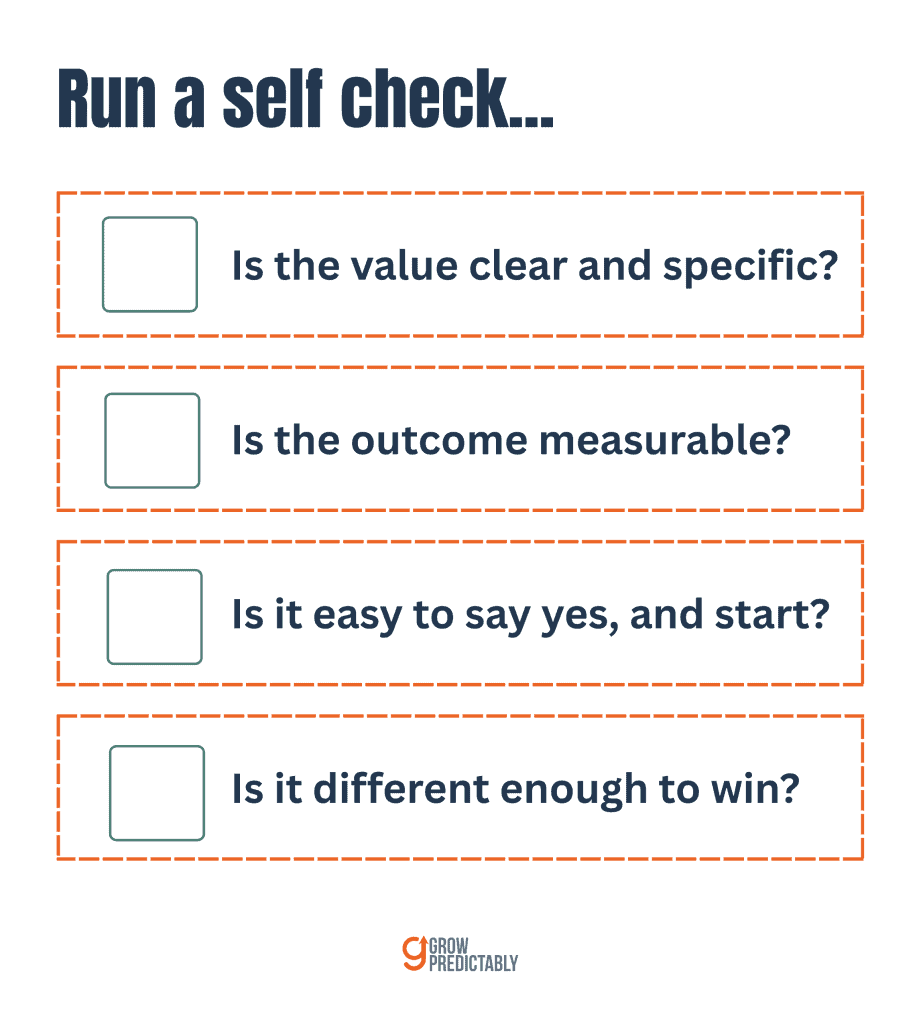
A finished offer is strong enough to publish when it passes four questions pulled directly from the structure above, one per part: does the promise name one buyer, is the outcome measurable, does the package remove the specific risk this buyer carries, and are the proof and urgency behind it genuine rather than manufactured?
Run a short self-check before it ships:
- Does the promise name one buyer?
- Is the outcome measurable?
- Does the package remove the specific risk this buyer carries?
- Are proof and urgency both genuine rather than manufactured?
This checklist comes from the same promise, plan, package, and supporting-elements structure that the rest of this article walks through, grading each part on the same terms it was built on rather than a separate set of criteria.
If you want a free way to run that check on a draft before it goes live, Rate My Offer grades an offer against these same criteria. And if the promise step is where you are stuck because you have not documented who the specific buyer actually is, the customer avatar worksheet is the fastest way to fix that before you write another word of the offer.
What is the next move on your offer?
Pick the offer you are about to pitch or renew, and rewrite its promise in one sentence using the formula from this article: help [named role] achieve [measurable outcome] in [timeframe] without [the objection] thanks to [the mechanism]. That one sentence will tell you fast whether the rest of the offer is built or borrowed.
Rebuilding an offer is real work, and teams sometimes spend a quarter on it before confirming the offer was the actual constraint, the same question the Growth Gap Marketing approach starts with.
Take the Growth Gap Scan first to see where your growth is actually capped before you touch a single word of your pricing page.
Frequently Asked Questions
What is an irresistible offer?
An irresistible offer is a specific, believable promise paired with a package that removes the buyer’s real risk. It names one buyer, a measurable outcome, a timeframe, and the objection it overcomes. For B2B SaaS specifically, it also has to survive being repeated by buying-committee members who never heard the original pitch.
What is the difference between an offer and a value proposition?
A value proposition explains why you are different from competitors. An offer packages that difference into something a buyer can say yes to this quarter: a named outcome, a timeframe, a price, and a way to reduce the risk of getting it wrong. A value proposition is a claim. An offer is a decision a buyer can act on.
Do B2B SaaS companies need a money-back guarantee?
Not necessarily a flat refund. A B2B SaaS guarantee works best when it matches how the business actually buys: a milestone-based commitment, a phased rollout with an exit point, or an extended pilot with agreed success criteria. The mechanism that makes any guarantee work, reducing perceived risk and signaling confidence, still applies, but the shape has to fit a recurring contract.
How is a B2B offer different from a B2C offer?
A B2C offer usually convinces one person to make a fast decision. A B2B SaaS offer has to survive being repeated inside a buying committee that averages six to ten stakeholders, most of whom never see the original pitch. That means the promise, the risk reversal, and the proof all have to be specific and consistent enough to hold up secondhand.
How do I know if my offer is good enough before I publish it?
Run it through a short self-check: does the promise name one buyer, is the outcome measurable, does the package remove the specific risk that buyer carries, and are the proof and urgency genuine rather than manufactured? A free tool like Rate My Offer can grade a draft against the same criteria before it goes live.
What is the DigitalMarketer Perfect Offer framework?
It is a structured way to build an offer across four parts: the promise, the plan, the package, and supporting elements. Brian is a DigitalMarketer Certified Partner and draws on that training here. Applied to B2B SaaS, the same four parts have to account for a buying committee and a recurring contract instead of a single buyer.
Should a B2B SaaS offer include urgency or scarcity?
Only if it is genuine. A real cohort start date, a real onboarding capacity limit, or a real, dated pricing change all work. A manufactured countdown timer erodes trust with a buying committee doing due diligence, and once one part of the offer looks fake, the committee starts questioning the rest of it too.