B2B SaaS Email Marketing: The Engine After the Sale

TL;DR: In B2B SaaS, email earns its keep after the sale. Fix the activation window first, trigger email on behavior instead of the calendar, and measure activation and retention, not opens.
Key Takeaways
- B2B SaaS email marketing is a lifecycle system, not a campaign checklist. Its job is to activate, retain, and expand customers you have already paid to acquire.
- The money is after the sale. As SaaS companies scale, net revenue retention becomes the dominant growth driver, and lifecycle email is the channel that moves it.
- The activation window is the leak. Only about 37.5% of SaaS signups ever activate, and reaching first value inside roughly 72 hours is the strongest single predictor of conversion.
- Trigger on behavior, not the calendar. In case studies, behavior-triggered emails have driven around 30% higher conversion and far more engagement than time-based drips.
- Measure activation and retention, not opens. Opens and clicks are inputs. Activation rate, stage conversion, and net revenue retention are the outcomes that prove the work compounded.
B2B SaaS email marketing is the lifecycle system that activates, retains, and expands software customers after they sign up. In a recurring-revenue business, your email ROI is decided after the sale, in the activation window and the expansion path, not at the acquisition click. The teams that win build email around where their funnel actually leaks, not around a checklist of campaign types.
Most SaaS email advice reads like a menu. Send a welcome email. Add a newsletter. Run a re-engagement campaign. Drip a nurture sequence. All true, all useful, and none of it tells you which one to build first or why. So teams build a bit of everything, the calendar fills up, and the numbers that matter still do not move.
This piece reframes email for the post-product-market-fit SaaS company around the question that actually governs return: not “what campaigns should we send,” but “where is the customer relationship leaking, and which email is built to fix that stage.” In SaaS, that answer almost always points to the same place most acquisition budgets ignore.
What is B2B SaaS email marketing?
B2B SaaS email marketing is the coordinated set of lifecycle emails that move a software user from signup through activation, habit, expansion, and renewal.
It covers:
- Onboarding sequences that get new users to their first meaningful outcome
- Behavior-triggered in-product nudges that respond to what a user does or doesn’t do
- Expansion and renewal campaigns timed to where the customer is in their journey
- Win-back flows for customers who’ve gone quiet
What separates this from other email marketing is the recurring-revenue model.
In a one-time-purchase business, email’s job largely ends at the sale. In SaaS, the sale is the start of the relationship that actually pays you; every month the customer stays and grows. That flips the email’s center of gravity. The highest-return email work isn’t the campaign that wins the click.
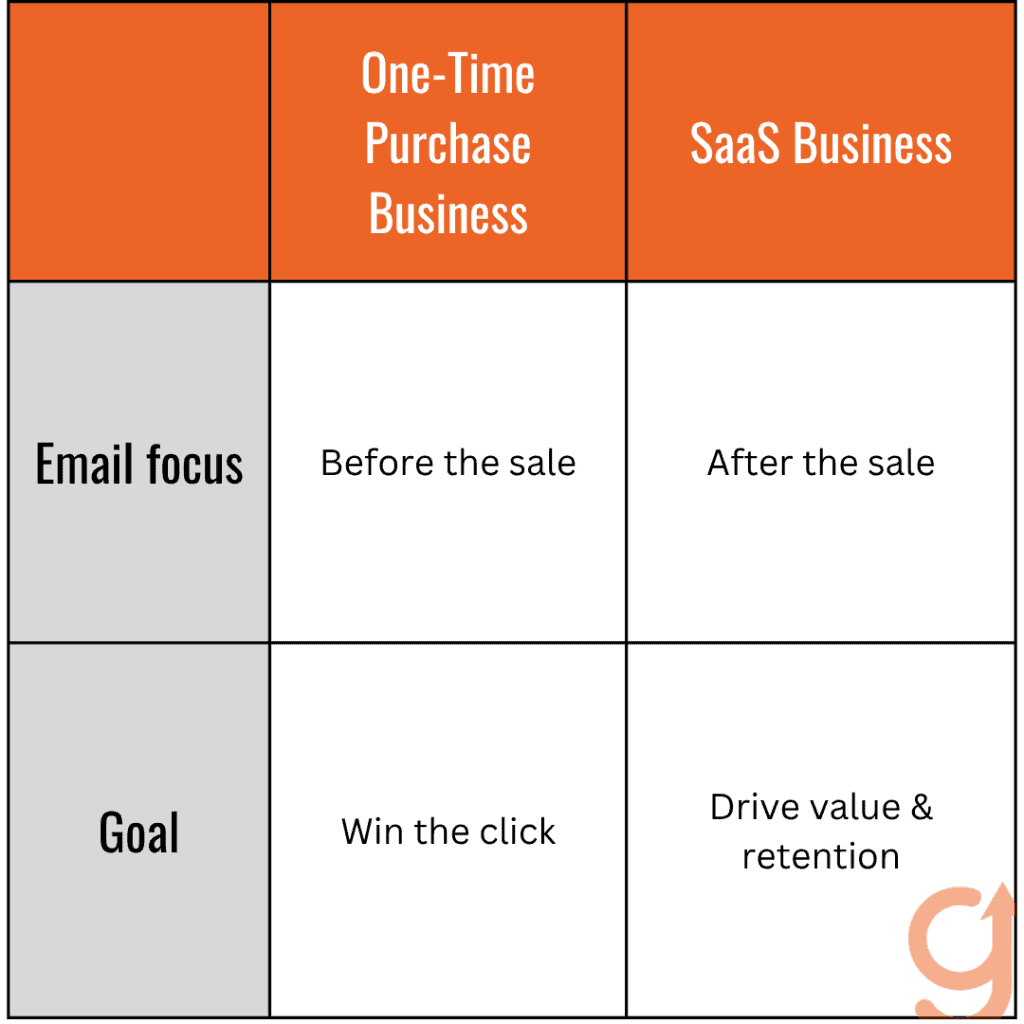
It’s the sequence that gets a new customer to value before they quietly drift, and the one that earns the expansion later.
Why email is the engine after the sale, not before it
Email is the engine after the sale because that’s where recurring revenue is won or lost. Acquisition gets the attention and the budget because it feels like progress. Retention and expansion quietly decide whether any of that acquisition spend ever pays back, and email is the lowest-cost channel that touches both.
The benchmark trend backs it up. ProductLed’s State of B2B SaaS 2025, an analysis of 446 companies, found that as SaaS companies scale, the binding performance indicators shift toward net revenue retention rather than raw new-logo acquisition (ProductLed).
Net revenue retention is a lifecycle outcome. It’s built in the inbox between onboarding and renewal, not at the top of the funnel.
That’s why email sits inside a larger system. It’s one channel in your B2B SaaS digital marketing mix, and like every other channel, its value depends on where your growth constraint actually sits. For most post-product-market-fit teams, that constraint is right after the sale.
The activation window: where SaaS email actually pays back
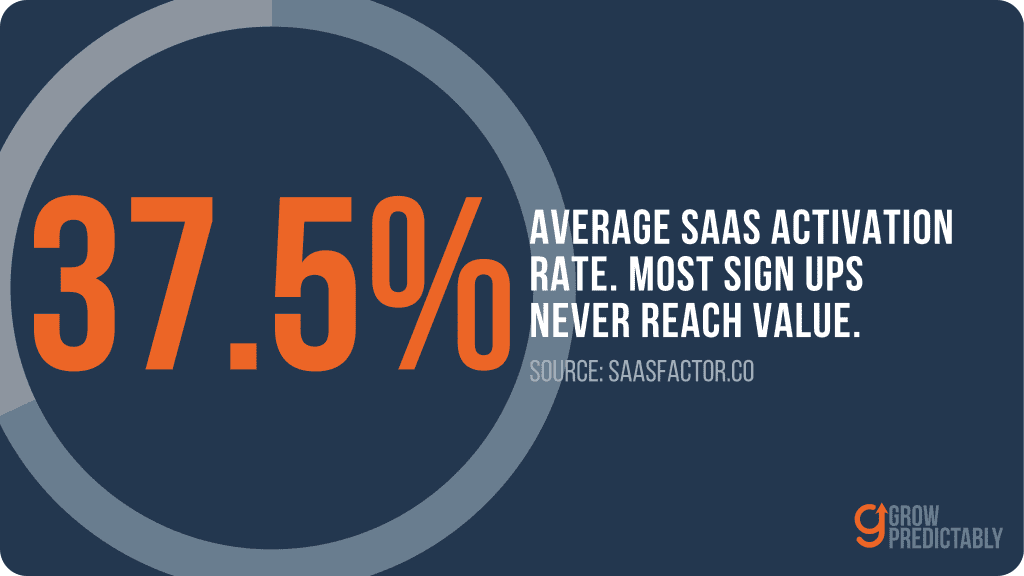
The single highest-return job email has is getting a new customer to first value fast. This is the activation window, and it is where most SaaS revenue leaks. Only about 37.5% of SaaS signups ever activate, which means most of the people you paid to acquire never reach the moment the product pays off (SaaS Factor).
The clock is short. Mixpanel’s 2025 Product Analytics Report identified reaching first value within roughly 72 hours as the strongest single predictor of trial conversion. That is the window onboarding email exists to serve, and a generic “welcome aboard” blast does not serve it. The job is to drive one specific first action, then the next, until the habit forms.
Val Geisler, founder of the SaaS email agency Fix My Churn, puts the link between onboarding and retention plainly: “reducing churn starts with onboarding, because the more powerful your customer onboarding is, the less likely they are to churn not just in that first month, but longterm in months to come.” Pour acquisition budget on top of a broken onboarding window and you have bought a bigger leak, not growth.
Which SaaS lifecycle emails actually matter?
The emails that matter are the ones that move the customer to the next stage of the lifecycle. The right set isn’t all of them at once. It’s the few that serve the stage where your funnel is leaking. Here’s the map, framed by the job each does.
Activation and onboarding
This is the sequence that drives first value in the opening days. Done right, it’s behavior-triggered, specific, and focused on one action at a time. For almost every SaaS team, this is where the highest-return email work lives and the right place to start.
The reason it matters so much comes back to the activation window. Only about 37.5% of SaaS signups ever activate, and Mixpanel’s 2025 Product Analytics Report identified reaching first value within roughly 72 hours as the strongest single predictor of trial conversion. Your onboarding sequence is what closes that gap, or widens it.
Engagement and habit
Getting a user to their first action is one job. Getting them back for the second, third, and tenth is another. Engagement emails surface the feature that makes your product sticky and reinforce the habit before it lapses. This is the stage most teams underinvest in because there’s no dramatic conversion event to point to, just the slow accumulation of users who stay.
Expansion and renewal
This is where net revenue retention is actually earned. Expansion emails identify the right moment to introduce a higher tier, an add-on, or a seat increase. Renewal emails protect the base you’ve already built. Together, they’re the lifecycle work that makes the recurring-revenue model work as advertised.
It’s also chronically under-built. Expansion and renewal don’t show up in a top-of-funnel report, so they don’t get the same attention as acquisition. That’s a gap worth closing, because growing an existing account costs a fraction of winning a new one.
Win-back
Win-back is the targeted re-engagement of dormant or churned users. It has a place in a mature lifecycle program, but it’s worth being clear-eyed about what it is: a patch on a leak the activation window should have prevented. Run it, but don’t let it substitute for fixing the earlier stages.
How do you build a B2B SaaS email program that compounds?
You build it by diagnosing the funnel leak first, then building the lifecycle email for that stage, instead of standing up every campaign type at once.
The method mirrors how you’d run any growth decision: find the constraint, then concentrate the work there.
Step 1: Find the funnel leak
Look at where customers stall. The diagnostic is straightforward:
- If signups aren’t activating, the leak is the onboarding window
- If activated users aren’t expanding, it’s the engagement and expansion stage
- If renewals are slipping, the lifecycle work between activation and renewal is the gap
Name the one stage that’s costing you the most. That’s where you start.
Step 2: Build the lifecycle email for that stage
Build the sequence that serves that specific stage, and only that one, well. An activation leak gets a behavior-triggered onboarding sequence built around first value, not a newsletter. Resist the urge to launch the whole menu. A focused sequence built for the right stage will outperform a scattered program built for all of them.
Step 3: Trigger on behavior and measure the stage
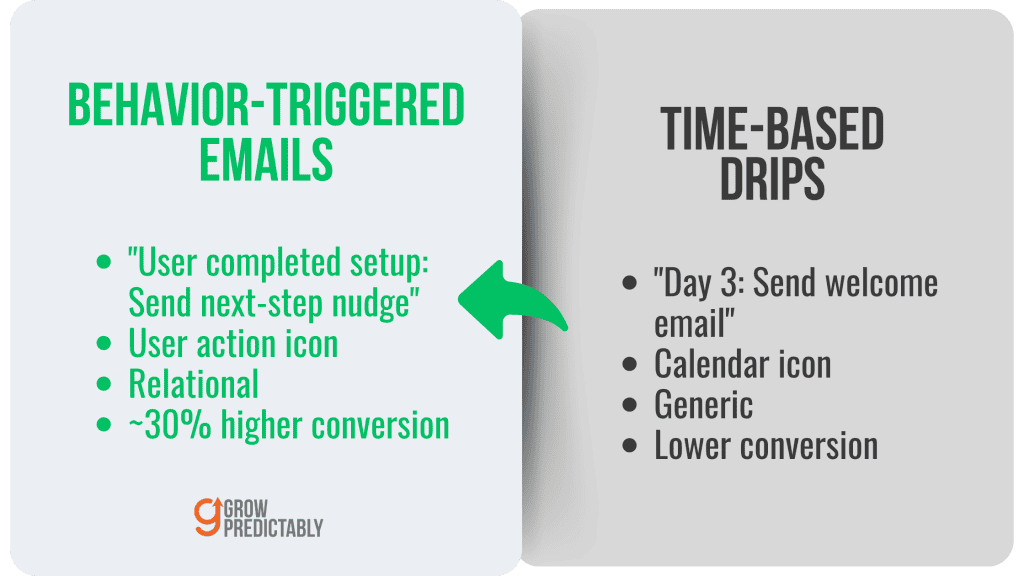
Fire emails on what the user does, not on the day count, and watch the conversion rate at the stage you’re fixing. As Val Geisler frames it, the work is relational, not promotional. You’re helping a customer build a new habit, not blasting a list.
Behavior-triggered emails reflect that distinction in the results: in case studies they have driven around 30% higher conversion than time-based drips because they respond to what’s actually happening in the product.
Once the stage you fixed is holding, move to the next constraint. This is the same discipline that runs the rest of a sound B2B SaaS growth strategy: diagnose, concentrate, measure, then move.
How do you measure whether B2B SaaS email is working?
You measure it by activation rate, stage conversion, and net revenue retention, not by opens and clicks alone. Opens and clicks tell you an email got attention. They tell you nothing about whether the customer reached value or stayed.
The distinction matters more than most teams act on. An onboarding sequence with great open rates and a flat activation rate is not working. It just looks busy. The metric you’re watching has to match the job the email is supposed to do.
Here’s how that maps across the lifecycle:
- Onboarding and activation emails answer to activation rate, the percentage of new signups who reach the first value within the window
- Engagement emails respond to feature adoption and return visit rate, signs that the habit is forming
- Expansion campaigns respond to expansion MRR and account growth, not click-through
- Renewal sequences respond to the renewal rate and net revenue retention over the quarter
Watch each stage metric week over week against your baseline. Then let retention confirm over the following quarter that the work compounded rather than just filled the calendar.
If activation improves but retention stays flat, the sequence got users to the first value but didn’t build the habit. That’s your next constraint.
Try It Yourself: Isolate & Patch Your Leak. Use this calculator to model your own activation or checkout drop-off. Slide the inactivity threshold to visualize how behavioral messaging routes can recapture lost users in real-time.
FLOW CONFIGURATOR
V3.0A conversion pipeline modeling utility. Isolate the exact point where active users drop off, formulate programmatic trigger rules to patch the leak, and instantly evaluate your recovery metrics.
How to Use This Tool:
- Isolate Drop-off: Enter your initial traffic and sign-up metrics below to instantly calculate the baseline leak percentage.
- Select Strategy: Assign a target flow stage and programmatic action channel to route the recovery messaging.
- Optimize Trigger: Slide delay thresholds and assign realistic recovery target rates to observe projected system impacts on the right.
Identify Funnel Leak
Select Target Flow Stage
Define Trigger Automation & Target
LIVE ANALYSIS OVERVIEW
Frequently Asked Questions About B2B SaaS Email Marketing
What is the most important SaaS email to get right?
The onboarding sequence that drives first value in the opening days. Activation is where most SaaS revenue leaks, since only about 37.5% of signups ever reach value, and reaching it within roughly 72 hours is the strongest predictor of conversion. Fix that sequence before you build newsletters or re-engagement campaigns.
How many emails should a SaaS onboarding sequence have?
Enough to drive each first action, not a fixed number. The better question is whether each email moves the user to the next activation step. Trigger them on what the user does inside the product rather than on a day count, and stop when the habit forms. A focused behavior-triggered sequence beats a long calendar drip.
Are behavior-triggered emails better than scheduled drips for SaaS?
Yes, in most cases. Behavior-triggered emails, fired by what a user does in the product, drive around 30% higher conversion and far more engagement than time-based drips. The calendar does not know whether a customer activated; their behavior does. Reserve scheduled sends for content that genuinely is time-bound.
What email metrics matter most for B2B SaaS?
Activation rate, stage-level conversion, and net revenue retention, not opens and clicks alone. Opens tell you an email got attention; they say nothing about whether the customer reached value or stayed. Tie each lifecycle email to the stage outcome it should move and confirm with retention over the following quarter.
How does email marketing reduce SaaS churn?
By engineering activation in the first 48 to 72 hours and sustaining the habit afterward. As Val Geisler puts it, reducing churn starts with onboarding, because the stronger the onboarding, the less likely customers are to churn long-term. Email is the lowest-cost channel that touches activation, engagement, and expansion.
Where to start
If you only fix one thing, fix the activation window. Most SaaS email programs over-invest in acquisition and newsletters while the real leak sits in the first 72 hours after signup. Build the behavior-triggered onboarding sequence that drives first value, measure activation, and only then extend into engagement and expansion.
If you want a fast read on where your funnel is actually leaking before you build, find your growth gap with the scan and let the diagnosis tell you which lifecycle email to build first.