AI Chatbots for Lead Capture: What Actually Qualifies a Lead

By Brian Shelton, Founder of GrowPredictably.com
TL;DR: AI chatbots for lead capture only outperform static contact forms when the conversation is designed to qualify visitors, not just collect contact details faster. A landmark MIT study found the odds of qualifying a lead drop 21-fold when response time stretches from 5 to 30 minutes, exactly the structural edge an instant chatbot has over a form. The platform matters far less than the qualification logic underneath it.
Key Takeaways
- AI chatbots for lead capture only outperform a contact form when the conversation is designed to qualify visitors, not just collect contact details faster.
- A landmark MIT/InsideSales.com study found the odds of qualifying a lead drop 21-fold when response time stretches from 5 to 30 minutes, exactly the structural edge an instant chatbot has over a form waiting on human follow-up.
- Design every chatbot conversation to sort visitors into one of three outcomes: book a call, enter a nurture sequence, or get told plainly they’re not a fit.
- AI adoption in sales and CX is now standard practice, not experimental. 87% of sales organizations already use some form of AI across prospecting and lead scoring, and Gartner projects 42% of organizations will hire for AI-focused CX roles by 2026.
- Platform choice matters far less than qualification-logic design, since most mainstream chatbot platforms can execute the same branching logic.
Watching marketing leaders hire and fire agencies for fifteen years taught me which agencies survive a bad quarter. The ones that survive can point to a specific, defensible reason a lead was qualified or wasn’t. This is for the agency owner or head of marketing who just rolled out a chatbot for a client, watched engagement climb, then got the call asking why sales is drowning in conversations that go nowhere.
This walks through the actual qualification-branch design, the MIT and InsideSales.com research on why response speed drives qualification odds, and a real quote from Drift’s Chris Handy on what a chatbot is actually for. The work here treats platform selection as the last decision, not the first one.
Do AI chatbots actually capture better leads than a contact form?
AI chatbots capture better leads than a contact form only when the conversation is built to qualify visitors, not just collect contact details faster. Engagement volume goes up with almost any chatbot. Lead quality depends entirely on qualification design.
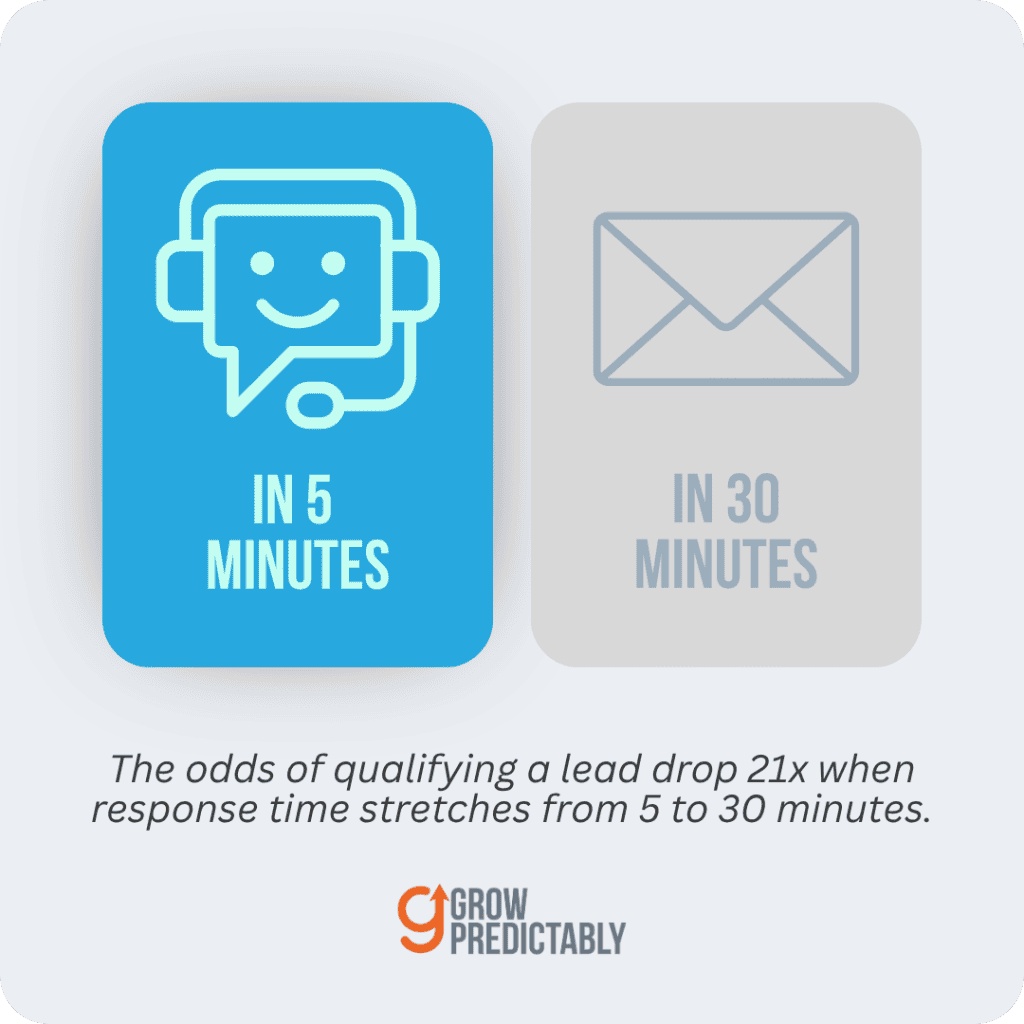
The strongest evidence for why speed matters comes from an unrelated but directly applicable study. The MIT and InsideSales.com Lead Response Management study drew on 15,000-plus leads and 100,000-plus call attempts across six companies. Led by Professor James Oldroyd, it found a steep drop in the odds of qualifying a prospect the longer response time stretched.
The odds of qualifying a prospect drop 21-fold when response time stretches from 5 minutes to 30.
MIT and InsideSales.com Lead Response Management study
A chatbot responds instantly. A form waits for a human to notice it, open it, and reply. That gap alone explains most of the real advantage, before qualification logic even enters the picture.
I’ve watched agencies roll out a chatbot, celebrate the engagement numbers in the first client report, then get quietly replaced two quarters later when sales never saw a usable lead.
Speed explains part of the gap. It doesn’t explain all of it.
Why do chatbot leads still feel unqualified to sales even when the chatbot works?
Chatbot leads feel unqualified because most chatbots are designed as a faster contact form, collecting a name and email quickly, rather than as a filter that separates a real buyer from someone just browsing. The visible symptom is engagement numbers climbing while sales keeps asking why none of these conversations turn into anything.
The root cause sits in the build, not the tool. A chatbot that asks “what’s your name and email” and stops there produces the same low signal a form does. It’s just faster and friendlier looking. Nothing about the conversation actually tests whether the visitor has a real problem, a budget, or a timeline. Speed without qualification just delivers noise to sales faster than before.
The same principle shows up outside chatbots entirely. In cold email and paid ads, a segmentation campaign asks a lead to self-identify their readiness, reply if you want this specific result. That filters far better than blasting everyone the same generic pitch. A breakdown of one $54M paid-ads account shows this directly.
The act of replying to a specific question is the segmentation. A chatbot that asks the right branching question does the identical job in real time.
The fix isn’t a smarter tool. It’s designing the branch before you touch a platform, which is exactly what the next section walks through.
The real decision: qualification logic, not chatbot platform
The decision that determines lead quality is how you design the conversation’s branching logic, not which chatbot platform you pick. Build 2 or 3 real qualifying questions. Route every visitor into one of three outcomes before you compare a single vendor.
The two or three questions that branch a conversation
Every question in the flow should exist to sort, not just to fill a CRM field. A question like “what’s slowing down your lead flow right now” tells you more about fit than “what’s your company size.” It forces the visitor to reveal an actual problem instead of a demographic fact.
What a disqualified visitor should see instead of a dead end
The three outcomes a well-designed conversation should produce:
- Qualified and ready: route straight to booking a call, no further steps in the way.
- Qualified but early: route to a nurture sequence instead of forcing a premature call neither side wants.
- Not a fit: say so plainly, rather than pushing every visitor toward booking regardless of whether they belong there.
The agencies I’ve watched keep client trust through a rocky quarter are the ones that can point to the disqualified conversations too. That’s proof the system filters honestly instead of just inflating a lead count.
Most chatbot platforms can execute all three branches without much difficulty. The branching logic is the hard part, and it’s the part that determines whether sales trusts what comes through.
How fast is chatbot adoption moving in B2B?
Chatbot and AI adoption in B2B sales and lead capture is moving from experimental to standard practice. Platform choice is becoming table stakes rather than a differentiator. Salesforce’s 2026 State of Sales Report found that 87% of sales organizations already use some form of AI across cycle tasks like prospecting, forecasting, and lead scoring.
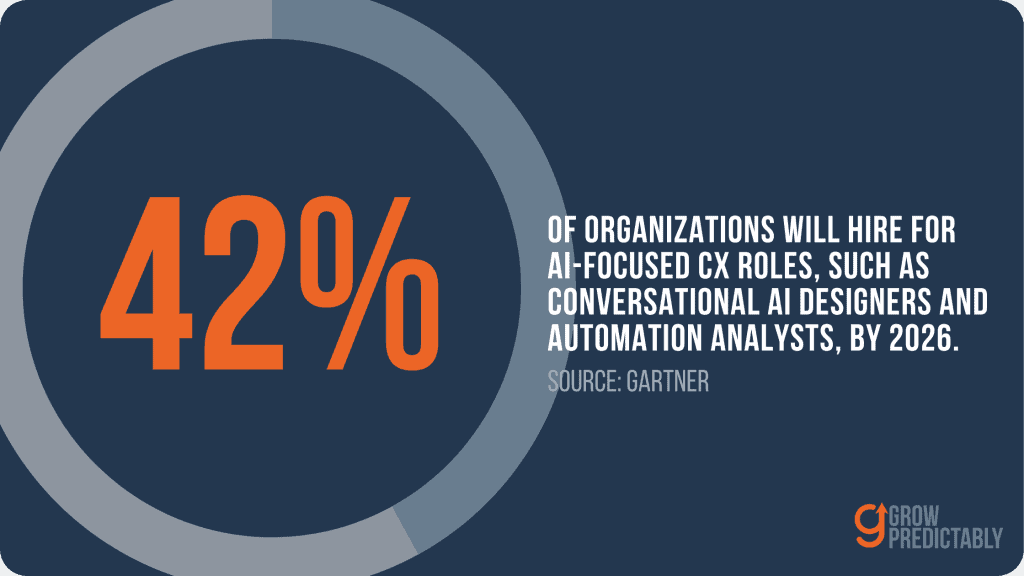
Gartner projects that 42% of organizations will hire for AI-focused CX roles, such as conversational AI designers and automation analysts, by 2026. When adoption moves this fast, every competitor will eventually have some version of a lead-capture chatbot. The qualification logic underneath it becomes the actual edge.
The tool itself stops being a differentiator the moment everyone has one.
What should a lead-capture chatbot do when a visitor doesn’t fit?
A lead-capture chatbot should tell a visitor plainly when they’re not a fit instead of pushing everyone toward booking a call regardless of relevance. Most guides only describe the happy path, visitor becomes a lead, and skip this part entirely.
As Chris Handy, Customer Marketing Leader at Drift, explains, “Drift connects you now with the people who are already interested now, so you can build better pipeline faster.” That quote comes from an interview on streamlining the sales process with chatbots, and the principle cuts both ways.
Connecting fast with the right people only works if the conversation is also willing to say, clearly, when someone isn’t the right person. A chatbot that treats every visitor as equally promising is just being polite at scale. It isn’t qualifying anyone.
How do you evaluate which chatbot platform to use?
Evaluate a chatbot platform on whether it supports real conditional branching first, integrates cleanly with the client’s CRM second, and hands off a qualified lead to a human without friction third. Price and brand recognition should come last.
Most mainstream platforms, Drift, Tidio, Zoho SalesIQ, and others, can execute the same basic branching logic described above. The real differences show up in two places. Does a qualified lead land in the right CRM pipeline stage automatically. Does a human get notified the moment someone hits the “qualified and ready” branch, or does the lead sit for hours instead.
For an agency serving several clients, pick a platform whose branching logic can be templated once. Reuse it across every new account.
How do you roll this out across multiple client accounts without redoing the work each time?
Roll this out efficiently by building the qualifying-question logic as a reusable template, then customizing only the specific questions and disqualification criteria per client. The platform setup is comparatively mechanical once the template exists.
The qualification design is the expensive, high-judgment work. A client can’t easily get that design from a generic vendor implementation. That’s what turns this into a real service rather than a commodity setup task. Document the branch logic once, in plain language. Adapt the specific questions to each client’s actual buyer instead of starting from a blank page every time.
Frequently Asked Questions
Which AI chatbots are best for lead generation?
The platform matters less than whether it supports real conditional branching and integrates with the client’s CRM. Most mainstream options, including Drift, Tidio, and Zoho SalesIQ, can execute the same qualification logic once you’ve designed it.
How do chatbots qualify leads?
By asking 2 or 3 branching questions that route the visitor to one of three outcomes: booking a call, entering a nurture sequence, or being told plainly they’re not a fit. The questions matter more than the platform running them.
Can ChatGPT do lead generation?
ChatGPT can hold a qualifying conversation, but it isn’t purpose-built for CRM integration, conversion tracking, or the human handoff a dedicated lead-capture chatbot platform handles natively.
Do chatbots convert better than contact forms?
Only when the conversation is designed to qualify, not just collect contact details faster. A landmark MIT and InsideSales.com study found the odds of qualifying a lead drop 21-fold when response time stretches from 5 to 30 minutes, the real edge a chatbot has over a form.
How long does it take to set up a lead-capture chatbot?
Platform setup itself is usually fast. The real time investment is designing the qualifying questions and disqualification criteria, which is also the part of the work worth doing carefully.
Ready to design the qualification logic before you pick a platform?
The shift that matters is designing the three-outcome branch before comparing a single chatbot vendor.
Read how AI can improve B2B agency proposal conversion rates to see what happens after a chatbot hands off a genuinely qualified lead.
Want to go deeper? Read Best Lead Magnets in the AI Era or explore An AI-Powered Quiz as a Lead Magnet.